


The Natural History Museum Abu Dhabi will be “like going in a time machine,” with galleries that will transport visitors to the UAE capital as it was several million years ago, according to a scientific research lead at the museum.
The Late Miocene Abu Dhabi gallery, for instance, will house several one-to-one scale models of animals that once inhabited the emirate. Visitors will find themselves in the midst of a model environment with rivers of freshwater fish, crocodiles, turtles and even hippopotamus that were unique to the region, smaller than their African counterparts.
“One of the things that astonishes people was that Abu Dhabi was kind of like east Africa,” said Mark Beech, a scientific research lead at the Natural History Museum Abu Dhabi, when speaking at a panel on Sunday at the Al Sidr Environmental Film Festival, which took place at The Arts Centre at NYU Abu Dhabi.

“There wasn’t an Arabian Gulf at this time. You had giant rivers running through the western region of Abu Dhabi. These rivers were teeming with crocodiles, with hippopotamus, with freshwater fish. These are all species that were local to this area.”
Many of these unique species will be described in detail for the first time, offering a significant contribution to the global scientific community. “Therefore this collection is very important,” Beech said.
curator at the Natural History Museum Abu Dhabi
The section will also present fossils from the Miocene epoch, a period 5.3 to 23 million years ago. It will also house pieces from the famous Mleisa Elephant Trackway that was discovered in the western region of Abu Dhabi. The tracks were left by a herd of elephants as they crossed a muddy area in the Al Dhafra Region seven million years ago.
“You'll see not only the fossils of these animals, but traces of the tracks made by them,” Beech said. “It gives you almost an immersive experience. We will have reconstructions of what these animals really looked like and how they interacted. It's like going in a time machine.”
The museum will cover the entire age of the universe, a story that stretches some 13.7 billion years, with elements that include the Murchison Meteorite, which contains a huge range of organic “stardust”, and pre-solar grains that formed long before the current solar system existed.

However, the Natural Museum History Abu Dhabi will stand distinct from similar institutions around the world in its focus on the region. After delving into the landmark moments in the planet’s history, including the mass extinction events, it will begin its exploration of the evolution of the Arabian Peninsula.
“You will understand the geological formation of Arabia and the early forms of life,” Beech said. “I've been with some of our team already collecting important fossil specimens from Jebel Hafeet. We have some very good Eocene fossils from about 50 million years ago. We have fantastic giant gastropods and other fossil marine organisms, because Abu Dhabi was under the sea in this period.”
It is after this gallery that the museum begins its exploration of the Late Miocene period in Abu Dhabi. While the museum will show the ecological diversity of Abu Dhabi in its prehistoric times, it will also delve into the richness of the landscape today, upending the notion that deserts are barren of life.

“Our museum is really all about being a global museum, but with this Arabian lens,” Brigitte Howarth, curator at the Natural History Museum Abu Dhabi, said at the panel.
Howarth pointed out that the museum will have a gallery showcasing the several different types of environments found across the world, several of these will be dedicated to the desert.
“We have multiple desert environments,” she said. “We have big, deep dunes with sabkha (sand, salt or mudflats) that are represented. We have coastal sand that is represented.”
As the colours of the sand change, so do the chemical properties and therefore the flora and fauna it can sustain. “One of our huge challenges is to document all of the life that occurs in all of these different environments,” Howarth said. “But then also understanding how they relate to one another.”
This research will be paramount to writing effective conservation plans. The museum is not only dedicated to showcasing the wonder of the natural world, but research and working for its conservation as well.
“The biodiversity of the UAE, the biodiversity of the desert, is surprisingly rich,” said Peter Kjaergaard, director of the Natural History Museum Abu Dhabi. “One of our tasks is not only to document that but collect that biodiversity, so we will have a full understanding of the biodiversity today and that we continue to collect specimens in the decades to come.”
Kjaergaard also pointed out that the Natural History Museum Abu Dhabi will be working with its neighbouring institutions in the Saadiyat Cultural District. This collaborative spirit is already under way, as the museum has lent major pieces, including the Murchison Meteorite, to Louvre Abu Dhabi as part of its children’s exhibition Picturing the Cosmos.
-
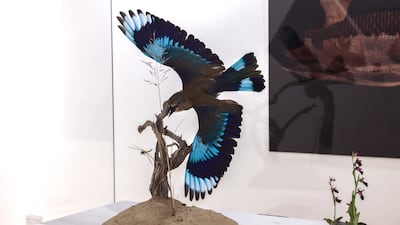
Indian Roller Coracias benghalensis, a species of a vibrantly coloured bird found in the UAE, mounted here with a dragonfly. All Photos: Victor Besa / The National -
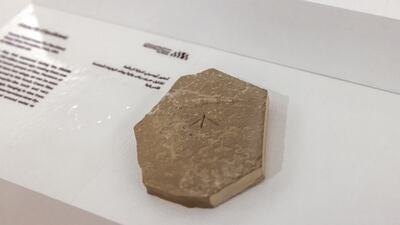
A 50 million-year-old fossil of a crane fly (Tipullidae) found in the Green River Formation in Utah, USA -
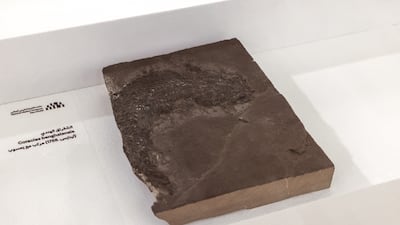
A fossil of the fish Gryoptychius agassizi, which is 420 to 360 million years old, found in Orkney Islands, Scotland -
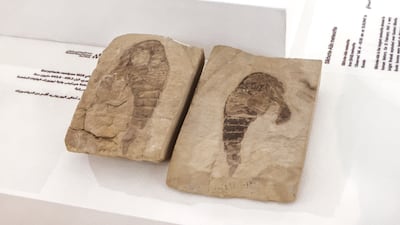
A fossil of the sea scorpion Eurypterus remipes, believed to be between 443.8-419.2 million years old, found in Herkimer County, New York State, USA -
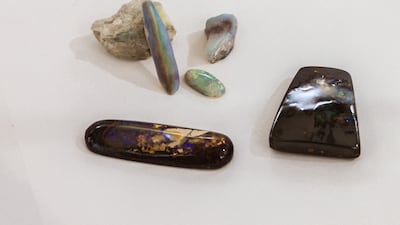
Black and Boulder opal, containing sediments that were once part of the ancient inland sea that covered most of Australia during the Cretaceous period -
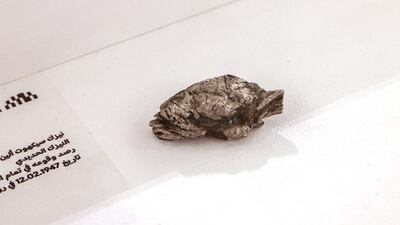
A piece of the Sikhote-Alin meteorite, which fell in the mountains of southeastern Russia in February 1947 -
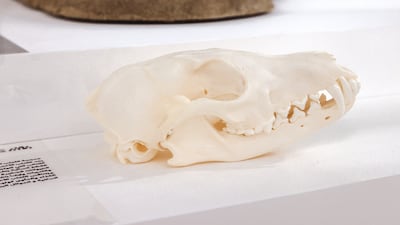
A model of a skull of a red fox, or vulpes vulpes -
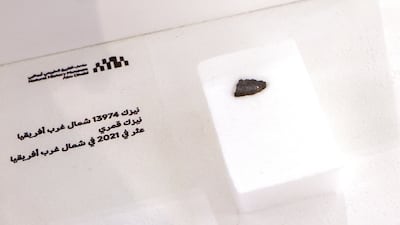
A lunar meteorite, known as Northwest Africa 13947 -
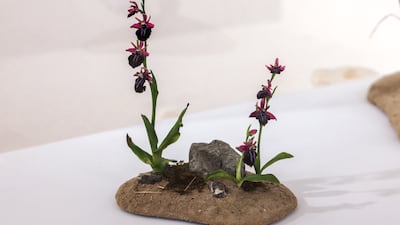
A model of the spider orchid, Ophrys spruneri subsp. grigoriana -

A model of the skull of a feral cat, or felis catus -
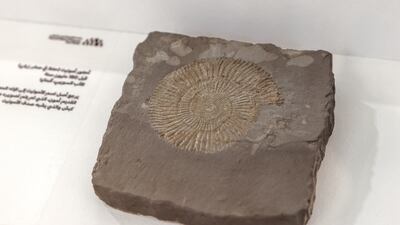
Ammonite, preserved in oil shale, 180 Million years old, found in the Swabian Jura mountain range, Germany -
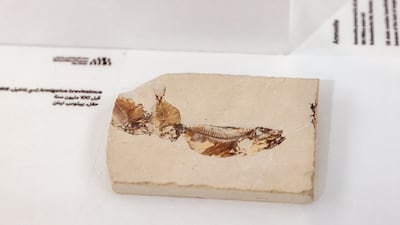
A 100 million year old fossil of Armigatus brevissimus from Haqil near Byblos, Lebanon -

Conservatory for Plants with Obesity by Camilla Singh features more than two dozen plants of various shapes and sizes huddled together -

The plants have been fitted with globules made from clay and other materials, to give the impression that they are discharging fat -
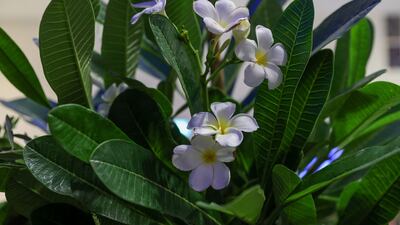
The space aims to prompt visitors to consider how we communicate with plants, or rather how plants communicate with us -
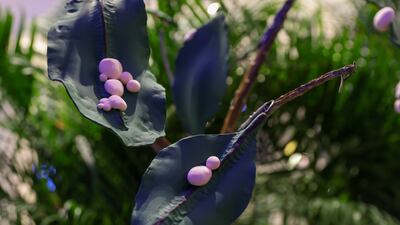
Conservatory for Plants with Obesity is also running as part of the Al Sidr Environmental Film Festival


The Natural History Museum Abu Dhabi will have a robust outreach and educational programme, Kjaergaard said. “We will be working closely together with schools. This will be a place for learning, for sharing, for education, but we’ll not stop there. We also have programmes inviting local communities. We want this to be an open, vibrant, exciting, engaging place where you can participate in what we do.”
Kjaergaard also said that it was more important now than ever to direct collective focus and care to the understanding and betterment of the planet’s diversity.
“The Natural History Museum is, more than anything else, a meeting place,” he said. “It’s a place where we can be together and we can have a conversation about what really matters to us. One of the things that matters to all of us is the next step that we're going to take as shared humanity. The decisions that we will make in the next couple of decades will determine centuries to come. This is one of the reasons why we're building a natural history museum here.”
Construction of the Natural History Museum Abu Dhabi is expected to be completed in 2025.

