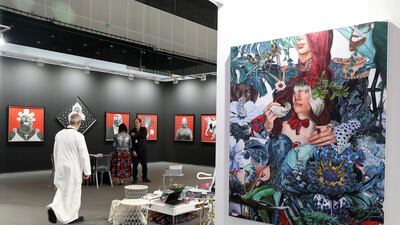
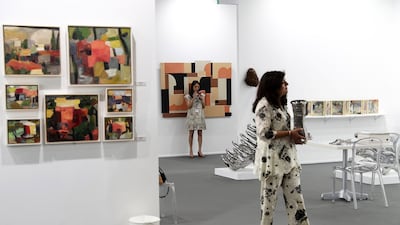
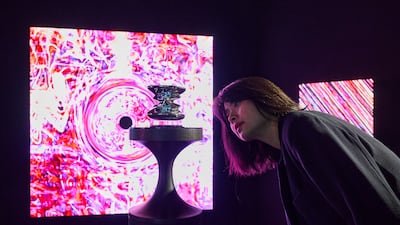
• Tabari Artspace's booth at Art Dubai focuses on emerging Gulf artists. All photos unless otherwise specified: Antonie Robertson / The National
    Tabari Artspace's booth at Art Dubai focuses on emerging Gulf artists. All photos unless otherwise specified: Antonie Robertson / The National
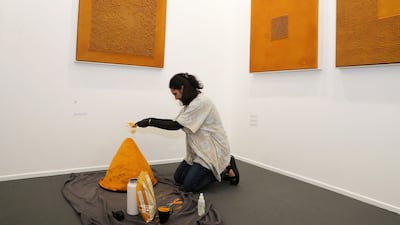
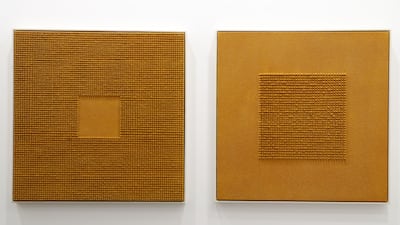
  • Hashel Al Lamki's body of work, titled Sphere
    Hashel Al Lamki's body of work, titled Sphere
  • Emirati artist Al Lamki
    Emirati artist Al Lamki
  • Peach by Al Lamki
    Peach by Al Lamki
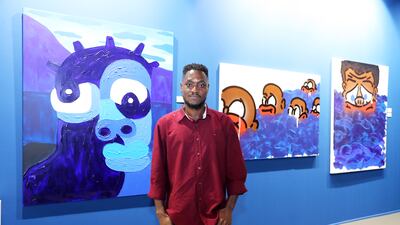
  • Emirati artist Zaid Al Najjar's work alongside Al Lamki's
    Emirati artist Zaid Al Najjar's work alongside Al Lamki's
  • Al Najjar
    Al Najjar
  • Paloma by Al Najjar
    Paloma by Al Najjar
  • Saudi artist Nasser Almulhim's work on display
    Saudi artist Nasser Almulhim's work on display
  • Dreams Will be True by Almulhim
    Dreams Will be True by Almulhim
  • Almulhim. Photo: Tabarai Artspace
    Almulhim. Photo: Tabarai Artspace

Young generation of Gulf artists present new Arab narratives at Art Dubai


Maan Jalal
  • English
  • Arabic

This year, Tabari Artspace’s group show at Art Dubai, which runs until Sunday at Madinat Jumeirah, is a celebration of a new generation of creative minds from the Gulf.

The DIFC-based gallery has a long history of highlighting the work of important Arab artists within the region and among the diaspora. Over the past 20 years, not only has it contributed to Dubai’s cultural vision, placing Arab art at the forefront, but it has helped to shape the careers of generations of emerging Arab talents.

For Art Dubai 2023, the gallery is presenting the work of three Gulf artists: Ziad Al Najjar and Hashel Al Lamki from the UAE, as well as Nasser Almulhim from Saudi Arabia.

“Artists of the Gulf have something new to show,” Maliha Tabari, Tabari Artspace’s founder, tells The National. “There's a genuine dialogue that's coming out from the Gulf now. It’s a dialogue that’s really intuitive and really emotional.”

Tabari, who is Palestinian but grew up between the UAE and Saudi Arabia, is passionate about introducing Arab artists to international audiences and changing narratives around Arab art and the Arab experience.

“Our region has something that's very uncertain about it,” she says.

“So, if I'm going to bring a dialogue of young Gulf artists to the fair and have them stand out, I had to feel like there was an uplifting, intuitive thread in all their works.”

Despite having distinct styles and outlooks, Tabari's presentation weaves a thread of continuity through the three artists' works, as they explore their internal worlds within the context of their external environments.

The booth is colourful, with one orange wall displaying 11 works by Al Lamki of varying sizes, another central wall with two large-scale works alongside smaller pieces by Al Najjar and one more with eight paintings by Almulhim, including a sculpture in the centre of the space.

Almulhim’s paintings stand out for their strong graphic elements that are simultaneously playful and precise. The painter and 3D artist produces geometric and organic forms not just as a creative process, but a form of therapy.

“My practice focuses on three main ideas: psychology, spirituality and feminism," Almulhim says.

“The reason I tackle these topics is because I struggled with depression. For me, making art is very personal, very expressive. When I paint, I try to heal myself and heal others.”

Almulhim’s work is intuitive. While made up of very defined geometric shapes, he doesn’t plan his composition as one might suspect. He works organically, "flirting" as he says, with the subconscious to guide him on what works aesthetically.

“That's the fun part of my practice. It’s like discovery, having a conversation with the canvas,” he says.

“Sometimes I'll end up disliking certain forms or I’ll add another colour to cover it then I'll build something on top of that. It's like a subconscious dialogue.”

Almulhim’s sculpture emerges as an extension of his painted works in the physical space. Bold and colourful but also minimal, it dances between abstract and spiritual ideas.

Nasser Almulhim's sculpture Conversation with my Inner Child at the Tabari Artspace booth at Art Dubai. Antonie Robertson / The National

Emirati painter and multi-disciplinary artist, Al Lamki’s work is a refreshing, painterly depiction of Al Ain’s mountainous landscapes. His lush gestures and colour palette is mesmerising and wistful, as he explores the community’s relationship with its natural environment.

Al Lamki, who grew up in Al Ain, developed a strong connection with his home town while living in Abu Dhabi during the pandemic.

“I grew up near Jebel Hafeet and that was like the focal monument of — Al Ain you can see it from anywhere,” he says.

“The mountain actually belongs to the Al Hajar Mountain range, but it shifted and separated itself from the main range. It’s kind of doing its own phenomena in a way.”

Al Lamki spent time visiting the area and observing the changing colours at different times of the day; soaking in how the mountain was shaped through light and different weather conditions. He would also bring back rocks to his studio to study, reimagining them in his paintings and physically working them into the bases of many of his compositions.

Meanwhile, Al Najjar created a series of paintings on canvas that build on the themes he explored in his solo exhibition at Tabarai Artspace in January.

Al Najjar explores connections between the natural, constructed and spiritual realms, creating an interplay between organic and inorganic forms. Painted in an earthy and pastel colour palate in floating compositions, his pieces are guided by an intuitive method of working — with a balance of immediacy and instinct that results in powerful and entrancing pieces.

“They are three young emerging Gulf artists that are paving the way for the upcoming younger generation,” says Tabari.

“They are the new change makers of the narrative of the Gulf. Each and every one of these artists is going to empower other artists in a certain way.”

Art Dubai runs at Madinat Jumeirah until Sunday. More information is available at artdubai.ae

Scroll through more images of Art Dubai 2023 below

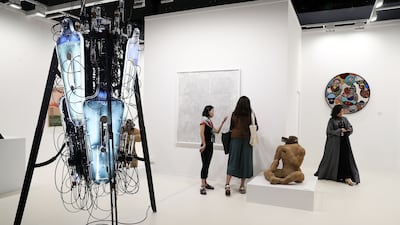
  • Art Dubai is back for its 16th year. All photos unless otherwise specified: Pawan Singh / The National
    Art Dubai is back for its 16th year. All photos unless otherwise specified: Pawan Singh / The National
  • The art fair mark its most ambitious and extensive iteration
    The art fair mark its most ambitious and extensive iteration
  • The programme features more than 130 presentations from across 40 countries
    The programme features more than 130 presentations from across 40 countries
  • Gunjan Kumar with her artwork
    Gunjan Kumar with her artwork
  • Sifr by Gunjan Kumar
    Sifr by Gunjan Kumar
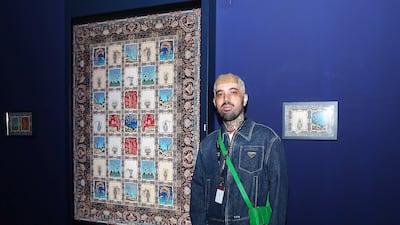
  • Jason Seife with his A Modern Genesis piece
    Jason Seife with his A Modern Genesis piece
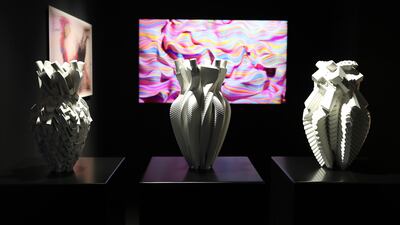
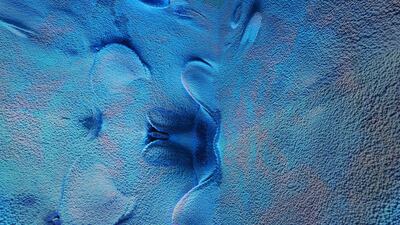
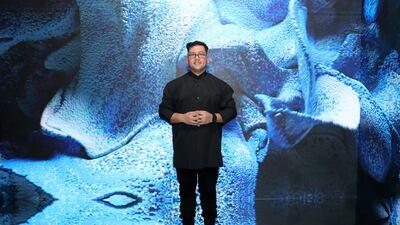
  • Refik Anadol’s Glacier Dreams uses AI to process a wealth of glacier visual materials
    Refik Anadol’s Glacier Dreams uses AI to process a wealth of glacier visual materials
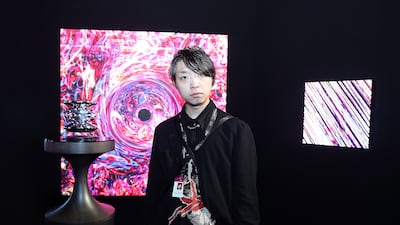
  • Yoichi Ochiai with his artwork at Art Dubai
    Yoichi Ochiai with his artwork at Art Dubai
  • Refik Anadol with his Glacier Dreams
    Refik Anadol with his Glacier Dreams
  • Isshaq Ismail with his Serenity painting, left
    Isshaq Ismail with his Serenity painting, left
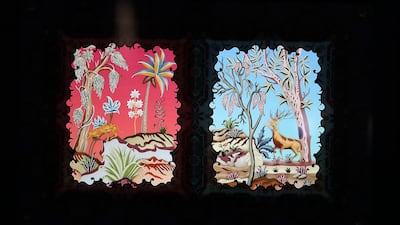
  • Jason Seife's work digitally explores the storytelling aspect of regional carpets, particularly the way they depict gardens
    Jason Seife's work digitally explores the storytelling aspect of regional carpets, particularly the way they depict gardens
  • There are four sections at the fair, including Contemporary, Modern, Bawwaba and Art Dubai Digital
    There are four sections at the fair, including Contemporary, Modern, Bawwaba and Art Dubai Digital
  • Yoichi Ochiai blurs the lines between the material and digital world with his work. Getty Images
    Yoichi Ochiai blurs the lines between the material and digital world with his work. Getty Images
How to get there

Emirates (www.emirates.com) flies directly to Hanoi, Vietnam, with fares starting from around Dh2,725 return, while Etihad (www.etihad.com) fares cost about Dh2,213 return with a stop. Chuong is 25 kilometres south of Hanoi.
 

Ten tax points to be aware of in 2026

1. Domestic VAT refund amendments: request your refund within five years

If a business does not apply for the refund on time, they lose their credit.

2. E-invoicing in the UAE

Businesses should continue preparing for the implementation of e-invoicing in the UAE, with 2026 a preparation and transition period ahead of phased mandatory adoption. 

3. More tax audits

Tax authorities are increasingly using data already available across multiple filings to identify audit risks. 

4. More beneficial VAT and excise tax penalty regime

Tax disputes are expected to become more frequent and more structured, with clearer administrative objection and appeal processes. The UAE has adopted a new penalty regime for VAT and excise disputes, which now mirrors the penalty regime for corporate tax.

5. Greater emphasis on statutory audit

There is a greater need for the accuracy of financial statements. The International Financial Reporting Standards standards need to be strictly adhered to and, as a result, the quality of the audits will need to increase.

6. Further transfer pricing enforcement

Transfer pricing enforcement, which refers to the practice of establishing prices for internal transactions between related entities, is expected to broaden in scope. The UAE will shortly open the possibility to negotiate advance pricing agreements, or essentially rulings for transfer pricing purposes. 

7. Limited time periods for audits

Recent amendments also introduce a default five-year limitation period for tax audits and assessments, subject to specific statutory exceptions. While the standard audit and assessment period is five years, this may be extended to up to 15 years in cases involving fraud or tax evasion. 

8. Pillar 2 implementation 

Many multinational groups will begin to feel the practical effect of the Domestic Minimum Top-Up Tax (DMTT), the UAE's implementation of the OECD’s global minimum tax under Pillar 2. While the rules apply for financial years starting on or after January 1, 2025, it is 2026 that marks the transition to an operational phase.

9. Reduced compliance obligations for imported goods and services

Businesses that apply the reverse-charge mechanism for VAT purposes in the UAE may benefit from reduced compliance obligations. 

10. Substance and CbC reporting focus

Tax authorities are expected to continue strengthening the enforcement of economic substance and Country-by-Country (CbC) reporting frameworks. In the UAE, these regimes are increasingly being used as risk-assessment tools, providing tax authorities with a comprehensive view of multinational groups’ global footprints and enabling them to assess whether profits are aligned with real economic activity. 

Contributed by Thomas Vanhee and Hend Rashwan, Aurifer

Company%20profile
%3Cp%3EName%3A%20Tabby%3Cbr%3EFounded%3A%20August%202019%3B%20platform%20went%20live%20in%20February%202020%3Cbr%3EFounder%2FCEO%3A%20Hosam%20Arab%2C%20co-founder%3A%20Daniil%20Barkalov%3Cbr%3EBased%3A%20Dubai%2C%20UAE%3Cbr%3ESector%3A%20Payments%3Cbr%3ESize%3A%2040-50%20employees%3Cbr%3EStage%3A%20Series%20A%3Cbr%3EInvestors%3A%20Arbor%20Ventures%2C%20Mubadala%20Capital%2C%20Wamda%20Capital%2C%20STV%2C%20Raed%20Ventures%2C%20Global%20Founders%20Capital%2C%20JIMCO%2C%20Global%20Ventures%2C%20Venture%20Souq%2C%20Outliers%20VC%2C%20MSA%20Capital%2C%20HOF%20and%20AB%20Accelerator.%3Cbr%3E%3C%2Fp%3E%0A
The biog

Year of birth: 1988

Place of birth: Baghdad

Education: PhD student and co-researcher at Greifswald University, Germany

Hobbies: Ping Pong, swimming, reading


The Penguin

Starring: Colin Farrell, Cristin Milioti, Rhenzy Feliz

Creator: Lauren LeFranc

Rating: 4/5

Updated: March 04, 2023, 7:41 AM