



Iranian artist Sasan Nasernia’s new solo exhibition Calligraphic Confluence is a journey into the power of words.
The written word in Nasernia's exhibition, at Mestaria Gallery in Alserkal Avenue, is not only a means to record and communicate, but a vehicle infused with ideas, feeling and energy.
“Writing is the first abstraction which humanity came up with,” Nasernia tells The National. “When you assign a line to a sound, these are all words, which are at the same time, codes of the existence.”
Scroll through the gallery above for more pictures from Sasan Nasernia's Calligraphic Confluence
Arabic calligraphy, in particular, has a long history as an art form, used as ornamentation in elements of architecture, decoration, coin and book design. Nasernia’s exhibition, featuring canvases of various sizes, draw from Arabic and Persian influences to create a captivating body of work.
Nasernia's work evokes strong emotions, even if you can't decipher the calligraphy, because of the way he paints them.
Stark, minimal backgrounds give way to a burst of painterly gestures. Layers of black and primary colours create a dynamic sense of push and pull. And in the midst of the chaos, there's a sense of balance.
“You cannot be lingering a lot when creating these,” Nasernia says. “This has to be fast. If you look at me doing it, every layer has to happen really fast. Because that speed gives you the dynamism that, at the end of the day, is present.”
It’s no surprise that Nasernia has worked as a graphic designer for 18 years. There is a natural understanding in his work of how to compose clean lines, a thoughtful intuitive consideration of the scale and balance of visual elements, of material and of the traditional frameworks of pictorial creation. Nasernia takes these elements and pushes them, breaking away from the traditional formats of how Arabic and Persian calligraphy exist.
“I'm interested in doing different styles and exploring different avenues,” he says. “Especially if there is something which hasn't been done before. Things which have been done, have been done to perfection by the old masters.”
While Nasernia has studied calligraphy, he doesn’t call himself a calligrapher. He uses calligraphy and letter forms, stylises them as informed by his study of Abstract Expressionists such as Cy Twombly.
He uses paint tubes as his tool, squeezing the paint straight out on to the canvas. The technique gives a thickness and crisp shape to his lines and a sense of speed, creating a tangible sense of movement and control in how the paint falls and settles.
It also reveals Nasernia's expert eye and skilful hand in composing multi-layered and multifaceted work.
“Coming up with your own personal style is not something you just decide on, it’s a process,” he says. “You always have to start learning the skills of the past, and the people who came before you.”
One of Nasernia’s great sources of inspiration was the art of Persian miniature paintings and its pinnacle, Shahnameh of Shah Tahmasp, (1525-35), also known as the Book of Kings.
The 16th-century manuscript was commissioned by the emperor Shah Ismail who sought to illustrate the Shahnameh, an epic poem which details the history of Persia’s rulers, written by the poet Ferdowsi between 977 and 1010.
Shahnameh, which has now been split and separated, features detailed miniatures illustrating the myths, heroic epics and battles of pre-Islamic Iran.
“We go back, every now and then as a nation to that book to find out what created this idea of Iran,” he says. “What does it mean in that primordial battle between good and evil? It is the same dynamic which has been going on through history, which we will be revisiting again.”
Nasernia channelled the sense of drama, the climax of movement, the entanglement of elements from the miniatures he studied in the Book of Kings, into his work.
Each canvas reveals a scene of juxtaposition. Traditional and contemporary, chaos and order, movement and stillness, moments of violence and tranquillity, good and evil — the viewer senses Nasernia’s immediate sense to capture this battle and balance.
“Good and evil are two sides of the same coin,” he says. “But the balance has to be always maintained.”
Sasan Nasernia’s solo exhibition Calligraphic Confluence is running until October 31 at Mestaria Gallery in Alserkal Avenue
Sharjah Arabic calligraphy — in pictures
-
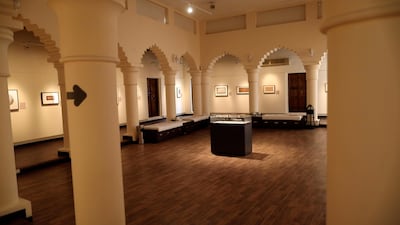
Sharjah Calligraphy Museum displays paintings by local and international artists and calligraphers. All photos: Andy Scott/ The National -

The museum is running a one-month course that offers hands-on experience of the techniques used in calligraphy. -
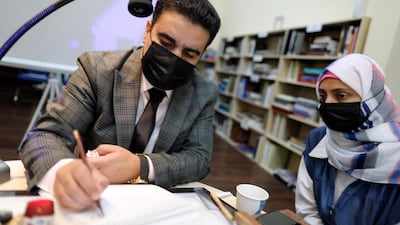
Shaher Al Taref, an instructor and calligraphist at the Sharjah Department of Culture, teaches the traditional writing styles. -

Every Monday and Wednesday, people learn to write the Diwani script, a formal style of the Ottoman court developed between the 16th and early 17th centuries. -
Residents from countries including Arab nations, Afghanistan, India, Bangladesh and Pakistan have taken part in training courses over the years. -

In May 2020, a one-month course was organised by the museum that taught 30 prisoners the basics of Al Roka and Al Diwani Arabic writing styles.



