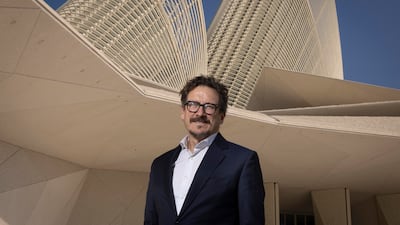

Peter Magee remembers the exact date he first arrived in the UAE: December 20, 1992. He was a PhD student with an interest in Middle Eastern archaeology and had been invited by a professor to participate in excavations in Umm Al Quwain.
He spent about eight weeks in the country, travelling to Al Ain to study archaeological material and piece together a picture of what life was like in the region 3,000 years ago. The experience changed the direction of his academic career.
“From the moment I arrived in December 1992, I thought: ‘This is where I want to focus my scholarly attention,’” Magee tells The National.

More than three decades later, he is the director of the Zayed National Museum, an institution commissioned telling the story of 300,000 years of human history, the formation of the Emirates and the legacy of UAE Founding Father, the late Sheikh Zayed bin Sultan Al Nahyan.
As the museum approaches its first anniversary, Magee reflects on the immensity of that undertaking. Leading an institution that carries Sheikh Zayed's name comes with a particular responsibility, although Magee is careful about where he places that responsibility.
“Even though I might be the museum director, I don't think that I have stewardship over that story,” he says. “It's a story which is shared.”
The museum spent years working with the community to develop its permanent galleries. Magee believes that relationship is fundamental to the institution's identity and will continue to shape its work.
“I think it's a shared stewardship. It's a shared responsibility between itself as a cultural institution and the community that it deals with.”
Interweaving the personal and the national

During his early years of research in the UAE, Magee would spend winters conducting fieldwork and would return in the summers to study the objects that had been unearthed.
His investigations into the country's distant past coincided with a period of rapid development. Despite the transformation of the UAE's infrastructure since the 1990s, he says several characteristics have endured, including its hospitality, the public's interest in archaeology and the leadership's support for historical research.
When Magee joined the museum project in 2019, the building had yet to take shape, although its architecture had been approved and much of the intellectual groundwork laid. He describes himself as the “lucky inheritor” of years of work undertaken by the Department of Culture and Tourism – Abu Dhabi and its predecessors.
One of the museum's defining challenges was integrating the biography of a leader with the history of a nation whose roots stretch back thousands of generations.
“You want to hear from the community. You want to hear from experts. You want to hear from people who worked closely with Sheikh Zayed, because we are building a narrative, which interweaves the personal and the national,” Magee says.
Those perspectives informed the presentation and interpretation of objects across the museum's six permanent galleries, connecting archaeological discoveries with cultural values and Sheikh Zayed's vision.
Magee was particularly interested in Sheikh Zayed's role in promoting archaeological research. In March 1959, more than a decade before the formation of the UAE, Sheikh Zayed invited archaeologists to Al Ain.
Magee says the invitation demonstrates Sheikh Zayed's passion for understanding history and his conviction that the country possesses a rich past waiting to be investigated.
That appreciation of history also informs the museum's contemporary message.
“We learn from the past. We learn of the importance of resilience, of adaptability, of innovation,” Magee says. “All of those characteristics flow through the narrative of the museum, just as they flow through society today.”
Revisiting the familiar
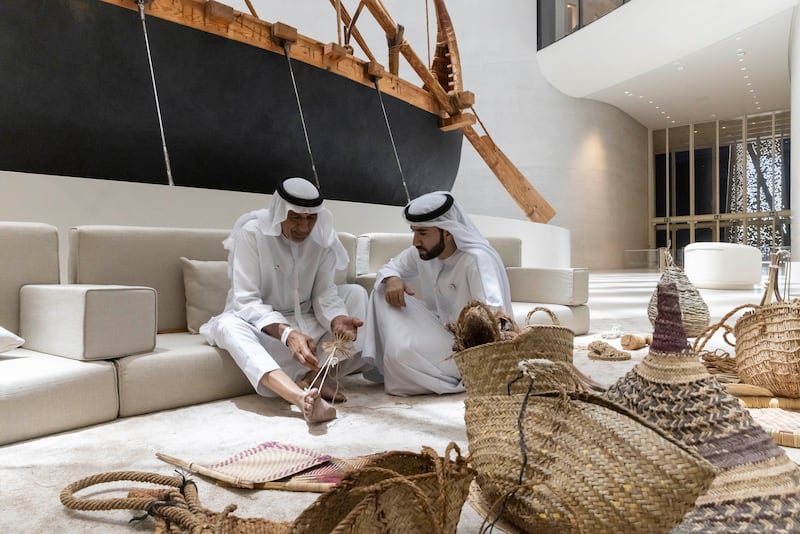
Zayed National Museum will mark its first anniversary alongside the UAE's 55th Eid Al Etihad with four days of celebrations, running from December 1 to 4. The programme, titled Our Story Brings Us Together, will feature traditional performances, workshops, specially curated tours and family activities, as well as a drone show, an aerial display by Fursan Al Emarat and a parade by Abu Dhabi Police Music Band.
Coinciding with the museum's anniversary on December 3 is the opening of its first temporary exhibition, Tracks Through Time: The Camel in Society, Trade and Art.
The exhibition explores more than 7,000 years of camel history across the UAE and the wider region. The subject intersects with Magee's own archaeological research into camel domestication, although he credits the curatorial team with bringing together decades of scientific research and translating it into an accessible exhibition.
Among the subjects it explores is the existence of wild camels in Arabia. Magee says genuinely wild camels, distinct from their domesticated counterparts, inhabited this part of the peninsula as recently as 2,000 to 3,000 years ago.
The relationship between humans and camels, today so deeply embedded in Emirati culture, was the product of millennia of environmental and cultural changes.
“We are where we are today because of a series of cultural adaptations, which stretch back at least 7,000 years here in the United Arab Emirates,” he says.
While the camel has become an internationally recognisable symbol of the Arabian Desert, Magee says its history reveals a dynamic relationship between people, animals and their surroundings. The exhibition examines the ingenuity of ancient communities and their ability to adapt to a changing climate.
Finding connections across Saadiyat

The exhibition also provides an early example of the possibilities for collaboration across the Saadiyat Cultural District. It features loans from the Natural History Museum Abu Dhabi, which Magee says are indispensable to telling the story.
Conversations between the institutions have already uncovered less obvious connections.
One potential avenue of collaboration emerged within weeks of Natural History Museum Abu Dhabi director Peter Kjaergaard taking up his role. The two directors discussed the 18th-century expedition to Arabia that included Danish explorer Carsten Niebuhr and Swedish botanist Peter Forsskal.
Zayed National Museum holds some of Niebuhr's books. The expedition's botanical research offers a starting point for exploring the significance of the mangrove, known domestically as qurm. Even its scientific name, Avicennia marina, carries a cultural connection: the genus honours the Persian polymath Ibn Sina, known in Latin as Avicenna.
The subject brings together botanical research, the history of scientific exploration and the enduring significance of mangroves in the UAE. “That's where you find these inadvertent connections, which I think are very exciting for the public to hear about,” Magee says.
He believes the district's museums are intrinsically linked, with their collections and expertise allowing them to tell interconnected stories of local, regional and global significance.
Looking back on the museum's first year, Magee, however, identifies something beyond the acquisition of knowledge as the common thread in visitors' experiences.
He says many are discovering the depth of the country's history, sometimes for the first time, while also learning about the individual who helped shape its modern identity. He hopes the experience inspires sufficient curiosity to bring them back.
“Emotional and inspiring,” Magee says. “I think that's the commonality of experience, regardless of where people are from.”

