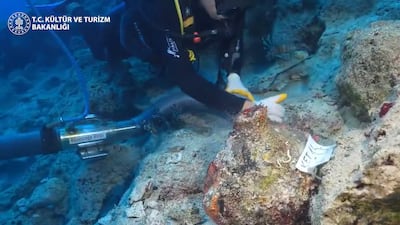

Archaeologists have identified an ancient shipwreck off Turkey's Mediterranean coast, dating back as far as 4,700 years, which they believe could be the oldest yet discovered.
More than 30 ceramic storage jars and three stone anchors have been found near Kekova Island in Antalya, about 30 metres beneath the surface. The pottery suggests the vessel dates to between 4,400 and 4,700 years ago, during the Early Bronze Age.
Although none of the ship’s wooden structure has survived, the team of archaeologists has been able to estimate its age by comparing the shapes and decoration of its pottery with objects discovered at other archaeological sites. Without surviving timber, radiocarbon dating cannot be used to establish when the ship sank.

Mehmet Nuri Ersoy, Turkey’s Culture and Tourism Minister, announced details of the continuing excavation on Wednesday and spoke of the world’s oldest known shipwreck. The vessel is believed to have been about 10 metres long and used to transport goods across the Mediterranean.
The wreck was first documented during an underwater survey by Akdeniz University in 2024. Two jars were recovered for examination in 2024 and 2025, before further excavations began this year under the Antalya Museum Directorate.
A preliminary study published in the Journal of Maritime Archaeology in July by archaeologists Hakan Oniz and Ceyda Oztosun suggested the ship had been travelling from east to west when it sank. The study also noted that the three anchors found in the surrounding area had not yet been conclusively linked to the vessel.
The oldest previously known shipwreck was discovered near the Greek island of Dokos in 1975. The Hellenic Institute of Marine Archaeology dates its ceramic cargo to around 2200BC, later than the dates proposed for the Kekova finds.
The Kekova discovery could also provide evidence of trading connections between the Levant, Egypt and Anatolia during the Early Bronze Age.
“Clay analyses indicate that the amphorae were probably produced in workshops in the Jordan Valley,” Ersoy said.
Similar vessels have been discovered near the Egyptian pyramids at Giza, Saqqara and Abusir, as well as at Troy and on the island of Crete. Archaeologists believe the ship may have departed from a port on the Levantine coast and been travelling towards Troy or Crete.
Some of the recovered jars contain residues that could help establish what the vessel was transporting. Karin Sowada, an archaeologist at Macquarie University in Australia who examined the finds, told the BBC she was surprised by how much material had survived inside them. Some jars were still intact and contained a glossy, viscous residue.

Analysis is continuing to determine whether the containers held olive oil, wine, tree resins or other goods. Sowada said the jars could also have been emptied and reused, so the surviving material may come from more than one use of the containers.
Another jar, marked with nine symbols and featuring two holes in its body, may have served a different purpose. Ersoy said it could have been used as a churn for making cheese or butter, suggesting sailors may have produced some of their own food during lengthy voyages.
Turkey’s Mediterranean coast has previously yielded several important Bronze Age vessels, including the Uluburun shipwreck, which sank around 1300BC carrying copper, tin, glass and other commodities.
The artefacts recovered from Kekova are undergoing conservation and further scientific examination. Ersoy said the finds would be displayed at the planned Mediterranean Underwater Archaeology Museum in Antalya.

