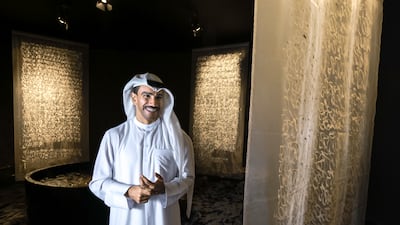

Juma Al Haj’s new exhibition arrives at a turning point in his life.
Last June, after 15 years in a corporate career, the Emirati artist left his job and returned to university to fully commit himself to art. Revelation, now on view at 421 Arts Campus in Abu Dhabi, grew out of this period of reassessment.
The exhibition – which is also Al Haj’s first institutional solo show – was developed through 421’s Artistic Development Programme. Running until January 10, the show brings together painting, glass, text, light, shadow, water and installation in a meditation on seclusion, reflection and the idea that personal revelation is part of an continuing process rather than a final answer.

Al Haj says the decision to become a full-time artist came relatively late. He studied visual communication before completing a master’s degree in international relations and moving into government work, following a path familiar to his family. His father is a diplomat, while his siblings also work in government and diplomacy.
While art remained present, it was something separate from his professional life.
“I always thought of it as a practice that I do in my spare time,” he says, describing that as a familiar regional attitude towards creative work. The assumption was that art could be pursued seriously, but not necessarily as a livelihood.

That changed when he began posting his work online during the Covid-19 pandemic. The response encouraged him to take his practice more seriously. Between 2020 and 2021, he started to see art as a possible career rather than a parallel pursuit.
Revelation grew from that shift.
When Al Haj joined the Artistic Development Programme about two years ago, he initially wanted to explore seclusion and the idea of a maze, asking why people withdraw from the world when trying to understand difficult experiences.
His thinking was shaped by journals, philosophy, poetry and spiritual texts from the three Abrahamic religions. Over time, however, the exhibition became less concerned with presenting a fixed narrative and more interested in creating a space where viewers could arrive at their own understanding.
That is reflected in the way the works are installed. Glass panels carry text, but their meaning changes according to light, shadow and reflection. Al Haj says the object itself is only one part of the work. The surrounding conditions are equally important.
He compares the panels to floppy disks that contain information revealed only when activated. Light performs that function in the exhibition, bringing inscriptions into view and casting shadows that become part of the experience.
“The artwork is also the placement of the light, the placement of the panel and the reflection of the shadow,” he says.

The installation gradually leads visitors towards Hijr, a darker and more enclosed space designed for contemplation. At the centre is water, which Al Haj uses as a symbol of movement and renewed energy.
“Revelation is not an ending point; it’s just a checkpoint,” he says.
The idea is that a person gathers what they need, reaches a moment of understanding and continues. The ripples in the water reinforce that sense of movement, with each disturbance creating another moment that quickly passes.
That cyclical thinking also appears in Balaa, one of the exhibition’s early works. The title refers to the Arabic concept of trial or affliction. Al Haj uses it to think about the way people count and measure their lives, whether through time, emotions, deeds or individual moments.
The tension comes from uncertainty: the constant questioning of whether choices are right or wrong, and whether progress can ever be measured with confidence.
The exhibition is also designed to be physical rather than purely visual.
A thick carpet covers the space, requiring visitors to remove their shoes. Al Haj connects that action to the experience of entering a sacred space such as a mosque, where removing footwear can signal respect and change a person’s awareness of their surroundings.

The softness underfoot, along with subdued lighting and dark walls, is intended to slow the pace of the room. “The artwork is the atmosphere as opposed to the items within the room itself,” he adds.
Black is used deliberately. Al Haj sees it as a contemplative colour that can bring certain elements forward while allowing others to recede. The room is meant to feel enclosed, but not oppressive. “It’s supposed to hug you like a cocoon, like a blanket,” he says.
That approach extends ideas already present in his painting.
Al Haj says his canvases can contain between seven and 14 layers, most of which are invisible once a work is complete. Revelation effectively opens up those layers and spreads them across a room, allowing viewers to move through a process that would normally remain compressed on a flat surface.
“A lot of my work is about turning the intangible into something visually tangible,” he says.
Al Haj is currently thinking more seriously about where his practice sits within the wider Emirati art scene.
He describes himself as part of a third generation of Emirati artists, following an earlier period when institutions and opportunities were fewer. Today, he says, younger artists can begin earlier, experiment more freely and build careers with greater institutional support.

At the same time, he believes exposure beyond the UAE remains important. He has just moved to Paris, partly motivated by a desire to understand the international art world from within, rather than only encountering it when major institutions and artists arrive in the Emirates.
He warns younger artists against confusing international exposure with imitation. His advice is simple: “Leave the comforts of home but take home with you.”
Al Haj’s visual language partly grew from Arabic handwriting exercises he practised as a child while attending an American school. This later fed into the gestural marks that appear across his work.
The goal, he says, is not to remain bound by tradition, but to develop something recognisably personal. “Find your own language, stick to your roots, but don’t be confined by your roots.”
Revelation by Juma Alhaj is on at 421 Arts Campus in Abu Dhabi until January 10