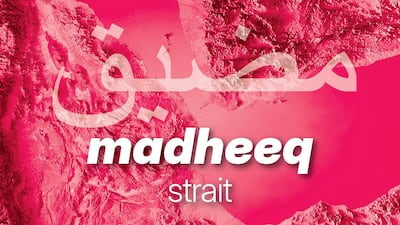

Our Arabic word of the week, madheeq, translates as a strait, a narrow aquatic passage that connects two larger bodies of water. It can also describe a tight place, a pass or a difficult narrowing of circumstances.
Its root, dhaad-yaa-qaf, carries meanings of constraint and distress, which gives the word a reach beyond geography. A madheeq is not only a place on a map. It is a crossing under pressure.
That layered meaning is especially fitting in the Middle East, where history has often turned on narrow waters. The Strait of Hormuz, or Madheeq Hormuz, links the Arabian Gulf to the Gulf of Oman and the wider Indian Ocean. It has long been a point of commercial and military attention. The Portuguese captured Hormuz in 1514 and built a fort there, before joint Anglo-Persian forces took it in 1622, ending Portuguese control.

To the west, Bab Al Mandeb connects the Red Sea to the Gulf of Aden. Its name translates to Gate of Tears, and its modern importance grew after the Suez Canal opened in 1869, making it part of the shorter sea route between Asia and Europe. Today, Bab Al Mandeb remains one of the world’s most important maritime chokepoints, with major oil and container traffic passing through it.

Further north, the Straits of Tiran became one of the defining flashpoints before the 1967 Arab-Israeli war. After the withdrawal of UN forces, Egyptian president Gamal Abdel Nasser announced the closure of the straits to Israeli shipping, a move the US had previously said it would treat as an act of war.
These places show why madheeq is such a precise word. A strait is small in width, but large in consequence. It is where trade, energy, military strategy and diplomacy are compressed into a few cubic metres of water.
That is why the word has returned so sharply to the news during the recent US-Iran conflict. The Strait of Hormuz remains one of the world’s most important energy corridors. In 2025, oil flowing through Hormuz averaged about 20 million barrels a day, roughly 20 per cent of global petroleum liquids consumption. In 2024, about a fifth of global LNG trade also passed through the strait, largely from Qatar.
The recent interim agreement between the US and Iran included measures aimed at restoring commercial passage through Hormuz and easing pressure on energy flows, underlining how central the strait is to the conflict’s economic stakes.
Madheeq, then, is a word of tension and passage. It describes a narrow place, but is also one the world gathers around: ships waiting to move, states calculating risk, markets reacting and history pressing in from both shores.

