• US actor Bruce Willis at the European premiere of 'Glass' in central London. AFP
    US actor Bruce Willis at the European premiere of 'Glass' in central London. AFP
  • Bruce Willis in a scene from the movie 'Glass'. Photo: Universal Pictures
    Bruce Willis in a scene from the movie 'Glass'. Photo: Universal Pictures
  • Bruce Willis in a scene from the 'Sixth Sense'. Photo: Spyglass Entertainment
    Bruce Willis in a scene from the 'Sixth Sense'. Photo: Spyglass Entertainment
  • Bruce Willis in 'Pulp Fiction'. Photo: Miramax
    Bruce Willis in 'Pulp Fiction'. Photo: Miramax
  • Bruce Willis in 'Breakfast of Champions'. Photo: Warner Bros
    Bruce Willis in 'Breakfast of Champions'. Photo: Warner Bros
  • Bruce Willis in a scene from 'Motherless Brooklyn'. Photo: Warner Bros
    Bruce Willis in a scene from 'Motherless Brooklyn'. Photo: Warner Bros
  • Bruce Willis stars as Captain Sharp in Wes Anderson's 'Moonrise Kingdom'.
    Bruce Willis stars as Captain Sharp in Wes Anderson's 'Moonrise Kingdom'.
  • Bruce Willis in 'Die Hard' (1988). Photo: IMDb
    Bruce Willis in 'Die Hard' (1988). Photo: IMDb
  • Bruce Willis stars as the original GI Joe in this sequel. Photo: Paramount Pictures
    Bruce Willis stars as the original GI Joe in this sequel. Photo: Paramount Pictures
  • From left, Steve Buscemi, Will Patton, Bruce Willis, Michael Clarke Duncan, Ben Affleck and Owen Wilson in 'Armageddon'. Photo: Touchstone Pictures
    From left, Steve Buscemi, Will Patton, Bruce Willis, Michael Clarke Duncan, Ben Affleck and Owen Wilson in 'Armageddon'. Photo: Touchstone Pictures
  • Bruce Willis attends the premiere of 'Motherless Brooklyn' during the 57th New York Film Festival. Invision / AP, File
    Bruce Willis attends the premiere of 'Motherless Brooklyn' during the 57th New York Film Festival. Invision / AP, File

Bruce Willis receives frontotemporal dementia diagnosis as health worsens


  • English
  • Arabic

Bruce Willis's health has deteriorated and he has been diagnosed with frontotemporal dementia, nearly a year after he was found to have aphasia, his family announced on Thursday.

The family said on Thursday that the actor, 67, had a more specific diagnosis of frontotemporal dementia as his “condition has progressed”.

“While this is painful, it is a relief to finally have a clear diagnosis,” their statement read.

“FTD is a cruel disease that many of us have never heard of, and [it] can strike anyone.”

Last March, Willis’s family said his aphasia had affected his cognitive abilities and that he would retire from acting. The condition causes the loss of the ability to understand or express speech.

His family said communication challenges were only one symptom of frontotemporal dementia.

“Today there are no treatments for the disease, a reality that we hope can change in the years ahead,” they said.

“As Bruce’s condition advances, we hope that any media attention can be focused on shining a light on this disease that needs far more awareness and research.”

The statement was posted on the website for the Association for Frontotemporal Degeneration and signed by Willis’s wife, Emma Heming Willis, his former wife Demi Moore, and his five children, Rumer, Scout, Tallulah, Mabel and Evelyn.

  • Bruce Willis in Detective Knight: Independence. Photo: Lionsgate
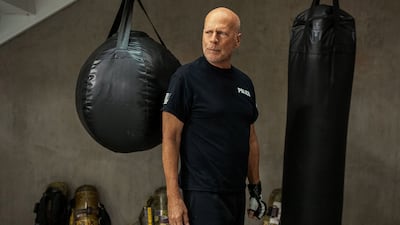
    Bruce Willis in Detective Knight: Independence. Photo: Lionsgate
  • Willis in a scene from The Sixth Sense. Photo: Spyglass Entertainment
    Willis in a scene from The Sixth Sense. Photo: Spyglass Entertainment
  • Willis in Pulp Fiction. Photo: Miramax
    Willis in Pulp Fiction. Photo: Miramax
  • Brad Pitt, left, and Willis in 12 Monkeys. Photo: Universal Pictures
    Brad Pitt, left, and Willis in 12 Monkeys. Photo: Universal Pictures
  • Jessica Alba as Nancy Callahan and Willis as John Hartigan in a scene from Sin City. Photo: Miramax Films
    Jessica Alba as Nancy Callahan and Willis as John Hartigan in a scene from Sin City. Photo: Miramax Films
  • Bruce Willis in Die Hard with a Vengeance
    Bruce Willis in Die Hard with a Vengeance
  • Bruce Willis in Die Hard, 1988. Photo: Imdb
    Bruce Willis in Die Hard, 1988. Photo: Imdb
  • Willis as Detective John McClane fights off cyber-terrorists in Die Hard 4.0. AP Photo / Fox
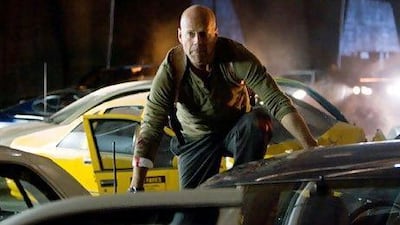
    Willis as Detective John McClane fights off cyber-terrorists in Die Hard 4.0. AP Photo / Fox

The Associated Press contributed to this report

Honeymoonish
%3Cp%3E%3Cstrong%3EDirector%3A%3C%2Fstrong%3E%20Elie%20El%20Samaan%3C%2Fp%3E%0A%3Cp%3E%3Cstrong%3EStarring%3A%20%3C%2Fstrong%3ENour%20Al%20Ghandour%2C%20Mahmoud%20Boushahri%3C%2Fp%3E%0A%3Cp%3E%3Cstrong%3ERating%3A%3C%2Fstrong%3E%203%2F5%3C%2Fp%3E%0A
Kill%20Bill%20Volume%201
%3Cp%3E%3Cstrong%3EDirector%3C%2Fstrong%3E%3A%20Quentin%20Tarantino%3Cbr%3E%3Cstrong%3EStars%3C%2Fstrong%3E%3A%20Uma%20Thurman%2C%20David%20Carradine%20and%20Michael%20Madsen%3Cbr%3E%3Cstrong%3ERating%3C%2Fstrong%3E%3A%204.5%2F5%3C%2Fp%3E%0A
10 tips for entry-level job seekers
  • Have an up-to-date, professional LinkedIn profile. If you don’t have a LinkedIn account, set one up today. Avoid poor-quality profile pictures with distracting backgrounds. Include a professional summary and begin to grow your network.
  • Keep track of the job trends in your sector through the news. Apply for job alerts at your dream organisations and the types of jobs you want – LinkedIn uses AI to share similar relevant jobs based on your selections.
  • Double check that you’ve highlighted relevant skills on your resume and LinkedIn profile.
  • For most entry-level jobs, your resume will first be filtered by an applicant tracking system for keywords. Look closely at the description of the job you are applying for and mirror the language as much as possible (while being honest and accurate about your skills and experience).
  • Keep your CV professional and in a simple format – make sure you tailor your cover letter and application to the company and role.
  • Go online and look for details on job specifications for your target position. Make a list of skills required and set yourself some learning goals to tick off all the necessary skills one by one.
  • Don’t be afraid to reach outside your immediate friends and family to other acquaintances and let them know you are looking for new opportunities.
  • Make sure you’ve set your LinkedIn profile to signal that you are “open to opportunities”. Also be sure to use LinkedIn to search for people who are still actively hiring by searching for those that have the headline “I’m hiring” or “We’re hiring” in their profile.
  • Prepare for online interviews using mock interview tools. Even before landing interviews, it can be useful to start practising.
  • Be professional and patient. Always be professional with whoever you are interacting with throughout your search process, this will be remembered. You need to be patient, dedicated and not give up on your search. Candidates need to make sure they are following up appropriately for roles they have applied.

Arda Atalay, head of Mena private sector at LinkedIn Talent Solutions, Rudy Bier, managing partner of Kinetic Business Solutions and Ben Kinerman Daltrey, co-founder of KinFitz

The years Ramadan fell in May

1987

1954

1921

1888

The specs: 2019 Haval H6

Price, base: Dh69,900

Engine: 2.0-litre turbocharged four-cylinder

Transmission: Seven-speed automatic

Power: 197hp @ 5,500rpm

Torque: 315Nm @ 2,000rpm

Fuel economy, combined: 7.0L / 100km

The Specs:

The Specs:

Engine: 2.9-litre, V6 twin-turbo

Transmission: 8-speed automatic

Power: 444bhp

Torque: 600Nm

Price: AED 356,580 incl VAT

On sale: now.

Mercer, the investment consulting arm of US services company Marsh & McLennan, expects its wealth division to at least double its assets under management (AUM) in the Middle East as wealth in the region continues to grow despite economic headwinds, a company official said.

Mercer Wealth, which globally has $160 billion in AUM, plans to boost its AUM in the region to $2-$3bn in the next 2-3 years from the present $1bn, said Yasir AbuShaban, a Dubai-based principal with Mercer Wealth.

Within the next two to three years, we are looking at reaching $2 to $3 billion as a conservative estimate and we do see an opportunity to do so,” said Mr AbuShaban.

Mercer does not directly make investments, but allocates clients’ money they have discretion to, to professional asset managers. They also provide advice to clients.

“We have buying power. We can negotiate on their (client’s) behalf with asset managers to provide them lower fees than they otherwise would have to get on their own,” he added.

Mercer Wealth’s clients include sovereign wealth funds, family offices, and insurance companies among others.

From its office in Dubai, Mercer also looks after Africa, India and Turkey, where they also see opportunity for growth.

Wealth creation in Middle East and Africa (MEA) grew 8.5 per cent to $8.1 trillion last year from $7.5tn in 2015, higher than last year’s global average of 6 per cent and the second-highest growth in a region after Asia-Pacific which grew 9.9 per cent, according to consultancy Boston Consulting Group (BCG). In the region, where wealth grew just 1.9 per cent in 2015 compared with 2014, a pickup in oil prices has helped in wealth generation.

BCG is forecasting MEA wealth will rise to $12tn by 2021, growing at an annual average of 8 per cent.

Drivers of wealth generation in the region will be split evenly between new wealth creation and growth of performance of existing assets, according to BCG.

Another general trend in the region is clients’ looking for a comprehensive approach to investing, according to Mr AbuShaban.

“Institutional investors or some of the families are seeing a slowdown in the available capital they have to invest and in that sense they are looking at optimizing the way they manage their portfolios and making sure they are not investing haphazardly and different parts of their investment are working together,” said Mr AbuShaban.

Some clients also have a higher appetite for risk, given the low interest-rate environment that does not provide enough yield for some institutional investors. These clients are keen to invest in illiquid assets, such as private equity and infrastructure.

“What we have seen is a desire for higher returns in what has been a low-return environment specifically in various fixed income or bonds,” he said.

“In this environment, we have seen a de facto increase in the risk that clients are taking in things like illiquid investments, private equity investments, infrastructure and private debt, those kind of investments were higher illiquidity results in incrementally higher returns.”

The Abu Dhabi Investment Authority, one of the largest sovereign wealth funds, said in its 2016 report that has gradually increased its exposure in direct private equity and private credit transactions, mainly in Asian markets and especially in China and India. The authority’s private equity department focused on structured equities owing to “their defensive characteristics.”

Updated: February 16, 2023, 11:24 PM