


The sale of government bonds has been moved to November 1 due to the fiscal announcement coming later this month, the Bank of England has said.
The UK's central bank had been due to start buying government bonds, called gilts, on October 31.
The move follows denials from the bank earlier on Tuesday that it would postpone the bond sale programme in an attempt to allow battered gilt markets to recover following the chaos unleashed by the government's mini-budget.
“The first gilt sales operation was scheduled to take place on October 31 and proceed thereafter,” the bank said in a statement on Tuesday evening.
“In light of the government’s fiscal announcement now scheduled for October 31, the first gilt sale operation will now take place on November 1.”
Chancellor Jeremy Hunt is set to unveil the fiscal announcement at the end of the month, which will backtrack on a serious of previous tax cut plans after predecessor Kwasi Kwarteng’s mini-budget shook market traders.
The Bank of England update came after senior officials at the central bank were reported to have decided to delay the plan to offload at the end of this month some of its £838 billion ($948bn) in UK government bonds bought under the so-called quantitative easing programme.
As part of its emergency bond-buying action launched late last month, the bank said it would postpone this plan — known as quantitative tightening — from October 3 until the end of October.
Chancellor of the Exchequer Jeremy Hunt — in pictures
-
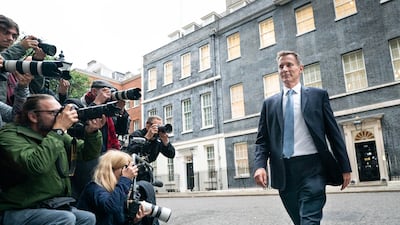
Jeremy Hunt leaves 10 Downing Street in London after he was appointed Chancellor of the Exchequer following the resignation of Kwasi Kwarteng. Here 'The National' looks back through Mr Hunt's political career. PA -
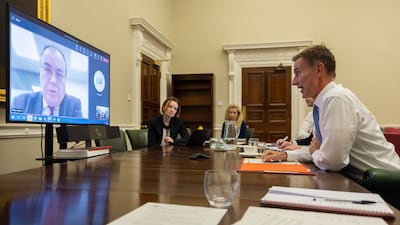
Mr Hunt holds a video conference call with Bank of England Governor Andrew Bailey from his offices in the Treasury. Photo: HM Treasury -
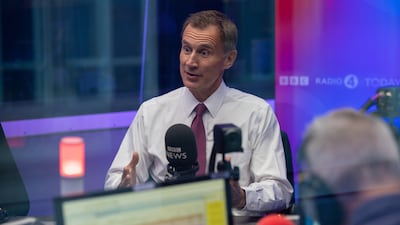
Mr Hunt conducts a series of television and radio interviews after his appointment as chancellor. Photo: HM Treasury -
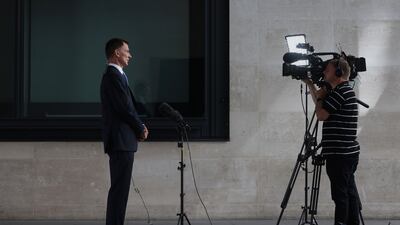
Mr Hunt speaks during an interview outside BBC Broadcasting House in July. At the time he was a contender to replace Prime Minster Boris Johnson as Conservative Party leader. Getty -
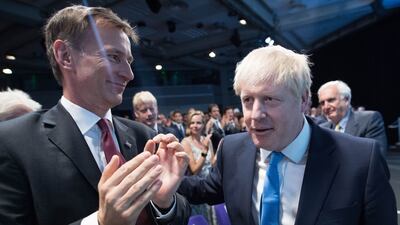
Mr Hunt after losing to leadership contender Boris Johnson, who became British Prime Minister in July 2019. Getty -

Showcasing his credentials in July 2019. Now, Mr Hunt is charged with leading Britain out of an economic malaise. Getty Images -

With party member and president of the Bramshot and Liphook Conservative branch Tony Rudgard, 96, in 2019. Getty -
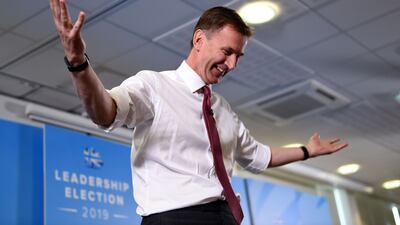
Mr Hunt speaks at the South-West Hustings in Exeter, in June 2019. Getty -
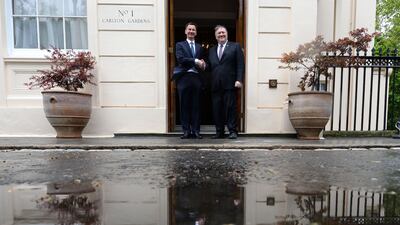
Meeting then-US secretary of state Mike Pompeo in May 2019 in London. Getty -
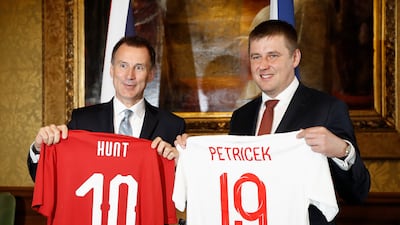
Mr Hunt and his Czech counterpart Tomas Petricek hold up football shirts on arrival at the Foreign Office in London in March 2019. Getty -
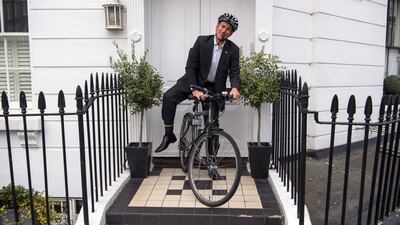
Mr Hunt as health secretary, outside his home in London in 2016. Getty -
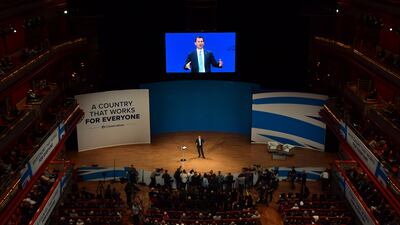
He delivers a speech at the Conservative Party Conference in Birmingham in 2016. Getty -

Mr Hunt joins local Conservative Party activists as they campaign on the constituency's battle bus in Thurrock in 2015. Getty -
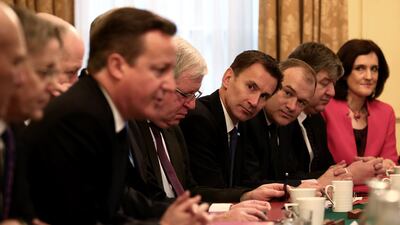
Mr Hunt looks on as then-prime minister David Cameron hosts a Cabinet meeting at No 10 Downing Street in 2015. Getty


The Financial Times reported that it was now expected to put quantitative tightening back further after senior figures at the bank look to give more time for the “very distressed” gilt markets to recover.
But the bank dismissed the report early on Tuesday, sending the pound lower, to $1.126 at one stage and affecting gilts after Monday’s bounceback.
The pound has since rebounded to $1.132, but the bond markets were shut at the time of the bank’s new statement.
“This morning’s FT report that the BoE has decided to delay MPC gilt sales … is inaccurate,” a bank spokesman said on Tuesday before the announcement.
Experts and investors have been increasingly calling for the bank to hold its quantitative tightening plan, given fears that it could trigger another sell-off of gilts.
Gilts rallied on Monday as financial markets were placated by Mr Hunt’s emergency statement, with yields on 30-year government bonds dropping by about 10 per cent.
But the rebound has still not undone the impact of the recent market turmoil, with yields significantly higher than the 3.75 per cent level seen before Mr Kwarteng unveiled his disastrous mini-budget on September 23, and rising back up by another 0.5 per cent on Tuesday.
The latest reaction to the Bank’s quantitative tightening denial shows how delicate the gilt markets still are.
What does the UK public think of Jeremy Hunt's changes? — video
Former pensions minister Baroness Ros Altmann is among those who have urged the bank to completely halt its plan to offload £80bn in gilts.
She recently told the PA news agency: “With £80bn of gilt sales overhanging the market, there’s every likelihood the market will plunge again.
“The bank must put its QT [quantitative tightening] on hold … not telling markets that it isn’t about to step into the market with £80bn of sales would invite further chaos.”
But the bank is thought to be keen to show its independence from the government and focus on its priority to fight rampant inflation through interest rate rises and reducing its balance sheet of bonds built up through quantitative easing.
Separately on Tuesday, deputy governor Sir Jon Cunliffe told the Treasury Committee that the bank was continuing to monitor developments in conventional and index-linked gilt markets this week after its emergency bond-buying programme ended on October 14.
In a letter to committee chairman Mel Stride, Sir Jon said: “The bank and the FPC [Financial Policy Committee] will continue to monitor market conditions, channels through which vulnerabilities could amplify future market stresses, and domestic and international progress towards reforms in the NBFI [non-banking financial institution] sector.”

