

Britain’s Energy Minister Greg Hands said Britain is “not immune” to rising energy prices caused by the escalation in tension between the West and Russia over Ukraine.
The turmoil between Russia and Ukraine is “clearly having an impact” on energy prices, Mr Hands said, as European natural gas led gains in commodities, jumping as much as 13 per cent, while the UK equivalent was up more than 8 per cent.
“We are obviously very susceptible to energy prices, the big move upwards in gas prices in particular,” Mr Hands told delegates attending an online session at International Energy Week in London.
“The UK is not immune to those price increases. We have seen that play out and the big increase in consumer gas prices that is coming with the increase in the price cap, effective in April, announced by Ofgem earlier this month.”
Energy markets have been on edge for weeks, swinging with every twist in the standoff between the West and Moscow as Europe grapples with a gas supply crisis that has sent prices quadrupling in the past year.
The tension has added to oil’s blistering rally that has also been driven by output not being able to keep up with steadily rising demand.
The escalation in tension comes at a difficult time for the UK, with consumers facing rising inflation and a cost-of-living squeeze that will worsen from April when the energy price cap — the maximum suppliers are allowed to charge in a year — goes up by £693 ($938), at the same time as a National Insurance increase of 1.25 per cent begins.
However, Mr Hands said “the better news” is that the security of the UK’s gas supply “remains good” with 50 per cent of consumption coming from domestic production and 30 per cent from Norway.
“Russia itself supplies typically less than 2 per cent to 3 per cent of our gas needs. So, I think from a supply perspective, the UK is not in a bad position,” Mr Hands said.
Energy prices surged on Tuesday after Russian President Vladimir Putin signed an order to send what he called “peacekeeping forces” to the two breakaway areas of Ukraine that he officially recognised, with Brent oil closing in on $100 a barrel and the FTSE 100 dropping sharply at the open, following Asian stocks into the red.
“The threat of war does not create a positive environment for investors, and so we have seen another big sell-off on global markets,” said Russ Mould, investment director at AJ Bell.
“Investors are very much in risk-off mode, dumping commodity producers — particularly those with exposure to either Russia or Ukraine — as well as tech and travel stocks,” said Mr Mould.
“Brent crude was just over one dollar away from hitting $100 a barrel as the market feared disruption to oil supplies.”
Russia is the biggest provider of gas to Europe, about a third of which typically travels through pipelines crossing Ukraine, and a major exporter of everything from crude oil to refined products.
Sanctions could also disrupt energy flows, with any curbs to Russia’s ability to trade in foreign currency having the potential to upend commodity markets from oil and gas to metals and agriculture.
“This means yet higher gas prices for longer as the market has already been very nervous for months,” said Katja Yafimava, a senior research fellow at the Oxford Institute for Energy Studies. “Some US, EU sanctions are likely to follow.”
Despite the crisis, Mr Hands said it was not in the UK’s interest to increase imports of foreign hydrocarbons. The solution in the medium to long-term, and also to some extent in the short-term, is “to move away from volatile price fossil fuels towards renewables”, he said.
“That is the best answer to this crisis. Net zero is not part of the problem. Net Zero is very much the solution: more domestically produced, low carbon, zero carbon energy, whether it be renewables or nuclear — that is the solution for UK consumers and businesses going forward,” said Mr Hands.
-
Firefighters arrive at a military building in Kiev that was damaged in an explosion. EPA -

A man looks at the debris of an unidentified object in the aftermath of an explosion in Kiev. EPA -
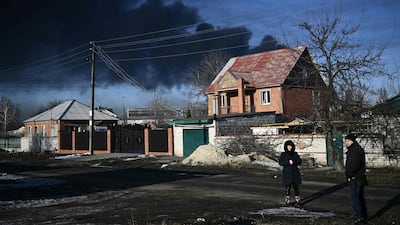
Black smoke rises from a military airport in Chuguyev near Kharkiv. AFP -

People take shelter in a Kiev subway station, after Russian President Vladimir Putin authorised a military operation in eastern Ukraine. Reuters -
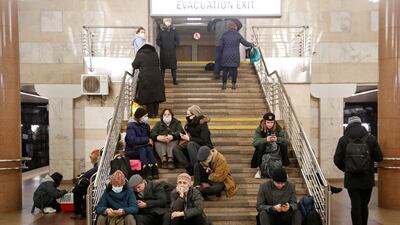
A Kiev underground train station provides some shelter. Reuters -

Clear airspace over Ukraine, shortly after the attack began, as shown on the Flightradar24 website. AP -

Kiev residents leave the city following pre-offensive missile strikes by the Russian armed forces and Belarus. Getty -
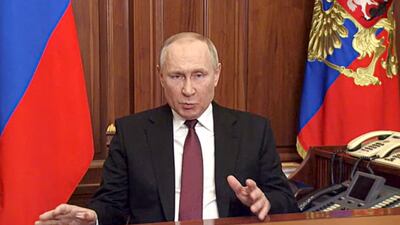
Russian President Vladimir Putin justified the attack in a televised address, saying it was to protect civilians in eastern Ukraine. AP -
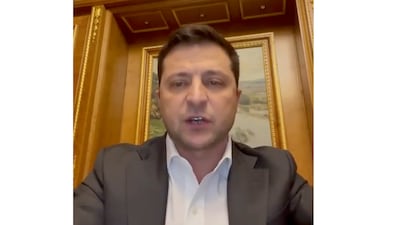
Ukrainian President Volodymyr Zelenskyy addresses the nation in Kiev. He has declared martial law, saying Russia has targeted Ukraine's military infrastructure. AP -
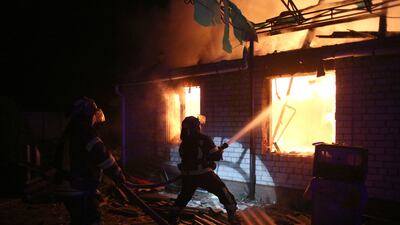
Firefighters extinguish a blaze at a house in Muratovo, in Ukraine's Luhansk enclave. AFP -

The house is said to have been hit during shelling by Russian-backed separatists. AFP -

The coffin of Capt Anton Sidorov is carried by members of the honour guard during a ceremony held at the Ministry of Defence in Kiev, Ukraine. Getty -
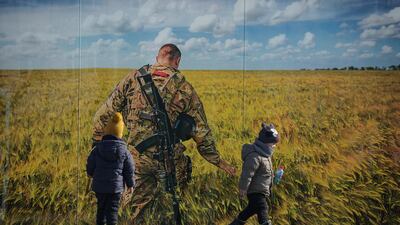
A picture memorial for those killed in the confrontation between Ukraine's military and pro-Russia separatist forces, in the Luhansk region in eastern Ukraine. AP -

UN Secretary General Antonio Guterres and Russia's Ambassador to the UN, Vassily Nebenzia, attend a Security Council meeting in New York to discuss the crisis in Ukraine. Reuters -
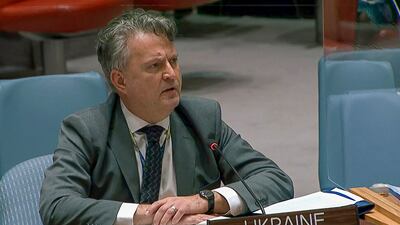
Ukraine's UN ambassador Sergey Kyslytsya speaks during an emergency meeting of the Security Council. AP -
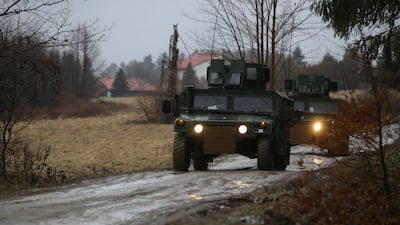
US Army soldiers from the 82nd Airborne Division head towards an air base near Arlamow, Poland. Reuters -

An employee works at the gun counter of a tactical equipment shop in Kiev, Ukraine. Getty -
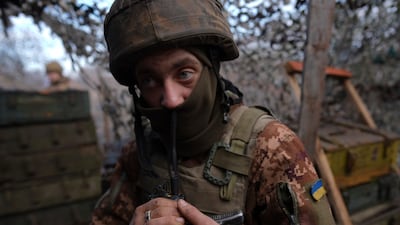
A Ukrainian soldier speaks on a walkie-talkie at his position at the line of separation between Ukraine-held territory and rebel-held territory near Svitlodarsk, eastern Ukraine. AP -
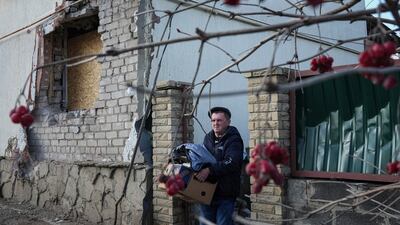
A man removes his belongings from his house after it was struck by artillery shells in Novoluhanske, eastern Ukraine. AP -
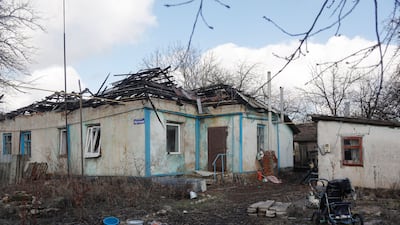
A damaged house in Vibrovka village. EPA -
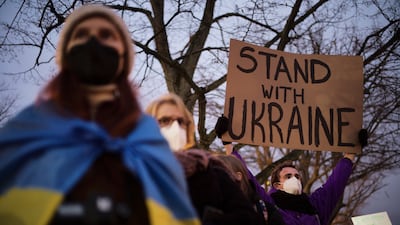
A man shows a poster in support of Ukraine as he protests against the escalation of the tension between Russia and Ukraine, in Berlin. AP -

Soldiers carry the coffin of Capt Anton Sydorov, 35, after he was killed in eastern Ukraine. AP -
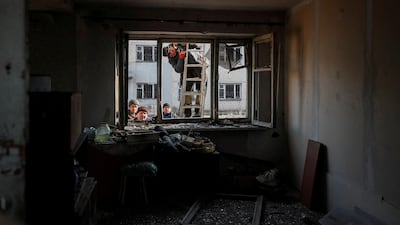
Workers look into a destroyed house after shelling near the city of Novoluhanske in Donetsk. Reuters -

Destroyed buildings in Krasnogorivka, Ukraine. AFP -
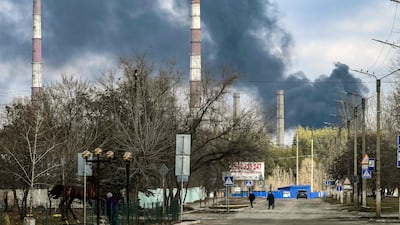
Smoke rises from a power plant after shelling outside the town of Schastia, a day after Moscow recognised two Ukrainian separatist republics and ordered the Russian Army to send in troops as ‘peacekeepers’. AFP -
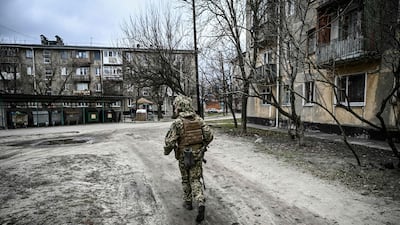
A Ukrainian Army soldier trudges through the wintry streets of Schastia on patrol. AFP -
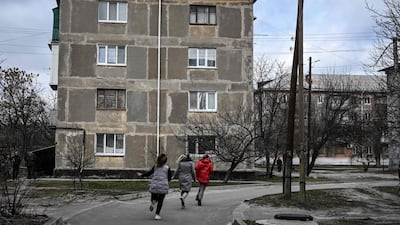
Three women run for cover during shelling in Schastia, eastern Ukraine. AFP -
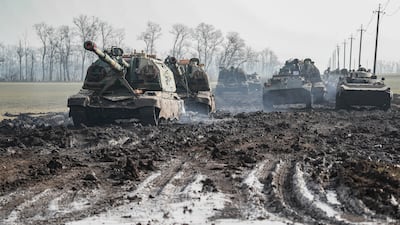
Russian tanks and armoured vehicles on the road in Rostov. EPA -
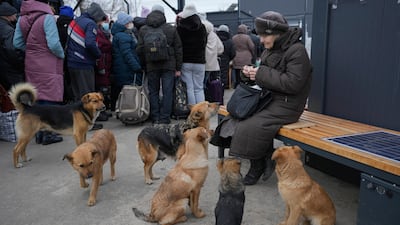
A woman shares food with dogs in Stanytsia Luhanska, a crossing point between Ukrainian government-controlled areas and pro-Russian separatists' territory. AP -
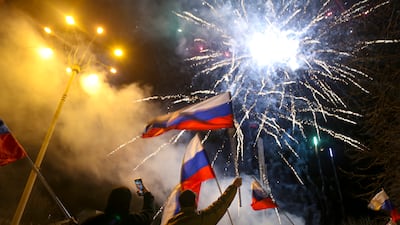
People wave Russian flags in Donetsk, the territory controlled by pro-Russian militants, in eastern Ukraine. AP -
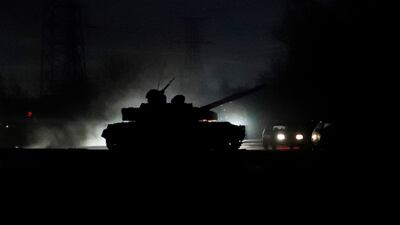
A tank drives along a street in the city of Donetsk. Reuters -
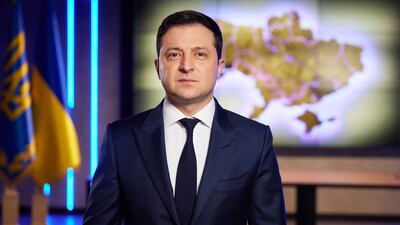
Ukrainian President Volodymyr Zelenskyy addresses the nation on TV and says 'we are not afraid' after Russian President Vladimir Putin ordered troops into Donetsk and Luhansk, two Moscow-backed rebel regions of Ukraine. AFP -
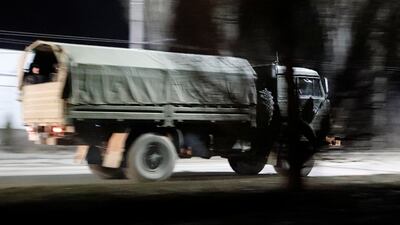
A military truck in Donetsk after Mr Putin ordered the deployment of Russian troops to the city. Reuters -
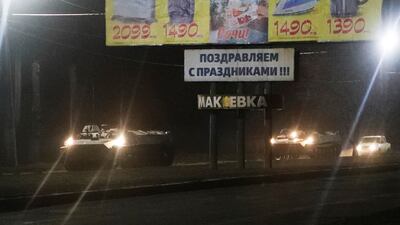
Russian state television showed Mr Putin signing a decree recognising the independence of the two Ukrainian breakaway regions. Reuters -
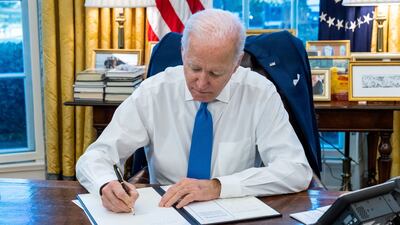
US President Joe Biden signs an executive order at the White House to prohibit trade and investment between US individuals and the two breakaway regions of eastern Ukraine. Reuters -
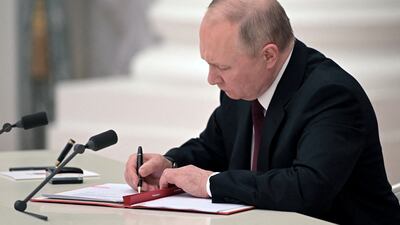
Mr Putin signs documents, including the decree recognising two Russian-backed breakaway regions in eastern Ukraine. Reuters -
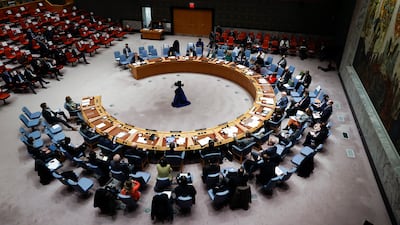
Ukraine ambassador to the United Nations, Sergiy Kyslytsya, addresses an emergency meeting of the UN Security Council on the situation between Ukraine and Russia in New York. EPA


Ministers fear more British energy companies could go bust if gas prices rise further amid the Ukraine turmoil, according to media reports.
Twenty-five British energy companies collapsed in the final quarter of last year, with two more small-scale companies failing on Friday, with preparations under way in Whitehall for “more supplier failures".
Analysts say the conflict could cause the UK gas price to increase to as much as 1,000 pence per therm — more than double its peak in December when it stood at slightly more 450 pence per therm.
The annual bill for a typical household is due to go up to £1,971, from £1,277, from April 1 but some industry analysts expect it to go up again to £2,300 from October 1, with the Ukraine-Russia tension potentially pushing this figure even higher.
Neil Shearing, group chief economist at Capital Economics, said in a worst-case scenario, oil prices could rise to $120 to 140 per barrel, with European natural gas prices also rising further.
“Were this to happen, it would add around 2 per cent to headline inflation [relative to our current baseline] in advanced economies this year, with Europe hit particularly hard,” Mr Shearing said.
“In normal times, central banks would tend to look through an energy-led rise in inflation, but given the current high rates of inflation, and corresponding concerns about it feeding higher inflation expectations, it is possible that this adds to the list of reasons for policymakers to raise interest rates.”

