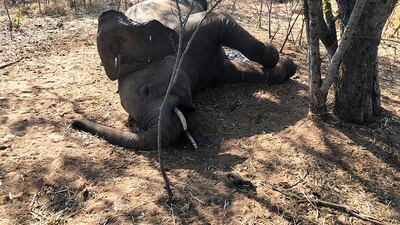
A dead elephant at Hwange National park, Zimbabwe. A new report says deforestation and agricultural expansion are the key drivers for a 70 per cent decline in wildlife populations since 1970. AP Photo

World's wildlife decreased by more than two thirds since 1970, report says


  • English
  • Arabic

Global animal, bird and fish populations have plummeted more than two thirds in less than 50 years because of rampant over-consumption, experts said on Thursday in a stark warning to save nature in order to save ourselves.

Human activity has severely degraded three quarters of all land and 40 per cent of Earth's oceans, and our quickening destruction of nature is likely to have untold consequences on our health and livelihoods.

The Living Planet Index, which tracks more than 4,000 species of vertebrates, warned that increasing deforestation and agricultural expansion were the key drivers behind a 68 per cent average decline in populations between 1970 and 2016.

All this is in a blink of an eye compared to the millions of years that many species have been living on the planet

It said relentless natural habitat loss increased the risk of future pandemics as humans expand their presence into ever closer contact with wild animals.

2020's Living Planet Report, a collaboration between WWF International and the Zoological Society of London, is the 13th edition of the biennial publication tracking wildlife populations around the world.

"It's an accelerating decrease that we've been monitoring for 30 years and it continues to go in the wrong direction," said WWF International director general Marco Lambertini.

"In 2016 we documented a 60 per cent decline, now we have a 70 per cent decline.

"All this is in a blink of an eye compared to the millions of years that many species have been living on the planet," he said.

In the last half decade there has seen unprecedented economic growth underpinned by an explosion in global consumption of natural resources.

Whereas until 1970, humanity's ecological footprint was smaller than the Earth's capacity to regenerate resources, the WWF now calculates we are over-using the planet's capacity by more than half.

While aided by factors such as invasive species and pollution, the biggest single driver of species lost is land-use changes: usually industry converting forests or grasslands into farms.

This takes an immense toll on wild species, which lose their homes.

But it also requires unsustainable levels of resources to uphold: one third of all land mass and three quarters of all freshwater are now dedicated to producing food.

The picture is equally dire in the ocean, where 75 per cent of fish stocks are overexploited.

And while wildlife is declining rapidly, species are disappearing faster in some places than others.

The index showed that the tropical regions of Central and South America had recorded a 94 per cent fall in species since 1970.

"It is staggering. It is ultimately an indicator of our impact on the natural world," said Mr Lambertini.

The Living Planet update comes alongside a study co-authored by more than 40 NGOs and academic institutions, which lays out ways of arresting and reversing the losses human consumption has inflicted.

The research, published in the journal Nature, suggests that reducing food waste and favouring healthier and more environment-friendly diets could help to "bend the curve" of degradation.

Coupled with radical conservation efforts, these measures could avert more than two thirds of future biodiversity loss, the authors suggested.

"We need to act now. Rates of biodiversity recovery are typically much slower than those of recent biodiversity loss," said lead study author David Leclere, research scholar at the International Institute of Applied System Analysis.

"This implies that any delay in action will allow further biodiversity losses that might take decades to restore."

Mr Leclere also warned of "irreversible" losses to biodiversity, such as when a species goes extinct.

Mr Lambertini said that, like public discourse on climate change, societies are increasingly concerned about the links between the health of the planet and human well-being.

"From being sad about losing nature, people are beginning to actually get worried," he said.

"We still have a moral duty to co-exist with life on the planet, but there's now this new element of impact on our society, our economy and, of course, our health."


UAE tour of Zimbabwe

All matches in Bulawayo
Friday, Sept 26 – UAE won by 36 runs
Sunday, Sept 28 – Second ODI
Tuesday, Sept 30 – Third ODI
Thursday, Oct 2 – Fourth ODI
Sunday, Oct 5 – First T20I
Monday, Oct 6 – Second T20I

Mercer, the investment consulting arm of US services company Marsh & McLennan, expects its wealth division to at least double its assets under management (AUM) in the Middle East as wealth in the region continues to grow despite economic headwinds, a company official said.

Mercer Wealth, which globally has $160 billion in AUM, plans to boost its AUM in the region to $2-$3bn in the next 2-3 years from the present $1bn, said Yasir AbuShaban, a Dubai-based principal with Mercer Wealth.

Within the next two to three years, we are looking at reaching $2 to $3 billion as a conservative estimate and we do see an opportunity to do so,” said Mr AbuShaban.

Mercer does not directly make investments, but allocates clients’ money they have discretion to, to professional asset managers. They also provide advice to clients.

“We have buying power. We can negotiate on their (client’s) behalf with asset managers to provide them lower fees than they otherwise would have to get on their own,” he added.

Mercer Wealth’s clients include sovereign wealth funds, family offices, and insurance companies among others.

From its office in Dubai, Mercer also looks after Africa, India and Turkey, where they also see opportunity for growth.

Wealth creation in Middle East and Africa (MEA) grew 8.5 per cent to $8.1 trillion last year from $7.5tn in 2015, higher than last year’s global average of 6 per cent and the second-highest growth in a region after Asia-Pacific which grew 9.9 per cent, according to consultancy Boston Consulting Group (BCG). In the region, where wealth grew just 1.9 per cent in 2015 compared with 2014, a pickup in oil prices has helped in wealth generation.

BCG is forecasting MEA wealth will rise to $12tn by 2021, growing at an annual average of 8 per cent.

Drivers of wealth generation in the region will be split evenly between new wealth creation and growth of performance of existing assets, according to BCG.

Another general trend in the region is clients’ looking for a comprehensive approach to investing, according to Mr AbuShaban.

“Institutional investors or some of the families are seeing a slowdown in the available capital they have to invest and in that sense they are looking at optimizing the way they manage their portfolios and making sure they are not investing haphazardly and different parts of their investment are working together,” said Mr AbuShaban.

Some clients also have a higher appetite for risk, given the low interest-rate environment that does not provide enough yield for some institutional investors. These clients are keen to invest in illiquid assets, such as private equity and infrastructure.

“What we have seen is a desire for higher returns in what has been a low-return environment specifically in various fixed income or bonds,” he said.

“In this environment, we have seen a de facto increase in the risk that clients are taking in things like illiquid investments, private equity investments, infrastructure and private debt, those kind of investments were higher illiquidity results in incrementally higher returns.”

The Abu Dhabi Investment Authority, one of the largest sovereign wealth funds, said in its 2016 report that has gradually increased its exposure in direct private equity and private credit transactions, mainly in Asian markets and especially in China and India. The authority’s private equity department focused on structured equities owing to “their defensive characteristics.”

Who's who in Yemen conflict

Houthis: Iran-backed rebels who occupy Sanaa and run unrecognised government

Yemeni government: Exiled government in Aden led by eight-member Presidential Leadership Council

Southern Transitional Council: Faction in Yemeni government that seeks autonomy for the south

Habrish 'rebels': Tribal-backed forces feuding with STC over control of oil in government territory

Reading List

Practitioners of mindful eating recommend the following books to get you started:

Savor: Mindful Eating, Mindful Life by Thich Nhat Hanh and Dr Lilian Cheung

How to Eat by Thich Nhat Hanh

The Mindful Diet by Dr Ruth Wolever

Mindful Eating by Dr Jan Bays

How to Raise a Mindful Eaterby Maryann Jacobsen

UAE currency: the story behind the money in your pockets