
As plans move forward on the Artemis programme, which aims to put humans back on the Moon, US-UAE collaboration will be critical to “unravelling the mysteries of the cosmos”, Emirati astronaut Sultan Al Neyadi has said.
“The enduring relationship between the United Arab Emirates and the United States … is rooted in the boundless pursuit of space exploration,” Dr Al Neyadi told an event in Washington.
“Our journey is underpinned by technological achievements and the unwavering spirit of collaboration.”
Friday's event, organised by the UAE embassy, brought together leaders from Nasa and the UAE Space Agency as well as industry representatives to tout the continuing collaboration between the two countries beyond Earth's atmosphere.
“There's so much commonality between our nations, from our tremendous ambitions in space to strong political support for the space industry, which is growing in the UAE,” said James Free, associate administrator of Nasa.
“Seeing our humans in space is a common ground that we work from.”
Artemis missions
The Artemis programme grew out of the Artemis Accords, which were signed by 35 countries, including the US and UAE. The agreement cemented the norms to be followed in space.
“Our commitment to exploring the lunar surface took us significantly forward with the signing of the Artemis Accords in 2020 – a visionary step towards collective exploration of the Moon and beyond,” said Dr Al Neyadi.
“Our journey with the United States in space … is a profound collaboration aimed at unravelling the mysteries of the cosmos for the benefit of all mankind.”

The Artemis programme aims to land the first woman, first person of colour and Nasa's first international partner astronaut on the Moon.
A lunar space station, called the Lunar Gateway, will support future missions to Mars and beyond.
The ultimate goal is to construct a sustainable base on the Moon that will allow for future missions to other parts of the solar system.
In January, Nasa and the Mohammed bin Rashid Space Centre announced the UAE would be providing the Crew and Science Airlock module for Gateway.
The airlock will be a highly important part of the station, as it will serve as a portal for crew and science research transfers between the station’s habitable environments and space.
Challenges ahead
The UAE will contribute not only the airlock but also an astronaut to the Artemis missions. And while the country has four trained astronauts, two of whom have already visited space, the person heading to the Moon will face a host of challenges.
“When you're talking about human space flight, it has that human element,” Hazza Al Mansouri, the first Emirati to travel to space, told The National.
“To prepare astronauts, it's really a very challenging, very long-term preparation.”
The challenges of building a lunar-orbiting station and an eventual base on the Moon are not only technical in nature but physical as well.
Astronauts spending long periods of time in space could receive radiation doses up to 700 times higher than on Earth, according to the European Space Agency.
Other problems include stress on the human body due to long periods spent in microgravity, which include bone density loss, muscle atrophy and cardiovascular issues.
But the Artemis missions will provide better understanding of how humans can adapt to lengthy stays in space.
Maj Al Mansoori advised newly minted astronauts Nora Al Matrooshi and Mohammed Al Mulla to “keep going, keep continuing your training, make sure you maintain your proficiency in terms of skill sets” to prepare for future space flight.
Gateway will necessitate contributions from international space agencies as well as from private companies.
UAE leaders attend Gateway Lunar Space Station inauguration - in pictures
-
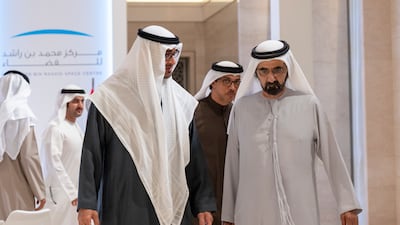
President Sheikh Mohamed and Sheikh Mohammed bin Rashid attend the inauguration of the Gateway Lunar Space Station construction project at Qasr Al Watan. Photo: Abdulla Al Bedwawi /Presidential Court -
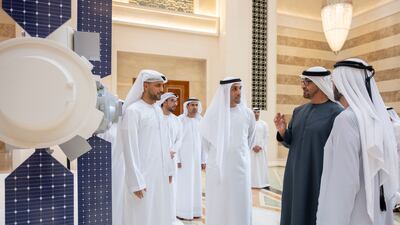
The President and Sheikh Mohammed speak to Salem Al Marri, director general of the Mohammed bin Rashid Space Centre. Photo: Abdulla Al Neyadi / Presidential Court -
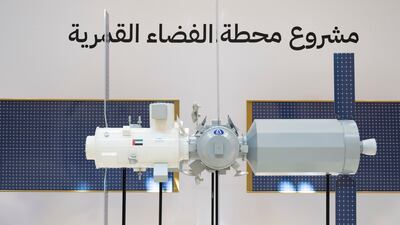
A model on display during the inauguration. Photo: Abdulla Al Bedwawi / Presidential Court -
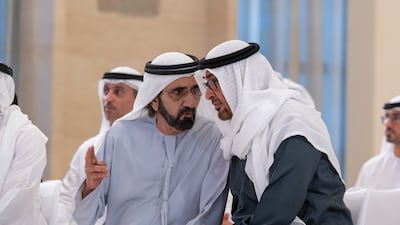
The President and Sheikh Mohammed pictured in discussion at the inauguration of the Gateway Lunar Space Station. Photo: Abdulla Al Bedwawi / Presidential Court -
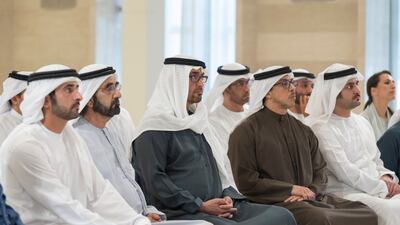
Sheikh Hamdan bin Mohammed, Crown Prince of Dubai, Sheikh Mohammed, President Sheikh Mohamed, Sheikh Mansour bin Zayed, Deputy Prime Minister and Minister of the Presidential Court, and Sheikh Maktoum bin Mohammed, First Deputy Ruler of Dubai and Minister of Finance, at the inauguration at Qasr Al Watan. Photo: Abdulla Al Neyadi / Presidential Court -
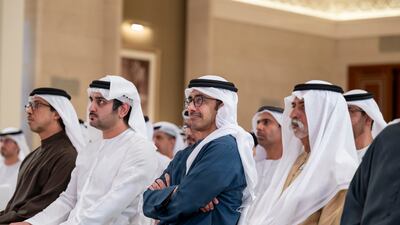
Sheikh Nahyan bin Mubarak, Minister of Tolerance and Coexistence, Sheikh Abdullah bin Zayed, Minister of Foreign Affairs, Sheikh Maktoum and Sheikh Mansour. Photo: Abdulla Al Bedwawi / Presidential Court -
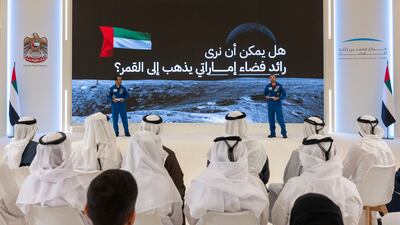
UAE astronauts and Hazza Al Mansoori, left, and Sultan Al Neyadi deliver a presentation at Qasr Al Watan. Photo: Abdulla Al Neyadi Presidential Court -
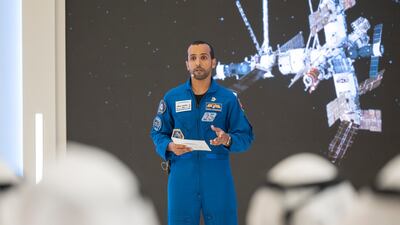
Hazza Al Mansoori. Photo: Abdulla Al Neyadi / Presidential Court -
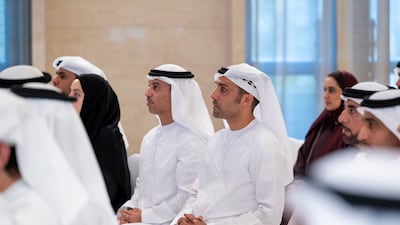
Mr Al Marri, Ahmad Al Falasi, Minister of Education, and other dignitaries. Photo: Abdulla Al Bedwawi / Presidential Court -
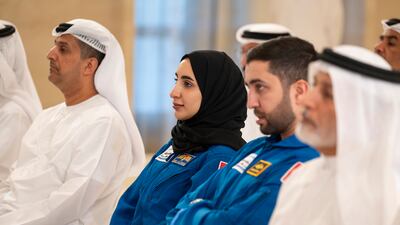
UAE Astronauts Noura Al Matrooshi and Mohamed Al Mulla were also in attendance at Qasr Al Watan. Photo: Abdulla Al Bedwawi / UAE Presidential Court -
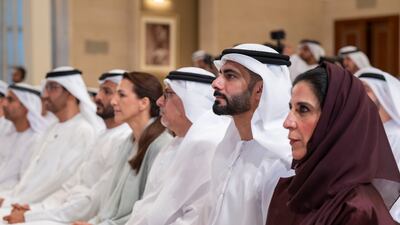
Salem Al Qassimi, Minister of Culture and Youth, Abdulrahman Al Awar, Minister of Human Resources and Emiratisation, and other ministers were also in attendance. Photo: Abdulla Al Bedwawi / Presidential Court -
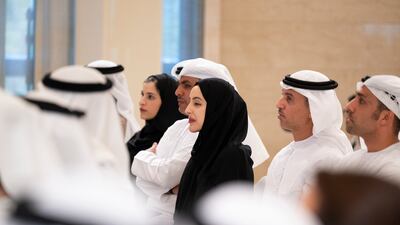
Shamma Al Mazrui, Minister of Community Development, and Mr Al Falasi among those listening to proceedings at Qasr Al Watan. Photo: Abdulla Al Bedwawi / Presidential Court -
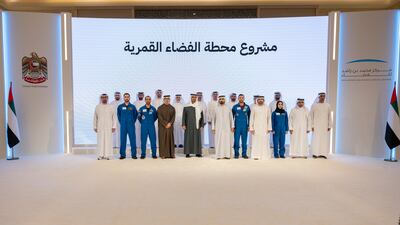
President Sheikh Mohamed, Sheikh Mohammed bin Rashid, Sheikh Mansour bin Zayed and Sheikh Hamdan bin Mohammed are joined by the four UAE astronauts and other members of the Mohammed bin Rashid Space Centre for a photograph. Photo: Abdulla Al Neyadi / Presidential Court


During the panel, experts discussed the need for industry-to-industry partnership in ensuring the Artemis programme is a success.
“My mission was a testament to what we achieve when we work together – I launched on an American spaceship, SpaceX Dragon,” Dr Al Neyadi told The National.
“I think we have a very busy time ahead of us, be it the astronauts' training for the specific missions or the engineering teams discussing with entities from the industry here in the US.”
Though collaboration is essential for the future of the Artemis missions, the “collective effort” of it is also one of its biggest problems.
“It's not just one little mission and that's it – it's a series of different missions,” Noora Alsaeed, senior space science researcher at the UAE Space Agency, told The National.
“It requires a sustained effort and that's [not just for the UAE and the US] – we're working hard on keeping up that energy.
“The private sector has a really pivotal role in providing that sustainable environment that is going to propel and make sure we follow through with these plans.”
She added that exploration of the Moon would allow scientists to better understand Earth's satellite and also provide a jumping-off point for future missions to Mars and the asteroid belt.
“We want to take exploration to the furthest possible point that humans can achieve and it's a step-by-step thing, so through our exploration of the Moon and having humans go back to the Moon, we can really hone in on the skills and the equipment needed for people to be able to survive even more challenging areas such as Mars.”

