


US President Joe Biden and Israel's Prime Minister Benjamin Netanyahu sparred publicly on the eve of Ramadan, with no ceasefire to the Israel-Gaza war on the horizon.
Mr Netanyahu on Sunday said Mr Biden was “wrong” that Israel's approach to the war in Gaza was self-defeating.
A day before, Mr Biden told a US news channel that while Israel has a right to defend itself, Mr Netanyahu has to do more to protect innocent civilians in Gaza.
The tense exchange comes as the prospects of a ceasefire before Ramadan, which begins on Monday, appear to be dim.
The Biden administration and allies in the region for weeks have been working on securing a six-week pause in the war by the start of the fasting month.
Mr Biden has also warned the Netanyahu government against an all-out offensive on the city of Rafah in southern Gaza, where about 1.4 million people are believed to be sheltering.
Mr Biden wants a six-week pause in war during which hostages held by Hamas can be released in exchange for Palestinian detainees held in Israeli prisoners.
The pause in fighting would also enable the entry of much-needed humanitarian aid.
Critics say Mr Biden, who is running for re-election in November, has not used the US's substantial influence – including billions of dollars in military aid – to force Israel to agree to a ceasefire and allow more relief into the enclave, and is instead going around Israel.
After months of US efforts to get Israel to allow sufficient and sustained aid into Gaza by land, on Sunday, an American ship set sail for Gaza as part of an international plan to deliver aid to the enclave by sea, a mission that will take weeks to complete.
And last week, the US began dropping food into the strip.
Martin Indyk, a former US ambassador to Israel, said that Mr Biden intends to adopt a tougher line with Mr Netanyahu, but is unlikely to cut or place conditions on military aid to Israel.
“[Biden] is intending to get tough with Netanyahu,” Mr Indyk said in a post on X. “An Israeli attack on Rafah is a red line.
“Bottom line: Unless Netanyahu changes course, a confrontation with Biden is coming.”
Illustrating the tension between the leaders, Mr Biden was recorded on Thursday saying that he told Mr Netanyahu that the two were headed for a “come to Jesus” conversation over the issue of humanitarian aid to Gaza
“I told him, Bibi, and don't repeat this, but you and I are going to have a 'come to Jesus' meeting,” Mr Biden said, using Mr Netanyahu's nickname.
He was having a conversation with Secretary of State Antony Blinken, Transport Secretary Pete Buttigieg and a Colorado Democratic senator after his State of the Union address.
“I'm on a hot mic here. Good. That's good,” Mr Biden said.
“Coming to Jesus” is an American expression that means having an honest, heart-to-heart conversation.
But Mr Biden appeared to be giving contradictory remarks on Saturday, calling Israel's threat to invade Rafah in southern Gaza a “red line”, but then backtracking.
“It was a red line but I'm never gonna leave Israel,” he said. “The defence of Israel is still critical. So there's no red line.”
The stakes are high for Mr Biden, whose support for Israel has earned him the nickname “Genocide Joe” among protesters, many of them his former supporters, daily taking to the streets and rallying outside his campaign events.
Some analysts say Mr Biden is contemplating a new manoeuvre, which involves distancing himself from Mr Netanyahu and his actions in Gaza, while continuing to support Israel in its stated goal of eradicating Hamas.
Khaled Elgindy a fellow in the Centre for Middle East Policy at Brookings and an expert on US-Israel relations, disagrees.
“This is just sophistry,” Mr Elgindy wrote on X.
“It is precisely the Netanyahu government – not the Israeli people or some abstraction called Israel – that Biden is supplying with unlimited weapons and unconditional support at the UN.”
Israel launched its punishing offensive on Gaza on October 7, the day Hamas gunmen attacked Israel, killing about 1,200 people, according to Israeli authorities.
Mr Biden immediately came out strongly in Israel's support. He made a wartime visit himself and bypassed Congress to pass two military weapons sales.
Officials in Gaza say more than 31,000 Palestinians, most of them women and children, have been killed, and the majority of the enclave's residents have been displaced to the south, where they lack access to food, water or medical care.
Israeli bombardments by land, air and sea have reduced entire neighbourhoods and critical infrastructure in Gaza to rubble.
And amid Israeli restrictions of the entry of aid by land through Israel or Egypt, the UN warned of an impending famine, and a worsening humanitarian crisis.
-
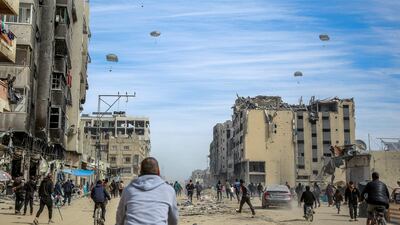
Palestinians rush to collect an aid air drop in Gaza city, amid reports that many people in the enclave face starvation after months of Israeli attacks. AFP -
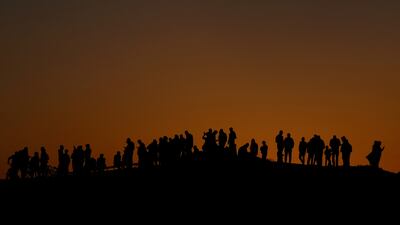
Displaced Palestinians try to get internet service on their phones in Rafah, southern Gaza. Reuters -

A room is cleared after the Jiangsu province delegation meeting at the National People's Congress at the Great Hall of the People in Beijing. AFP -
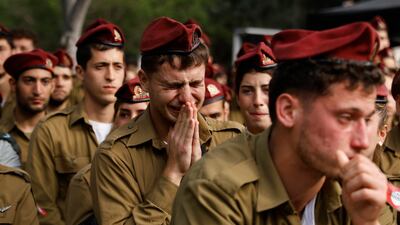
Israeli soldiers mourn Sgt David Sassoon at a funeral in Netanya. Sgt Sassoon was one of more than 245 Israeli troops killed in the Gaza war. Getty Images -

Inter Miami captain Lionel Messi argues with Anibal Godoy of Nashville SC during a Concacaf Champions Cup match in Nashville. Getty Images -
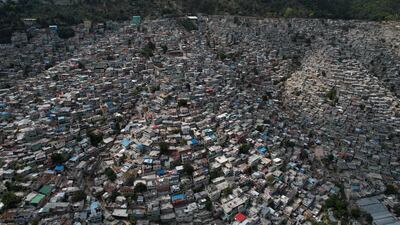
The state of emergency in Haiti capital Port-au-Prince has been extended until March 11 amid gang violence and calls for Prime Minister Ariel Henry to resign. AFP -
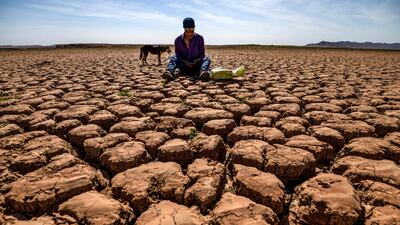
A shepherd on his mobile phone at Al Massira Dam in Ouled Essi Masseoud, about 140km south of Casablanca. AFP -

A bread delivery man in the al-Darb al-Ahmar district in the old quarter of Cairo. AFP -

Andres Cuervo, teacher and curator of the Ornithology collection of the Institute of Natural Sciences, works with Eutoxeres species at the research laboratory of the National University in Bogota. AFP -

A Moroccan traditional bath, known as a hammam, in Rabat. Climate change and droughts have forced Morocco's famous public baths to close a few days a week. AP -

A technician scans an old newspaper at the National Archives Conservation and Restoration Centre in Abu Dhabi. Pawan Singh / The National -

Palestinian skateboarder Aram Sabbah at the World Skateboarding Tour. Dubai Harbour, Dubai. Chris Whiteoak / The National -

A model presents a teddy-bear-themed creation by Swiss fashion house Vetements at Paris Fashion Week. AFP -

An activist from animal rights group Peta protests in front of Victoria Beckham at her show at the Paris Fashion Week, over her use of animal products. Reuters -

Mount Fuji, Japan's highest peak at 3,776m, viewed from the window of a flight from Tokyo to Hong Kong, above Shizuoka Prefecture. AFP -
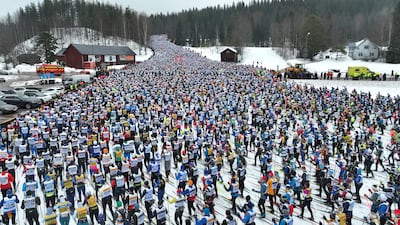
Cross-country skiing in Salen, Sweden, the start of the 100th Vasaloppet, the world's biggest race in the discipline. Reuters -
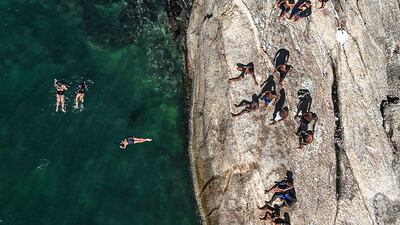
Jumping from a rock at Piratininga beach in Niteroi, Brazil. EPA -
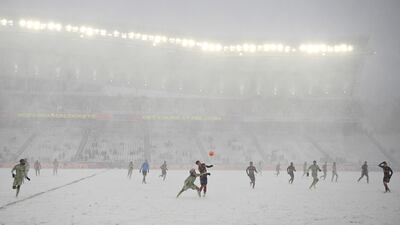
Real Salt Lake on their way to a 3-0 win over LAFC in the snow at America First Field in Sandy, Utah. Reuters -
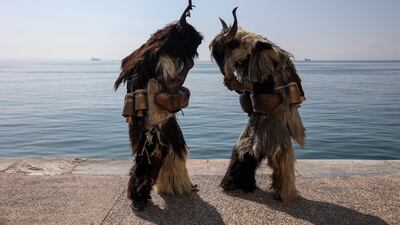
Participants during the sixth European Festival of Bell-bearing traditions in Thessaloniki, Greece. Reuters -
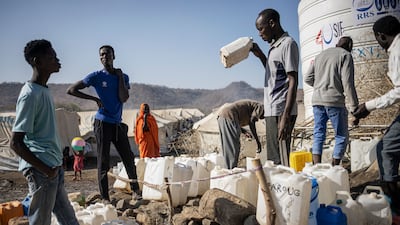
Sudanese refugees wait in line to collect water at Kumer refugee camp in Ethiopia's Amhara region. Refugees face conflict and insecurity as the border region of Amhara is plagued by unrest and clashes in which the Ethiopian army is battling an ethnic Amhara militia known as Fano. AFP -
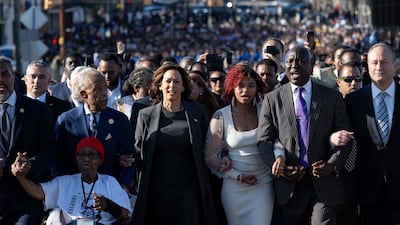
US Vice President Kamala Harris, second from left, her husband Doug Emhoff, right, civil rights laywer Ben Crump, second right, and Rev Al Sharpton, second left, join a march across the Edmund Pettus Bridge during a commemoration of the 59th anniversary of Bloody Sunday in Selma, Alabama. AFP -
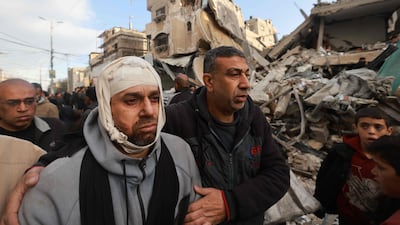
Wounded Palestinian Nidal Al Gharib, who lost his wife and daughter, walks past houses in his community destroyed by an Israeli bombardment in Rafah in the southern Gaza Strip. AFP -

The Northern Lights illuminate the sky above F-35B Lightning jets on the flight deck of the Royal Navy's HMS Prince of Wales, off the coast of Norway. AP -
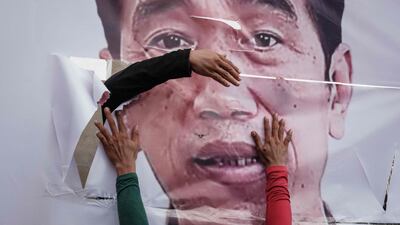
Counter-protesters in Jakarta fix a ripped banner of Indonesia's President Joko Widodo as demonstrators demanded his impeachment, the rejection of the general election results and the removal of members of the General Election Commission. AFP -

Models present creations at Chanel's ready-to-wear autumn-winter 2024/2025 show at Paris Fashion Week. AFP -
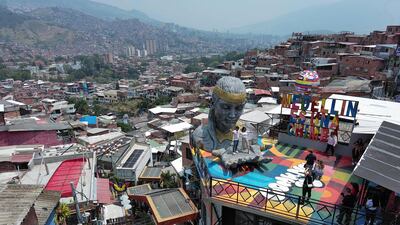
Tourists at the Pachamama sculpture, which pays homage to the city of Medellin, Colombia. AFP -
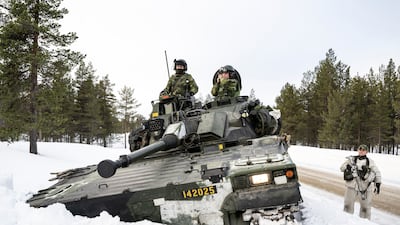
Swedish soldiers join Finnish hunting units in Hetta, northern Finland, for an exercise that is part of the Nordic Response. EPA -

US presidential hopeful Donald Trump arrives at a Super Tuesday election night event at Mar-a-Lago in Palm Beach, Florida. AFP -
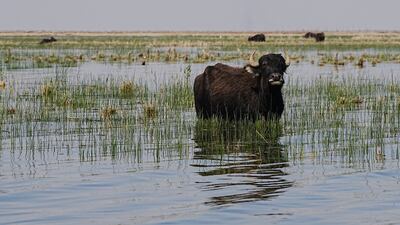
A buffalo in Iraq's central Mesopotamian marshes, where water levels have risen thanks to good rainfall after a long drought. AFP -
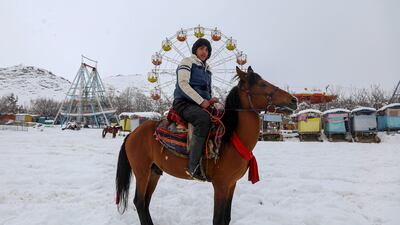
An Afghan horseman in Kabul. EPA



