

Live updates: Follow the latest news on Israel-Gaza
Israeli war cabinet member Benny Gantz met Vice President Kamala Harris on Monday as the US tries to rein in the bombardment of the Gaza Strip.
Mr Gantz, a retired general and former defence minister, is a long-time rival of Prime Minister Benjamin Netanyahu and is seen as a possible replacement to the far-right leader.
The leader of the centrist National Unity Party reportedly infuriated Mr Netanyahu with his visit to Washington this week.
While Mr Gantz was quick to join the war cabinet after the October 7 attack by Hamas against Israel, the trip may point to friction in the fragile unity coalition.
Opinion polls in Israel have him well ahead of Mr Netanyahu, who has become increasingly unpopular as the war has dragged on, and who has been blamed for some of the security failings on October 7.
“There is also a rivalry,” Gerald Steinberg, a professor of political science at Bar Ilan University, told The National.
“There's competition between them and it's clear that as Israeli politics returns to some form of normality over the next few months, we could see Gantz departing the government and an election.”
US Vice President calls for immediate six-week ceasefire in Gaza – video
Mr Steinberg stressed that while the war cabinet is showing signs of strain, he did not believe a collapse was imminent as the war remains the government’s priority.
“There is no visible daylight between their policies in pursuing the war and they very frequently support each other's positions,” he said.
The White House defended the meeting between Ms Harris and Mr Gantz, saying it was a chance to highlight Washington's increased interest in expanding humanitarian assistance.
“A member of the war cabinet from Israel wants to come to United States, wants to talk to us about the progress of that war, giving us an opportunity to talk about the importance of getting humanitarian assistance, increased opportunity to talk about the importance of this hostage deal,” said White House National Security spokesman John Kirby.
“We’re not going to turn away that sort of opportunity.”
In the meeting, Ms Harris “expressed her deep concern about the humanitarian conditions in Gaza and the recent horrific tragedy around an aid convoy in northern Gaza”, the White House said.
She “urged Israel to take additional measures in co-operation with the United States and international partners to increase the flow of humanitarian assistance into Gaza and ensure its safe distribution to those in need”.
Mr Gantz is also expected to meet White House National Security Adviser Jake Sullivan and Secretary of State Antony Blinken on Tuesday.
His meeting with Ms Harris comes a day after she called for an “immediate ceasefire”, the strongest call yet by a US official since Israel launched its war on Gaza.
More than 30,500 people have been killed in the densely populated enclave in nearly five months of fighting, according to the Hamas-run Health Ministry in Gaza.
The US, along with Egypt and Qatar, has been trying to broker a deal that would lead to Hamas releasing the rest of the hostages it seized on October 7 in exchange for a six-week pause in fighting.
“Given the immense scale of suffering in Gaza, there must be an immediate ceasefire for at least the next six weeks, which is what is currently on the table,” Ms Harris said.
“This will get the hostages out and get a significant amount of aid in.”
On Saturday, the US dropped dozens of food pallets over the Gaza Strip in an effort to get much-needed humanitarian aid into the besieged strip.
The US, which had been reluctant to conduct such a mission before, was compelled to act after 115 Palestinians were killed and more than 700 wounded when they tried to retrieve aid off of a lorry.
Washington is trying to get a ceasefire deal in place before the start of Ramadan, which is expected to begin around March 10.
Latest from the Israel-Gaza war – in pictures
-
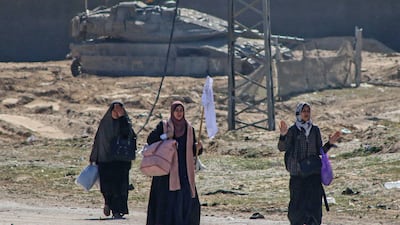
Displaced Palestinians hold a white flag as they pass an Israeli tank position while fleeing the Hamad Town district of Khan Younis. Bloomberg -
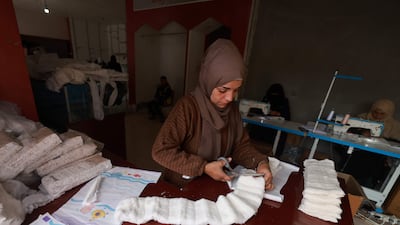
A Palestinian woman cuts material to be used for sewing nappies at a workshop in Rafah. AFP -
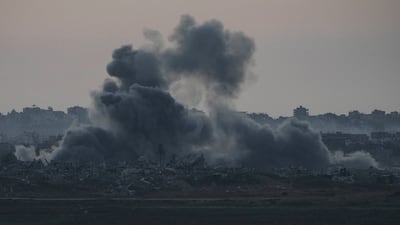
Smoke rises following an explosion in Gaza, as seen from southern Israel. AP -

Parachutes carrying relief for Palestinians drop from an Egyptian Air Force cargo plane over central Gaza. Bloomberg -
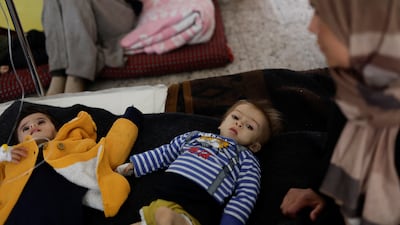
A Palestinian boy who is suffering from malnutrition is treated at a healthcare centre amid widespread hunger. Reuters -
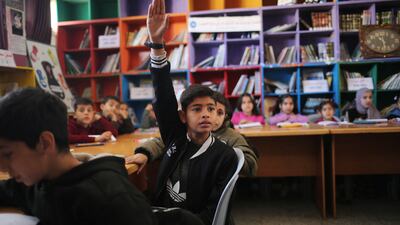
Palestinian children attend an English class in the library of the school housing displaced people in Rafah, the southern Gaza Strip. AFP -
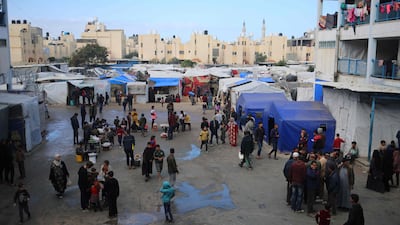
An UNRWA-run school housing displaced Palestinians in Rafah. AFP -
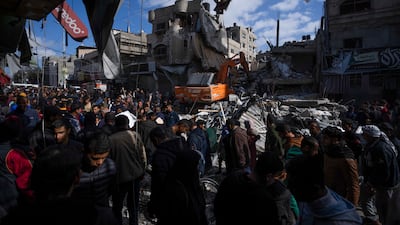
Palestinians search for bodies and survivors in the rubble of a residential building destroyed in an Israeli air strike in Rafah. AP -
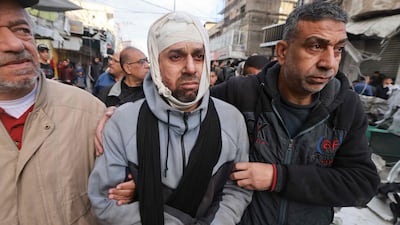
A wounded Palestinian man who lost his wife and daughter walks past a neighbours' house destroyed by Israeli bombing in Rafah. AFP -

An injured man is rescued from the rubble after an Israeli air strike on the Rafah camp in Gaza. EPA -
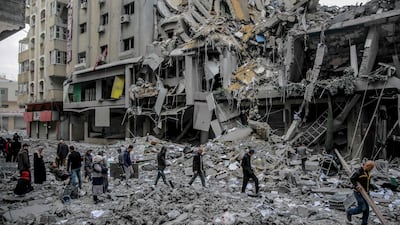
Palestinians walk amid the rubble of houses destroyed by the Israeli bombardment of Gaza city. AFP -

Aid is dropped into Gaza from US military aircraft. Reuters -

Palestinians gather at air lorries in Gaza. More than 100 were killed when Israeli troops opened fire. AP -

The sun sets behind destroyed buildings in Gaza. AFP -

A Palestinian man enters a heavily damaged house following an Israeli strike in Rafah, in the southern Gaza Strip. AFP -

A wounded Palestinian is assisted at the site of an Israeli strike in Deir Al Balah, in the central Gaza Strip. Reuters -
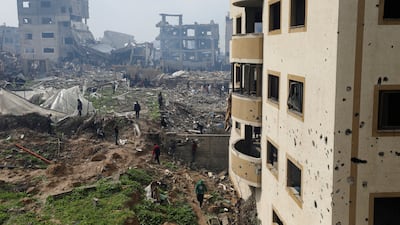
Palestinians gather in the hope of getting bags of flour carried by air lorries near an Israeli checkpoint in Gaza city, as the enclave's residents face crisis levels of hunger. Reuters -

Palestinian children wait to receive food cooked by a charity kitchen as the conflict between Israel and Hamas continues in Gaza. Reuters -

A displaced Palestinian child holds a crying baby in a camp in Rafah, in the southern Gaza Strip. Reuters



