Washington is “not letting up pressure” on combating Syria's role in the Captagon trade in the Middle East, despite escalating regional tension, the congressman leading the US drive against the drug has told The National.
Republican French Hill, who has spearheaded Captagon legislation in Washington, spoke to The National on Thursday after his Illicit Captagon Trafficking Suppression Act cleared a key hurdle in the House Foreign Affairs Committee with unanimous support.
The bill, co-sponsored by Democrat Jared Moskowitz, would impose new sanctions on people and networks associated with the production and trafficking of the drug.
“These things signal that the US is not letting up our pressure on [President Bashar Al Assad's] regime to come to the table to take a different approach in the situation in Syria, and I think it's important send that message to the region,” Mr Hill said.
It received support from the committee's senior Democrat Gregory Meeks after including language allowing for humanitarian waivers on new sanctions.
He said President Joe Biden's administration has “taken steps to improve” Washington's co-ordination with its partners on Captagon, but “much more can be done”.
“The bipartisan amendment ensures legitimate humanitarian work can continue, while making sure that these additional sanctions are targeted and effective,” Mr Meeks told the committee at the bill's mark-up hearing this week.
Mr Hill said: “Using the best open source intelligence that's been released … we've identified key actors in the Lebanese and Syrian region that we believe are easily and well-documentedly responsible for the Captagon trade.”
Maher Al Assad, brother of the Syrian President and leader of an elite brigade in the Syrian military, is among those to be designated under the legislation.
Previously, Mr Hill sponsored the Captagon Act, which mandates that the State Department, the Pentagon and other federal agencies devise a strategy against narcotics production and trafficking networks linked to the Assad regime.
The congressman said this new legislation is “a good step” in boosting US efforts “assisting of the region in eradicating Captagon”.
“It also sends the signal that we are committed to keeping the pressure on the Assad regime … and also providing a major voice that one of the goals that the Arab League stated that they were attempting to achieve through their normalisation process with Assad,” he added.
Arab countries allowed Damascus back into the Arab League in May after a 12-year absence in hopes of addressing Syria's refugee crisis engaging with the Assad regime to curb the Captagon trade.
Mr Hill said this new legislation “has a diplomatic, important contribution to the Arab League's efforts to also put pressure on the Assad regime for policy and major changes that they want to see the Assad regime accomplish”.
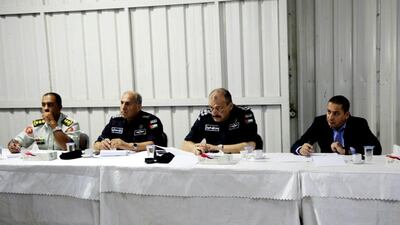
Jordanian authorities destroy 12.5 million Captagon pills – in pictures
Seven tips from Emirates NBD
1. Never respond to e-mails, calls or messages asking for account, card or internet banking details
2. Never store a card PIN (personal identification number) in your mobile or in your wallet
3. Ensure online shopping websites are secure and verified before providing card details
4. Change passwords periodically as a precautionary measure
5. Never share authentication data such as passwords, card PINs and OTPs (one-time passwords) with third parties
6. Track bank notifications regarding transaction discrepancies
7. Report lost or stolen debit and credit cards immediately
ESSENTIALS
The flights
Fly Etihad or Emirates from the UAE to Moscow from 2,763 return per person return including taxes.
Where to stay
Trips on the Golden Eagle Trans-Siberian cost from US$16,995 (Dh62,414) per person, based on two sharing.
Ten tax points to be aware of in 2026
1. Domestic VAT refund amendments: request your refund within five years
If a business does not apply for the refund on time, they lose their credit.
2. E-invoicing in the UAE
Businesses should continue preparing for the implementation of e-invoicing in the UAE, with 2026 a preparation and transition period ahead of phased mandatory adoption.
3. More tax audits
Tax authorities are increasingly using data already available across multiple filings to identify audit risks.
4. More beneficial VAT and excise tax penalty regime
Tax disputes are expected to become more frequent and more structured, with clearer administrative objection and appeal processes. The UAE has adopted a new penalty regime for VAT and excise disputes, which now mirrors the penalty regime for corporate tax.
5. Greater emphasis on statutory audit
There is a greater need for the accuracy of financial statements. The International Financial Reporting Standards standards need to be strictly adhered to and, as a result, the quality of the audits will need to increase.
6. Further transfer pricing enforcement
Transfer pricing enforcement, which refers to the practice of establishing prices for internal transactions between related entities, is expected to broaden in scope. The UAE will shortly open the possibility to negotiate advance pricing agreements, or essentially rulings for transfer pricing purposes.
7. Limited time periods for audits
Recent amendments also introduce a default five-year limitation period for tax audits and assessments, subject to specific statutory exceptions. While the standard audit and assessment period is five years, this may be extended to up to 15 years in cases involving fraud or tax evasion.
8. Pillar 2 implementation
Many multinational groups will begin to feel the practical effect of the Domestic Minimum Top-Up Tax (DMTT), the UAE's implementation of the OECD’s global minimum tax under Pillar 2. While the rules apply for financial years starting on or after January 1, 2025, it is 2026 that marks the transition to an operational phase.
9. Reduced compliance obligations for imported goods and services
Businesses that apply the reverse-charge mechanism for VAT purposes in the UAE may benefit from reduced compliance obligations.
10. Substance and CbC reporting focus
Tax authorities are expected to continue strengthening the enforcement of economic substance and Country-by-Country (CbC) reporting frameworks. In the UAE, these regimes are increasingly being used as risk-assessment tools, providing tax authorities with a comprehensive view of multinational groups’ global footprints and enabling them to assess whether profits are aligned with real economic activity.
Contributed by Thomas Vanhee and Hend Rashwan, Aurifer
'Worse than a prison sentence'
Marie Byrne, a counsellor who volunteers at the UAE government's mental health crisis helpline, said the ordeal the crew had been through would take time to overcome.
“It was worse than a prison sentence, where at least someone can deal with a set amount of time incarcerated," she said.
“They were living in perpetual mystery as to how their futures would pan out, and what that would be.
“Because of coronavirus, the world is very different now to the one they left, that will also have an impact.
“It will not fully register until they are on dry land. Some have not seen their young children grow up while others will have to rebuild relationships.
“It will be a challenge mentally, and to find other work to support their families as they have been out of circulation for so long. Hopefully they will get the care they need when they get home.”
Our family matters legal consultant
Name: Hassan Mohsen Elhais
Position: legal consultant with Al Rowaad Advocates and Legal Consultants.