


Live updates: Follow the latest news on Israel-Gaza
The Pentagon on Tuesday faced pressure over its policy of supplying arms to the Israel army without any conditions or monitoring.
The US is sending weapons to its ally as it conducts retaliatory strikes in the Gaza Strip against Hamas, which attacked Israel on October 7 and killed about 1,400 people.
But the Pentagon is not monitoring when or where the Israeli army uses the weapons, or setting any conditions for them, raising the possibility that US bombs are being used in Israeli strikes that kill civilians.
“We did not put preconditions on Israel when it came to providing security assistance,” Pentagon spokeswoman Sabrina Singh said as she faced questions on the Israeli army's use of US weapons.
“We feel that Israel, and democracies like Israel and [the US], should follow the law of war and will follow the law of war in protecting innocent civilians.”
Gaza health officials say about 3,000 people have been killed in the Palestinian enclave since October 7.
On Tuesday, as many as 500 people were killed in a strike at Al Ahli Arab Hospital in the Gaza Strip.
Hamas and several Arab countries said Israel had attacked the hospital, while the Israeli military blamed a failed rocket launch by the Palestinian Islamic Jihad militant group.
“I don’t know who was responsible,” Ms Singh said. “As we learn more, that will inform conversations."
The Pentagon and the State Department are often required to monitor weapons shipped overseas to ensure they are being used responsibly and with minimum risk to civilians.
But the situation for Israel as it strikes Gaza is different, because the US considers its campaign against Hamas self-defence.
“They have a right to defend themselves,” White House National Security spokesman John Kirby said.
"They have a right to go after this terrorist threat. And we're going to continue to do everything we can to help them do that."
The US has sent interceptors for Israel's Iron Dome missile defence system, and artillery rounds and small-diameter bombs used to blast bunkers and other structures.
It was not immediately known what US weaponry the Israeli military had used as they level neighbourhoods and conduct what are known as “shaping operations”, to prepare the terrain for an expected ground incursion that could lead to protracted street-to-street fighting.
“While it’s unclear whether any US weapons have been directly used by Israeli security forces for human rights violations in Gaza, given the types of weapons and attacks Israel security forces have recently used and the large amount of civilian casualties, there is a strong likelihood that US weapons could be used in such violations,” Amnesty International said in a statement.
The rights group called on Israel to use the “least intrusive” weapons possible in striking Hamas, noting that the military had used a one-tonne bomb on a home to kill one member of Hamas.
The Gaza Strip is one of the most densely populated parts of the world.
Ms Singh said that as of Tuesday, the Pentagon has sent five C-17 cargo plans filled with US military equipment to Israel.
“You're seeing almost near daily deliveries into Israel and I would expect that those are going to continue to flow,” Ms Singh said.
A US State Department official told The National that governments receiving US military aid are responsible for complying with conditions of arms transfers and obligations under international law, including those relating to human rights.
President Joe Biden and Secretary of State Antony Blinken “have made it clear that we believe democracies are stronger, more secure, more successful when they act according to rule of law, including law of war during military operations,” the official said.
The latest from the Israel-Gaza war – in pictures
-

Israel's Iron Dome air defence system fires a missile above Ashkelon to intercept a rocket fired from Gaza. AP -
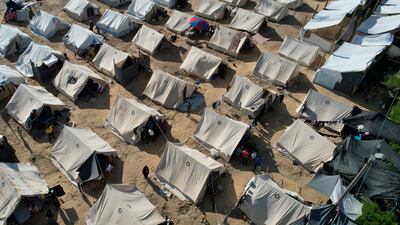
Tents provided by the UN – to house Palestinians displaced by the Israeli bombardment of Gaza – dot the landscape in Khan Younis. AP -
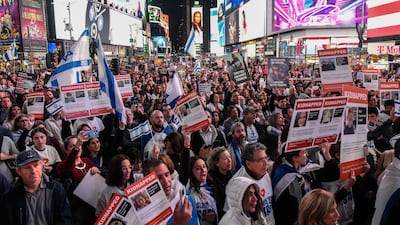
Protesters call for the release of hostages held by Hamas during a demonstration in the Times Square district of New York. Bloomberg -
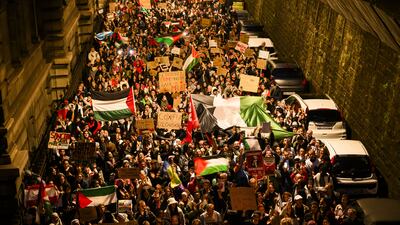
Protesters hold placards and Palestinian flags during a rally in support of Palestinians, in Lausanne, Switzerland. EPA -
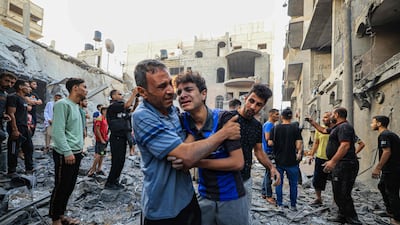
Palestinian civil defence members search for survivors after an Israeli bombardment in Khan Yunis, southern Gaza Strip. AFP -
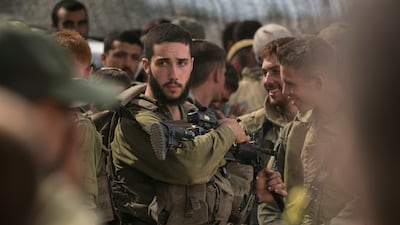
Israeli soldiers wait for a meeting with Israeli Minister of Defence Yoav Gallant in Sderot. Getty Images -
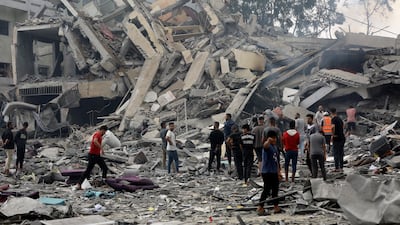
Palestinians inspect the damage of a destroyed building following Israeli air strikes on Gaza city. AP -
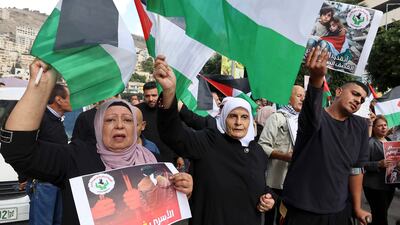
People shout slogans and wave flags during a protest in support of Palestinians, in the occupied West Bank. AFP -
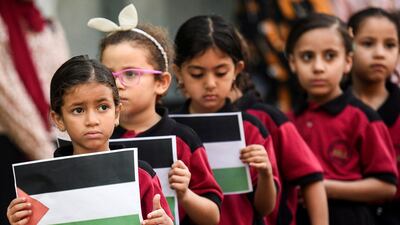
Pupils stand to mourn Palestinian children killed in Gaza, in Cairo, Egypt. Reuters -
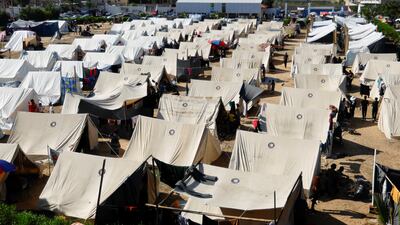
Palestinians, who fled their houses amid Israeli strikes, in a tent camp in Khan Younis, southern Gaza Strip. Reuters -
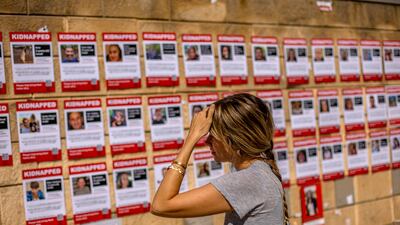
Pictures of hostages held in Gaza by Hamas militants, outside the Israeli military base of The Kirya, Tel Aviv. EPA -
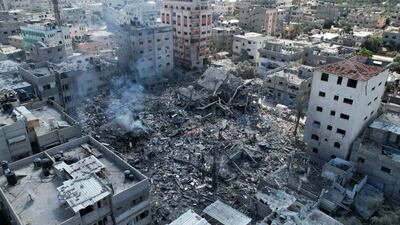
Buildings destroyed by Israeli air strikes on Bureij refugee camp in the Gaza Strip. AP -
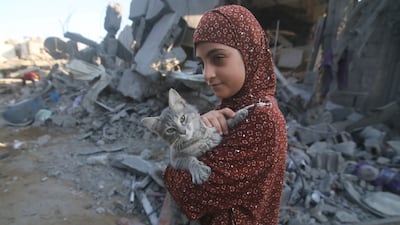
A Palestinian girl rescues her cat from the rubble of destroyed buildings after Israeli air strikes in Rafah. AP -
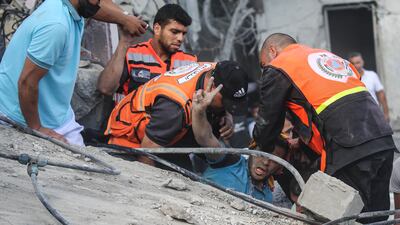
Palestinian emergency services search for victims in buildings destroyed during Israeli raids in Khan Younis. Getty Images -
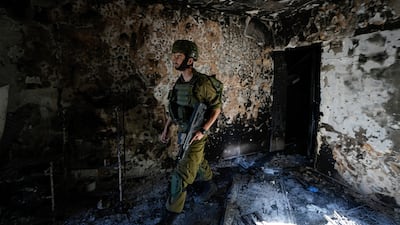
An Israeli soldier inspects a house damaged by Hamas militants in Kibbutz Kfar Azza, Israel. AP -
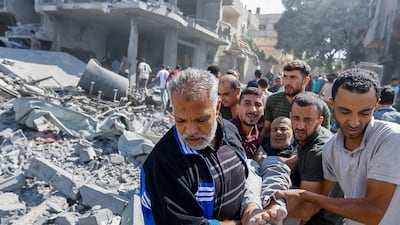
Palestinians carry a wounded man following Israeli strikes in Rafah, southern Gaza Strip. Reuters -
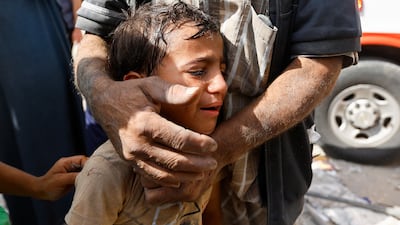
A Palestinian boy cries following Israeli strikes on houses in Rafah. Reuters -
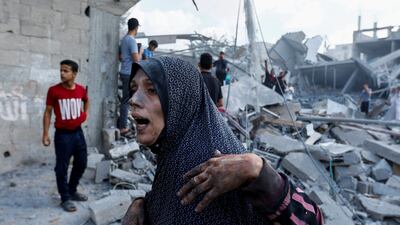
A Palestinian woman surveys the damage following Israeli strikes in Rafah. Reuters -

A baby is fed amid the war, while those with dual citizenship await for permission to leave Gaza. Reuters -
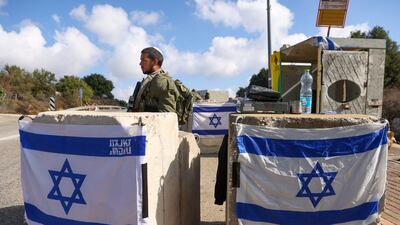
An Israeli soldier mans a checkpoint near the northern Kibbutz of Sasa, close to the border with Lebanon. AFP -
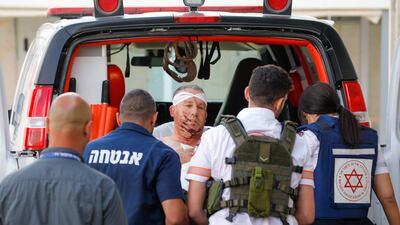
An Israeli, wounded in cross-border shelling between Hezbollah and Israel, at the Ziv Medical Centre in Safed. AFP -
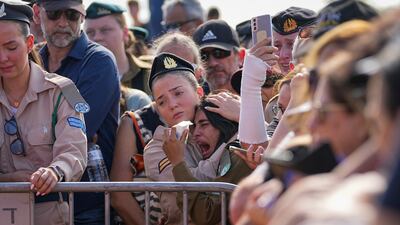
Mourners attend a funeral in Gan Yavne, Israel. AP -
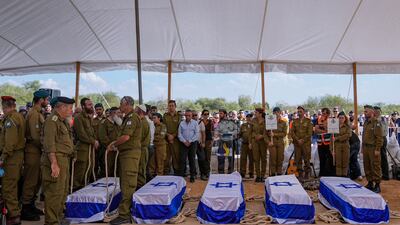
Mourners gather around the five coffins of the Kotz family during their funeral in Gan Yavne. AP -
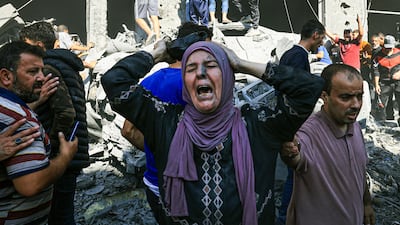
A Palestinian woman looks for victims in the rubble of a building following an Israeli strike in Khan Younis. AFP -
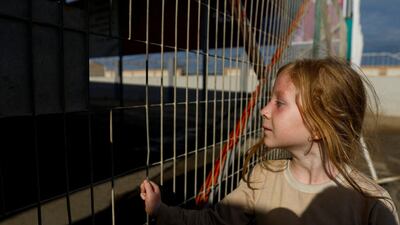
A Palestinian with dual citizenship waits outside the Rafah crossing with Egypt. Reuters -
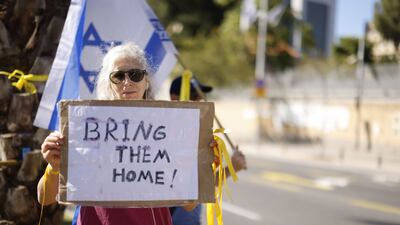
A woman holds a sign demanding the release of Israelis kidnapped by Hamas militants. Bloomberg -

Keren Shelf holds up a picture of her daughter, Israeli-French citizen Mia Shem, held hostage by Hamas. EPA



