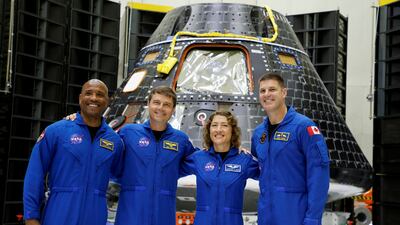
Nasa's Artemis 3 mission, set to return humans to the Moon in 2025, might not involve a crewed landing after all, an official said on Tuesday.
Jim Free, the space agency's associate administrator for the Exploration Systems Development Mission Directorate, told reporters in a briefing that certain key elements would have to be in place – notably the landing system that is being developed by SpaceX.
Should that not be ready on time, “we may end up flying a different mission”, he said.
Under the Artemis programme, Nasa is planning a series of missions of escalating complexity to return to the Moon and build a sustained presence to develop and test technologies for an eventual journey to Mars.
The first, Artemis 1, flew an uncrewed spacecraft around the Moon in 2022. Artemis 2, planned for November 2024, will do the same with crew on board.
But it is during the Artemis 3 mission planned for December 2025 that Nasa has planned its grand return to the Moon with humans for the first time since 1972, this time on the lunar south pole, where the ice can be harvested and turned into rocket fuel.
Elon Musk's SpaceX has won the contract for a landing system based on a version of its prototype Starship rocket, which remains far from ready. An orbital test flight of Starship ended in an explosion in April.
Mr Free said Nasa officials had visited SpaceX's Starbase facility in Texas a few weeks ago to “learn where they are with the hardware, trying to understand their schedule some more”.
Though he found the visit insightful, he said he remained concerned “because they haven't launched” and will need to do so several times before the rocket will be ready.
What's more, delays to Starship have knock-on effects because the spacesuit contractor needs to know how the suits will interface with the spacecraft, and simulators need to be built for astronauts to learn its systems.
He added that Nasa will update the public in the near future once it has had time to “digest” the information gathered during the Starbase visit.
James Webb space images - in pictures
-
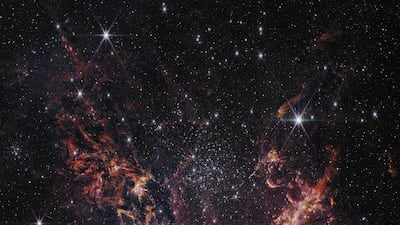
A cluster of stars in the Small Magellanic Cloud in an image taken by the James Webb Space Telescope. PA -
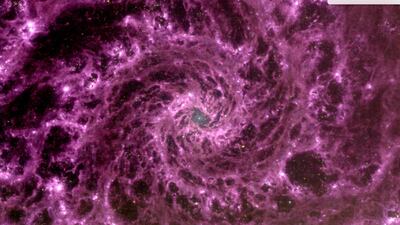
A colour composite image of the Messier 74 galaxy. Photo: Gabriel Brammer (Cosmic Dawn Center, Niels Bohr Institute, University of Copenhagen) / James Webb Space Telescope -
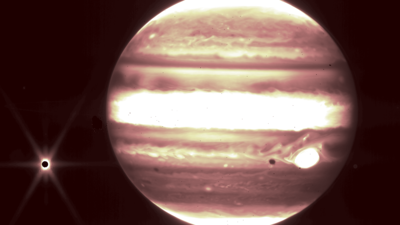
Jupiter and its moon Europa, left, are seen through the James Webb Space Telescope. Photo: Nasa -
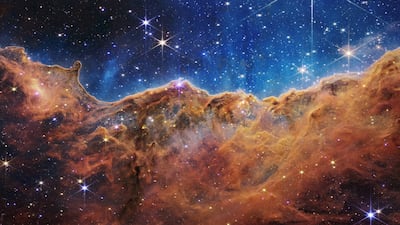
Captured in infrared light by Nasa's new James Webb Space Telescope, this image reveals areas of star birth in Carina Nebula. All photos: James Webb Space Telescope -

Known as Webb's First Deep Field, the picture showcases a galaxy cluster called SMACS 0723 as it appeared 4.6 billion years ago. The image was revealed by US President Joe Biden on July 11 during an event at the White House. -
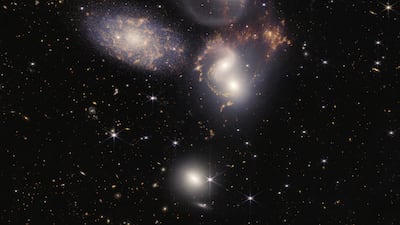
An image of Stephan's Quintet, an area in space with a group of five galaxies. -
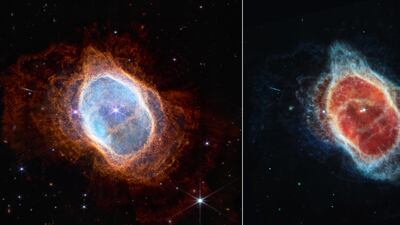
Side-by-side comparison shows observations of the Southern Ring Nebula in near-infrared light (left) and mid-infrared light. -

The telescope has captured the distinct signature of water, along with evidence for clouds and haze, in the atmosphere surrounding a hot, puffy gas giant planet orbiting a distant Sun-like star, called WASP-96 b. Photo: James Webb Space Telescope