Colin Powell holds up a vial to illustrate Saddam Hussein’s alleged use of anthrax. AFP

Revisiting Colin Powell's UN address that led to war in Iraq


Adla Massoud
  • English
  • Arabic

Twenty years ago, Colin Powell caught the world’s attention during an emergency session of the UN Security Council.

As George W Bush's secretary of state, he delivered an address that would go down in history as a prelude to the US invasion of Iraq in 2003.

The war ultimately lasted nine years, claiming hundreds of thousands lives, leaving the country lawless and opening the way for Iran to aggressively pursue regional hegemony.

Congress had already authorised Mr Bush to “use any means necessary” against Iraq.

Taking his seat on the horseshoe table in front of his UN counterparts, he assured the council chamber that “every statement” he would make was “backed up by solid sources”.

“Iraq had already been found guilty of material breach of its obligations, stretching back over 16 previous resolutions and 12 years,” said Mr Powell, a retired four-star general, as he laid out “evidence” of Baghdad's failures to comply with several UN resolutions demanding co-operation with weapons inspectors.

Satellite images, audio recordings and illustrations of supposed weapons of mass destruction (WMDs) were displayed to prove that Iraqi officials were purposely evading their obligations and hiding arms.

Mr Powell even held up a tiny vial of white powder to illustrate Saddam Hussein’s alleged use of anthrax.

He argued that Washington believed, without a doubt that Hussein, a grave and imminent security threat to the US and the world, was developing nuclear, biological and chemical weapons.

Mr Powell died in 2020 due to complications from Covid-19 after cancer treatment.

After the First Gulf War, which broke out in April 1991, the Security Council passed Resolution 687, which banned Iraq from possessing WMDs. In accordance with that resolution, International Atomic Energy Agency inspectors destroyed Iraq’s nuclear, chemical and biological weapons programme.

UN weapons inspectors repeatedly checked suspected plants in Iraq and had cameras installed to monitor activity at those sites.

Despite widespread scepticism, the US and its allies were able to use Mr Powell's arguments to secure the support of key Security Council members, including Britain.

Mr Powell's former chief of staff, Lawrence Wilkerson, told The National that he had been selected to address the UN because he was the “only member of the [Bush] administration the American people would believe” and that the general “had poll ratings … barely a point or two below Mother Teresa”.

In the lead-up to the now infamous speech, Mr Powell was “sceptical”.

“They exploited him,” said Mr Wilkerson.

Mr Powell would tell his chief of staff that the October 2002 National Intelligence Estimate — the highest-level document produced by intelligence agencies — had informed his UN speech, which officials had assured him was “solid”.

On the eve of the US-led attack in 2003 ordered by Mr Bush, UN inspectors had still not found any chemical or biological weapons by the time they were forced to leave the country.

Evidence of any active WMD programmes were nowhere to be found.

“We didn't think he [Saddam Hussein] was ever going to shed himself of the effort to build WMD. We just didn't know that he didn't have any at that present time,” said Mr Wilkerson.

The “solid intelligence” that Mr Powell had cited proved illusory and was allegedly based on unsubstantiated reports from Iraqi exiles, such as the Iraqi National Congress, a secular opposition group led by Ahmad Chalabi.

Mr Chalabi had gained the trust of senior officials in the Bush administration and convinced them of the necessity of destroying Hussein's Baathist regime.

“We [the US State Department] wanted the United States government to get rid of him but president Bush wouldn't allow it. [Vice president Dick] Cheney wouldn't allow it. They were feeding the Bush administration what they wanted to be fed. Intelligence shaped the policy that took us into war with Iraq,” said Mr Wilkerson.

The invasion of Iraq in 2003 marked a significant shift in the way the international community viewed the use of force and set a dangerous moral precedent that continues to affect global politics to this day.

The UN Charter, which was signed in 1945, established the principle of non-interference in the internal affairs of sovereign states, and explicitly prohibited the use of force except in self-defence or with the authorisation of the Security Council.

“They did enormous damage to US credibility at the UN and that legacy still lingers on 20 years later,” Richard Gowan, UN Director at the International Crisis Group, told The National.

“The Bush administration's decision to go to war with Iraq without explicit UN authorisation demonstrated the inability of the Security Council to constrain the major powers,” said Mr Gowan. “And the council has never entirely recovered from this display of weakness.”

It was “the greatest strategic disaster created by America in the 21st century”, Mr Wilkerson said.

“We should have never been a part of it,” he added.

Mr Powell would later regret making the case for the 2003 invasion.

The UN speech, he wrote in his 2012 memoir It Worked for Me, “was by no means my first, but it was one of my most momentous failures, the one with the widest-ranging impact”.

“The event will earn a prominent paragraph in my obituary,” he added.

“To this day, Iran's influence outside its own borders is vastly more than it would have been had Saddam Hussein been still in Iraq. So that's the first huge error and repercussion of the war,” said Mr Wilkerson.

Hussein encouraged the perception that Iraq had WMDs because he was afraid of appearing weak in Iran's eyes and wanted to maintain his ability to suppress large-scale domestic opposition to the regime, noted Mr Wilkerson.

“That was a shrewd but really deep error by Saddam because I think he really didn't want to come clean in a way that would have kept us from entering the country with the military, because if he came totally clean, he would be admitting to Iran and to his own people that he didn't have these vicious weapons. And he didn't want to do that.”

Hans Blix, the chief UN weapons inspector in the lead-up to the 2003 invasion, wrote that after the terrorist attacks of September 11, 2001, the Bush administration felt a “need to let the weight and wrath of the world’s only superpower fall on more evil actors than just Afghanistan’s Taliban regime”.

“No target could have seemed more worthy of being crushed than Iraq’s brutal dictator, Saddam Hussein,” he said. “Sadly, however, the elimination of this tyrant was perhaps the only positive result of the war.”

America invaded Iraq in large part because of the Security Council’s attention, Benny Avni, an American journalist who covered the Security Council’s debate at the time for The New York Sun, told The National.

“The Bush administration's view was that America needed to project power to prevent a repeat of 9/11,” Avni said. “There were already numerous council resolutions on Iraq, which Saddam kept violating.

“That was why the Bush administration focused on WMDs.”

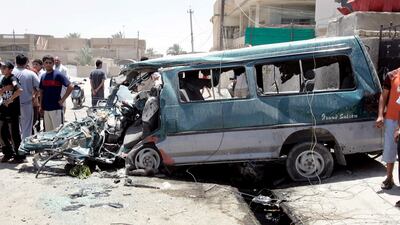
  • January 29, 2002: US President George Bush identifies Iraq, Iran and North Korea as part of an 'axis of evil' in his State of the Union address. 'States like these, and their terrorist allies, constitute an axis of evil, arming to threaten the peace of the world. By seeking weapons of mass destruction, these regimes pose a grave and growing danger,' he says. Getty
    January 29, 2002: US President George Bush identifies Iraq, Iran and North Korea as part of an 'axis of evil' in his State of the Union address. 'States like these, and their terrorist allies, constitute an axis of evil, arming to threaten the peace of the world. By seeking weapons of mass destruction, these regimes pose a grave and growing danger,' he says. Getty
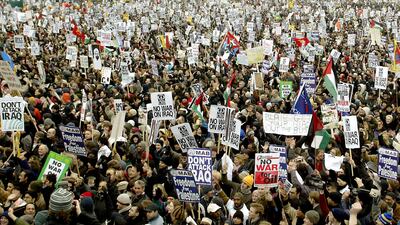
  • February 15, 2002: Thousands of people gather in Hyde Park in London after finishing a protest against war in Iraq. The march is believed to be the UK's biggest ever peace protest. Getty
    February 15, 2002: Thousands of people gather in Hyde Park in London after finishing a protest against war in Iraq. The march is believed to be the UK's biggest ever peace protest. Getty
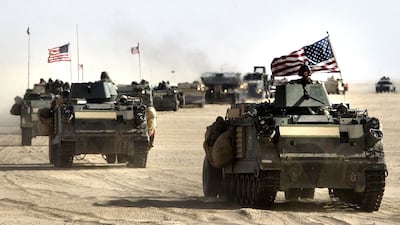
  • March 18, 2003: US and British forces move into position before a possible military strike near the Kuwait-Iraq border. A day prior, Mr Bush gave Iraqi President Saddam Hussein and his sons 48 hours to leave the country or face war. Getty
    March 18, 2003: US and British forces move into position before a possible military strike near the Kuwait-Iraq border. A day prior, Mr Bush gave Iraqi President Saddam Hussein and his sons 48 hours to leave the country or face war. Getty
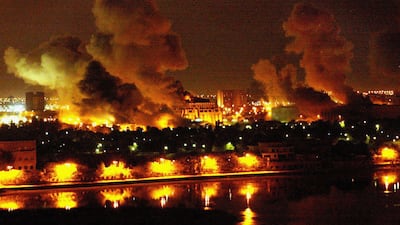
  • March 21, 2003: Fires burn in and around Saddam's Council of Ministers during the first wave of US-led coalition airstrikes on Iraq in Baghdad. 'These are the opening stages of what will be a broad and concerted campaign,' he says in an address. The attack begins with a massive air strike campaign named 'shock and awe'. Getty
    March 21, 2003: Fires burn in and around Saddam's Council of Ministers during the first wave of US-led coalition airstrikes on Iraq in Baghdad. 'These are the opening stages of what will be a broad and concerted campaign,' he says in an address. The attack begins with a massive air strike campaign named 'shock and awe'. Getty
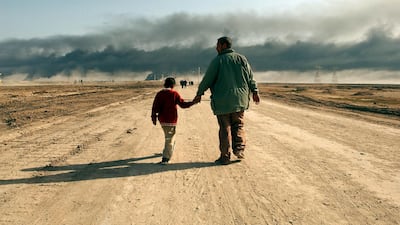
  • March 29, 2003: A man and child walk on a road near the entrance of the besieged city of Basra as oil fires burn in the distance. Baath Party loyalists take up positions in Basra, Iraq's second largest city, making it a target of the US-led war on Iraq. Getty
    March 29, 2003: A man and child walk on a road near the entrance of the besieged city of Basra as oil fires burn in the distance. Baath Party loyalists take up positions in Basra, Iraq's second largest city, making it a target of the US-led war on Iraq. Getty
  • April 9, 2003: Iraq’s capital, Baghdad, falls to US forces. Saddam’s regime loses control as American troops enter the city centre. On May 1, US President George W Bush prematurely declares the end of major combat in Iraq. Reuters
    April 9, 2003: Iraq’s capital, Baghdad, falls to US forces. Saddam’s regime loses control as American troops enter the city centre. On May 1, US President George W Bush prematurely declares the end of major combat in Iraq. Reuters
  • August 30, 2003: A burnt-out car is removed from outside Najaf’s Imam Ali Mosque, the holiest Shiite shrine in Iraq, a day after 87 people were killed in a car bomb attack. The attack raises sectarian tension as thousands of Iraqi Shiites, some of them backed by Iran, demand the right to form militias. Reuters
    August 30, 2003: A burnt-out car is removed from outside Najaf’s Imam Ali Mosque, the holiest Shiite shrine in Iraq, a day after 87 people were killed in a car bomb attack. The attack raises sectarian tension as thousands of Iraqi Shiites, some of them backed by Iran, demand the right to form militias. Reuters
  • December 13, 2003: Ousted president Saddam Hussein is found by US troops in a cellar south of Tikrit, near his hometown. 'Ladies and gentlemen, we got him,' says US ambassador Paul Bremer, who was appointed to lead the Coalition Provisional Authority. AFP
    December 13, 2003: Ousted president Saddam Hussein is found by US troops in a cellar south of Tikrit, near his hometown. 'Ladies and gentlemen, we got him,' says US ambassador Paul Bremer, who was appointed to lead the Coalition Provisional Authority. AFP
  • March 31, 2004: A car burns in the aftermath of an insurgent attack on Fallujah, in which four Blackwater private security contractors were killed and their mutilated, burnt bodies were left hanging from a bridge. Reuters
    March 31, 2004: A car burns in the aftermath of an insurgent attack on Fallujah, in which four Blackwater private security contractors were killed and their mutilated, burnt bodies were left hanging from a bridge. Reuters
  • May 3, 2004: Coffins of US military personnel killed in Iraq are prepared to be offloaded at Dover Air Force Base in Delaware. Days later, Al Qaeda beheaded US businessman Nicholas Berg and recorded his killing. Reuters
    May 3, 2004: Coffins of US military personnel killed in Iraq are prepared to be offloaded at Dover Air Force Base in Delaware. Days later, Al Qaeda beheaded US businessman Nicholas Berg and recorded his killing. Reuters
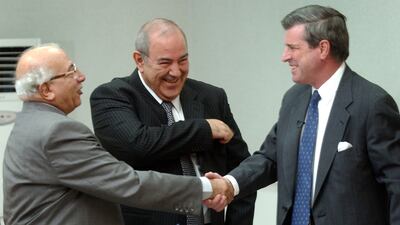
  • June 28, 2004: US administrator in Iraq Paul Bremer (R), Iraqi Prime Minister Ayad Allawi (C) and the country's most senior judge Midhat Mahmoud (L) smile as the US transfers sovereignty to Iraq in Baghdad. Mr Allawi calls the event 'a historic day' and says that Iraq was 'capable of controlling the security situation'. Reuters
    June 28, 2004: US administrator in Iraq Paul Bremer (R), Iraqi Prime Minister Ayad Allawi (C) and the country's most senior judge Midhat Mahmoud (L) smile as the US transfers sovereignty to Iraq in Baghdad. Mr Allawi calls the event 'a historic day' and says that Iraq was 'capable of controlling the security situation'. Reuters
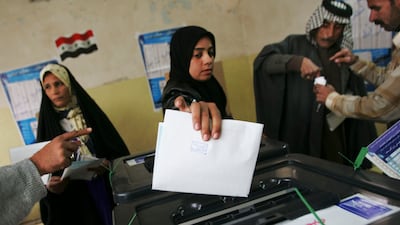
  • January 30, 2005: Iraqis vote in the first parliamentary elections of the post-Saddam era. Sunnis largely boycott the vote, while most Shiite parties coalesce into a sectarian bloc, cementing divisions within the country. Getty
    January 30, 2005: Iraqis vote in the first parliamentary elections of the post-Saddam era. Sunnis largely boycott the vote, while most Shiite parties coalesce into a sectarian bloc, cementing divisions within the country. Getty
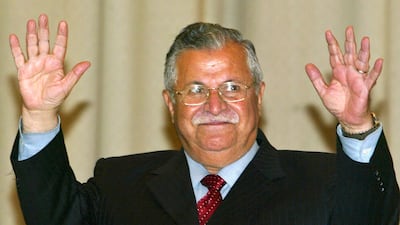
  • April 7, 2005: Veteran Kurdish leader Jalal Talabani raises his hands after being sworn in as Iraq's first democratically elected president. Later that month, Shiite Islamist Ibrahim Al Jaafari takes office as prime minister, hailing from the exiled Dawa Party. Getty
    April 7, 2005: Veteran Kurdish leader Jalal Talabani raises his hands after being sworn in as Iraq's first democratically elected president. Later that month, Shiite Islamist Ibrahim Al Jaafari takes office as prime minister, hailing from the exiled Dawa Party. Getty
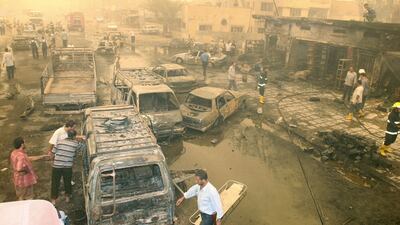
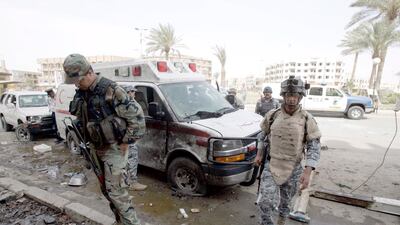
  • July 24, 2005: Burnt-out vehicles at the scene of a lorry bombing outside a police station that killed 22 people in south-east Baghdad. The explosion also injured 25 people, destroyed 22 cars and 10 shops. AFP
    July 24, 2005: Burnt-out vehicles at the scene of a lorry bombing outside a police station that killed 22 people in south-east Baghdad. The explosion also injured 25 people, destroyed 22 cars and 10 shops. AFP
  • October 19, 2005: Saddam’s trial begins. Prosecutors focus on a massacre in the village of Dujail, 100 kilometres north of Baghdad, where about 150 people, including children, were killed following an assassination attempt against the former dictator. Many other charges relate to a genocidal campaign against Kurds during the 1980s, during which Saddam ordered a chemical attack on the town of Halabja, killing up to 5,000 people. Getty
    October 19, 2005: Saddam’s trial begins. Prosecutors focus on a massacre in the village of Dujail, 100 kilometres north of Baghdad, where about 150 people, including children, were killed following an assassination attempt against the former dictator. Many other charges relate to a genocidal campaign against Kurds during the 1980s, during which Saddam ordered a chemical attack on the town of Halabja, killing up to 5,000 people. Getty
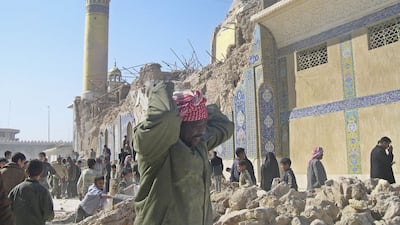
  • February 23, 2006: Iraqis clean up debris after an Al Qaeda bombing at Al Askariya holy Shiite shrine in Samarra, Iraq. Shiite police and militia members — in many cases indistinguishable — responded by rampaging through Sunni-majority areas, in an onslaught that coalition forces appeared powerless to halt. Getty
    February 23, 2006: Iraqis clean up debris after an Al Qaeda bombing at Al Askariya holy Shiite shrine in Samarra, Iraq. Shiite police and militia members — in many cases indistinguishable — responded by rampaging through Sunni-majority areas, in an onslaught that coalition forces appeared powerless to halt. Getty
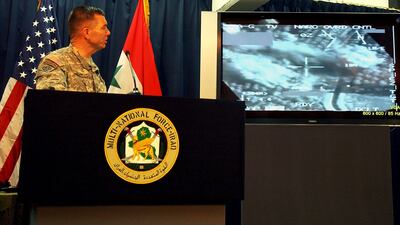
  • June 8, 2006: Maj Gen Bill Caldwell speaks during a press conference as satellite images are shown of a US air strike that killed the leader of Al Qaeda in Iraq, Abu Musab Al Zarqawi, in a joint US-Iraqi raid. Getty
    June 8, 2006: Maj Gen Bill Caldwell speaks during a press conference as satellite images are shown of a US air strike that killed the leader of Al Qaeda in Iraq, Abu Musab Al Zarqawi, in a joint US-Iraqi raid. Getty
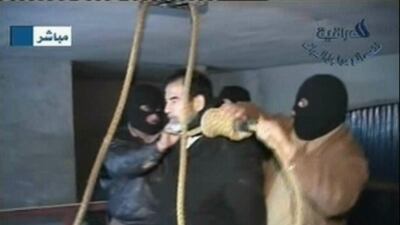
  • December 30, 2006: Saddam is executed by hanging. The execution and taunting of Saddam before his death is secretly filmed by a witness, stirring further tension within Iraq. Getty
    December 30, 2006: Saddam is executed by hanging. The execution and taunting of Saddam before his death is secretly filmed by a witness, stirring further tension within Iraq. Getty
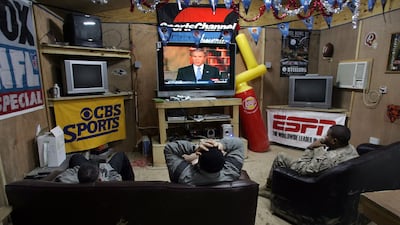
  • January 11, 2007: US officers watch Mr Bush's speech announcing that another 20,000 soldiers will be sent to Iraq, at Camp Ramadi in Iraq's violent Anbar province. The approach becomes known as the 'Surge,' and envisages a closer partnership between US and Iraqi forces and tribes, as well as American forces being stationed closer to Iraqi communities. Getty
    January 11, 2007: US officers watch Mr Bush's speech announcing that another 20,000 soldiers will be sent to Iraq, at Camp Ramadi in Iraq's violent Anbar province. The approach becomes known as the 'Surge,' and envisages a closer partnership between US and Iraqi forces and tribes, as well as American forces being stationed closer to Iraqi communities. Getty
  • July 12, 2007: Two Reuters photographers and five civilians are killed by a US Apache helicopter in Baghdad. US video footage of the incident would later be released by Wikileaks. EPA
    July 12, 2007: Two Reuters photographers and five civilians are killed by a US Apache helicopter in Baghdad. US video footage of the incident would later be released by Wikileaks. EPA
  • December 14, 2008: Mr Bush makes his final visit to Iraq to sign a co-operation agreement between Iraq and the US known as the Strategic Framework Agreement. At a press conference with Nouri Al Maliki, Munthadar Al Zaidi, a journalist, throws his shoes at Mr Bush. Mr Al Zaidi is severely beaten and jailed for six months. Reuters
    December 14, 2008: Mr Bush makes his final visit to Iraq to sign a co-operation agreement between Iraq and the US known as the Strategic Framework Agreement. At a press conference with Nouri Al Maliki, Munthadar Al Zaidi, a journalist, throws his shoes at Mr Bush. Mr Al Zaidi is severely beaten and jailed for six months. Reuters
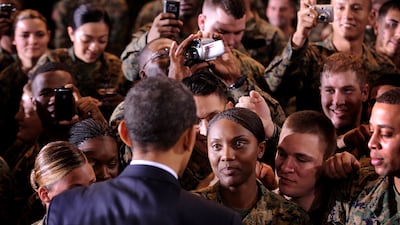
  • February 27, 2009: US President Barack Obama announces Washington’s decision to withdraw most American troops by August 31, 2010. Mr Obama says 50,000 troops will remain for smaller missions and to train Iraqi soldiers. EPA
    February 27, 2009: US President Barack Obama announces Washington’s decision to withdraw most American troops by August 31, 2010. Mr Obama says 50,000 troops will remain for smaller missions and to train Iraqi soldiers. EPA
  • April 23: At least 80 people are killed in three suicide bombings in Baghdad, making it the biggest daily death toll since early 2008. A woman standing in a group of other women and children receiving aid reportedly set off one of the bombs. EPA
    April 23: At least 80 people are killed in three suicide bombings in Baghdad, making it the biggest daily death toll since early 2008. A woman standing in a group of other women and children receiving aid reportedly set off one of the bombs. EPA
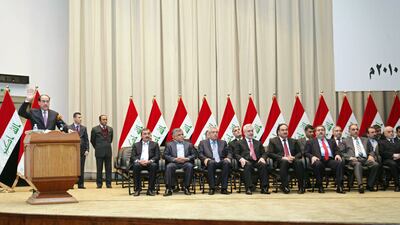
  • December 21, 2010: Iraqi Prime Minister Mr Al Maliki (L) and members of his newly formed cabinet attend a voting session at the Iraqi Parliament in Baghdad, Iraq. The new government was unanimously approved, ending nine months of deadlock. Getty
    December 21, 2010: Iraqi Prime Minister Mr Al Maliki (L) and members of his newly formed cabinet attend a voting session at the Iraqi Parliament in Baghdad, Iraq. The new government was unanimously approved, ending nine months of deadlock. Getty
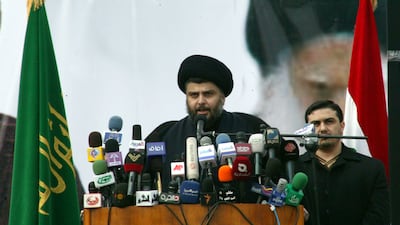
  • JANUARY 8, 2011: Populist Shiite cleric Moqtada Sadr returns to Iraq after four years of self-imposed exile in Iran. In his first public statement, he urges his followers to resist the 'occupiers' of Iraq. EPA
    JANUARY 8, 2011: Populist Shiite cleric Moqtada Sadr returns to Iraq after four years of self-imposed exile in Iran. In his first public statement, he urges his followers to resist the 'occupiers' of Iraq. EPA
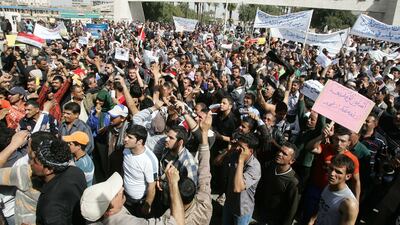
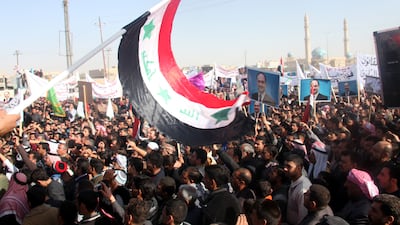
  • February 25, 2011: A 'day of rage' is declared as tens of thousands of Iraqis protest against Mr Al Maliki’s government. At least 23 people are killed and hundreds injured in a sign of Mr Al Maliki’s growing authoritarianism. Getty
    February 25, 2011: A 'day of rage' is declared as tens of thousands of Iraqis protest against Mr Al Maliki’s government. At least 23 people are killed and hundreds injured in a sign of Mr Al Maliki’s growing authoritarianism. Getty
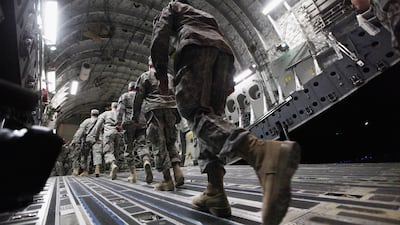
  • December 17, 2011: The last of the US Troop Brigade board a plane to depart Iraq at Camp Adder, now known as Imam Ali Base, near Nasiriyah, Iraq. Two days prior, the US military formally declared the end of the Iraq War in a ceremony in Baghdad. Getty
    December 17, 2011: The last of the US Troop Brigade board a plane to depart Iraq at Camp Adder, now known as Imam Ali Base, near Nasiriyah, Iraq. Two days prior, the US military formally declared the end of the Iraq War in a ceremony in Baghdad. Getty
  • December 23, 2012: Protests against harsh security crackdowns break out in Fallujah, Ramadi and Tikrit. Sunni protesters say men are being arbitrarily jailed without evidence while the government holds back pensions for former army officers. The demonstrations last until December 2013 when the Iraqi army tries to break up protest camps. EPA
    December 23, 2012: Protests against harsh security crackdowns break out in Fallujah, Ramadi and Tikrit. Sunni protesters say men are being arbitrarily jailed without evidence while the government holds back pensions for former army officers. The demonstrations last until December 2013 when the Iraqi army tries to break up protest camps. EPA
  • July 22, 2013: Mourners pray at the coffin of a victim killed during an attack on a prison in Taji, during a funeral at the Imam Ali shrine in Najaf. Reuters
    July 22, 2013: Mourners pray at the coffin of a victim killed during an attack on a prison in Taji, during a funeral at the Imam Ali shrine in Najaf. Reuters
  • December 22, 2013: Funeral proceedings for a major general of the Iraqi army’s 7th division in Anbar. The division's leadership were killed when a house they are raiding explodes after being rigged with bombs. The mixed Sunni-Shiite group is seen as one of the last non-sectarian units in the Iraqi army. Reuters
    December 22, 2013: Funeral proceedings for a major general of the Iraqi army’s 7th division in Anbar. The division's leadership were killed when a house they are raiding explodes after being rigged with bombs. The mixed Sunni-Shiite group is seen as one of the last non-sectarian units in the Iraqi army. Reuters
  • June 11, 2014: ISIS fighters stand guard at a checkpoint in the northern Iraqi city of Mosul. Days prior, the militants seized Iraq's second biggest city of Mosul as well as Tikrit, hometown of former dictator Saddam Hussein, and other towns and cities north of Baghdad. Reuters
    June 11, 2014: ISIS fighters stand guard at a checkpoint in the northern Iraqi city of Mosul. Days prior, the militants seized Iraq's second biggest city of Mosul as well as Tikrit, hometown of former dictator Saddam Hussein, and other towns and cities north of Baghdad. Reuters
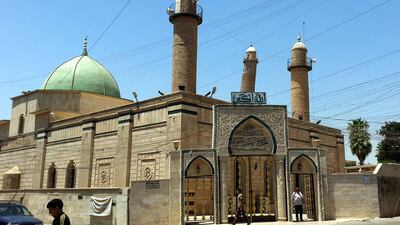
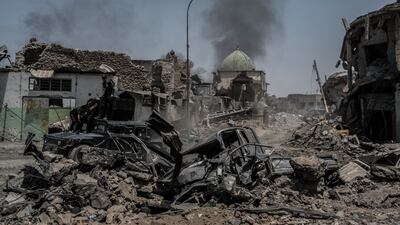
  • July 9, 2014: Al Nuri Mosque in Mosul before it was destroyed by ISIS militants during their retreat three years later. On June 29, Abu Bakr Al Baghdadi, leader of ISIS, appeared for the first time in public at the mosque to declare the caliphate. EPA
    July 9, 2014: Al Nuri Mosque in Mosul before it was destroyed by ISIS militants during their retreat three years later. On June 29, Abu Bakr Al Baghdadi, leader of ISIS, appeared for the first time in public at the mosque to declare the caliphate. EPA
  • October 18, 2014: Smoke rises over Syrian town of Kobani after an air strike. Three days prior, Washington launched a campaign called Operation Inherent Resolve. Over the next year, the US military conducts more than 8,000 air strikes in Iraq and Syria. Reuters
    October 18, 2014: Smoke rises over Syrian town of Kobani after an air strike. Three days prior, Washington launched a campaign called Operation Inherent Resolve. Over the next year, the US military conducts more than 8,000 air strikes in Iraq and Syria. Reuters
  • November 13, 2015: Kurdish forces seized Sinjar from ISIS after a prolonged siege, in the largest urban battle undertaken by the Kurdish Peshmerga. Getty
    November 13, 2015: Kurdish forces seized Sinjar from ISIS after a prolonged siege, in the largest urban battle undertaken by the Kurdish Peshmerga. Getty
  • October 16, 2006: Iraq launches US-backed campaign to liberate Mosul from ISIS. EPA
    October 16, 2006: Iraq launches US-backed campaign to liberate Mosul from ISIS. EPA
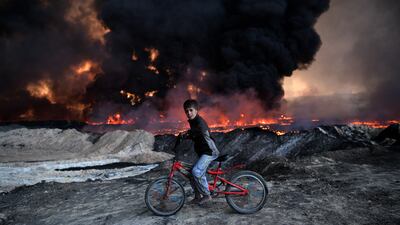
  • October 21, 2016: Fire at an oil field that was set on fire by retreating ISIS fighters before the Mosul offensive in Qayyarah, Iraq. Getty
    October 21, 2016: Fire at an oil field that was set on fire by retreating ISIS fighters before the Mosul offensive in Qayyarah, Iraq. Getty
  • July 2, 2017: While retreating from Mosul, ISIS destroys Al Nuri mosque. Iraqi forces encounter stiff resistance from ISIS with improvised explosive devices, car bombs, suicide bombers, heavy mortar fire and snipers hampering their advance. Getty
    July 2, 2017: While retreating from Mosul, ISIS destroys Al Nuri mosque. Iraqi forces encounter stiff resistance from ISIS with improvised explosive devices, car bombs, suicide bombers, heavy mortar fire and snipers hampering their advance. Getty
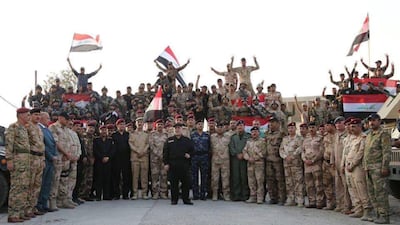
  • July 9, 2017: Iraqi Prime Minister Haider Al Abadi declares victory over ISIS in Mosul. In December, he declares full victory over ISIS. AFP
    July 9, 2017: Iraqi Prime Minister Haider Al Abadi declares victory over ISIS in Mosul. In December, he declares full victory over ISIS. AFP
Classification of skills

A worker is categorised as skilled by the MOHRE based on nine levels given in the International Standard Classification of Occupations (ISCO) issued by the International Labour Organisation. 

A skilled worker would be someone at a professional level (levels 1 – 5) which includes managers, professionals, technicians and associate professionals, clerical support workers, and service and sales workers.

The worker must also have an attested educational certificate higher than secondary or an equivalent certification, and earn a monthly salary of at least Dh4,000. 

Dust and sand storms compared

Sand storm

  • Particle size: Larger, heavier sand grains
  • Visibility: Often dramatic with thick "walls" of sand
  • Duration: Short-lived, typically localised
  • Travel distance: Limited 
  • Source: Open desert areas with strong winds

Dust storm

  • Particle size: Much finer, lightweight particles
  • Visibility: Hazy skies but less intense
  • Duration: Can linger for days
  • Travel distance: Long-range, up to thousands of kilometres
  • Source: Can be carried from distant regions
Avatar: Fire and Ash

Director: James Cameron

Starring: Sam Worthington, Sigourney Weaver, Zoe Saldana

Rating: 4.5/5

MATCH INFO

Kolkata Knight Riders 245/6 (20 ovs)
Kings XI Punjab 214/8 (20 ovs)

Kolkata won by 31 runs

Pros%20and%20cons%20of%20BNPL
%3Cp%3E%3Cstrong%3EPros%3C%2Fstrong%3E%0D%3C%2Fp%3E%0A%3Cul%3E%0A%3Cli%3EEasy%20to%20use%20and%20require%20less%20rigorous%20credit%20checks%20than%20traditional%20credit%20options%0D%3C%2Fli%3E%0A%3Cli%3EOffers%20the%20ability%20to%20spread%20the%20cost%20of%20purchases%20over%20time%2C%20often%20interest-free%0D%3C%2Fli%3E%0A%3Cli%3EConvenient%20and%20can%20be%20integrated%20directly%20into%20the%20checkout%20process%2C%20useful%20for%20online%20shopping%0D%3C%2Fli%3E%0A%3Cli%3EHelps%20facilitate%20cash%20flow%20planning%20when%20used%20wisely%0D%3C%2Fli%3E%0A%3C%2Ful%3E%0A%3Cp%3E%3Cstrong%3ECons%3C%2Fstrong%3E%3C%2Fp%3E%0A%3Cul%3E%0A%3Cli%3EThe%20ease%20of%20making%20purchases%20can%20lead%20to%20overspending%20and%20accumulation%20of%20debt%0D%3C%2Fli%3E%0A%3Cli%3EMissing%20payments%20can%20result%20in%20hefty%20fees%20and%2C%20in%20some%20cases%2C%20high%20interest%20rates%20after%20an%20initial%20interest-free%20period%0D%3C%2Fli%3E%0A%3Cli%3EFailure%20to%20make%20payments%20can%20impact%20credit%20score%20negatively%0D%3C%2Fli%3E%0A%3Cli%3ERefunds%20can%20be%20complicated%20and%20delayed%0D%3C%2Fli%3E%0A%3C%2Ful%3E%0A%3Cp%3E%3Cem%3ECourtesy%3A%20Carol%20Glynn%3C%2Fem%3E%3C%2Fp%3E%0A
ICC Awards for 2021

MEN

Cricketer of the Year – Shaheen Afridi (Pakistan)

T20 Cricketer of the Year – Mohammad Rizwan (Pakistan)

ODI Cricketer of the Year – Babar Azam (Pakistan)

Test Cricketer of the Year – Joe Root (England)

WOMEN

Cricketer of the Year – Smriti Mandhana (India)

ODI Cricketer of the Year – Lizelle Lee (South Africa)

T20 Cricketer of the Year – Tammy Beaumont (England)

T20 World Cup Qualifier fixtures

Tuesday, October 29

Qualifier one, 2.10pm – Netherlands v UAE

Qualifier two, 7.30pm – Namibia v Oman

Wednesday, October 30

Qualifier three, 2.10pm – Scotland v loser of qualifier one

Qualifier four, 7.30pm – Hong Kong v loser of qualifier two

Thursday, October 31

Fifth-place playoff, 2.10pm – winner of qualifier three v winner of qualifier four

Friday, November 1

Semi-final one, 2.10pm – Ireland v winner of qualifier one

Semi-final two, 7.30pm – PNG v winner of qualifier two

Saturday, November 2

Third-place playoff, 2.10pm

Final, 7.30pm

Museum of the Future in numbers
  •  78 metres is the height of the museum
  •  30,000 square metres is its total area
  •  17,000 square metres is the length of the stainless steel facade
  •  14 kilometres is the length of LED lights used on the facade
  •  1,024 individual pieces make up the exterior 
  •  7 floors in all, with one for administrative offices
  •  2,400 diagonally intersecting steel members frame the torus shape
  •  100 species of trees and plants dot the gardens
  •  Dh145 is the price of a ticket
Match statistics

Abu Dhabi Harlequins 36 Bahrain 32


Harlequins

Tries: Penalty 2, Stevenson, Teasdale, Semple

Cons: Stevenson 2

Pens: Stevenson


Bahrain

Tries: Wallace 2, Heath, Evans, Behan

Cons: Radley 2

Pen: Radley


Man of the match: Craig Nutt (Harlequins)

Dubai Creek Open in numbers
  • The Dubai Creek Open is the 10th tournament on this year's Mena Tour
  • It is the first of five events before the season-concluding Mena Tour Championship
  • This week's field comprises 120 players, 21 of which are amateurs
  • 15 previous Mena Tour winners are competing at Dubai Creek Golf and Yacht Club  
Sinopharm vaccine explained

The Sinopharm vaccine was created using techniques that have been around for decades. 

“This is an inactivated vaccine. Simply what it means is that the virus is taken, cultured and inactivated," said Dr Nawal Al Kaabi, chair of the UAE's National Covid-19 Clinical Management Committee.

"What is left is a skeleton of the virus so it looks like a virus, but it is not live."

This is then injected into the body.

"The body will recognise it and form antibodies but because it is inactive, we will need more than one dose. The body will not develop immunity with one dose," she said.

"You have to be exposed more than one time to what we call the antigen."

The vaccine should offer protection for at least months, but no one knows how long beyond that.

Dr Al Kaabi said early vaccine volunteers in China were given shots last spring and still have antibodies today.

“Since it is inactivated, it will not last forever," she said.

HOW TO WATCH

Facebook: TheNationalNews 

Twitter: @thenationalnews 

Instagram: @thenationalnews.com 

TikTok: @thenationalnews   

Muguruza's singles career in stats

WTA titles 3

Prize money US$11,128,219 (Dh40,873,133.82)

Wins / losses 293 / 149

Mercer, the investment consulting arm of US services company Marsh & McLennan, expects its wealth division to at least double its assets under management (AUM) in the Middle East as wealth in the region continues to grow despite economic headwinds, a company official said.

Mercer Wealth, which globally has $160 billion in AUM, plans to boost its AUM in the region to $2-$3bn in the next 2-3 years from the present $1bn, said Yasir AbuShaban, a Dubai-based principal with Mercer Wealth.

Within the next two to three years, we are looking at reaching $2 to $3 billion as a conservative estimate and we do see an opportunity to do so,” said Mr AbuShaban.

Mercer does not directly make investments, but allocates clients’ money they have discretion to, to professional asset managers. They also provide advice to clients.

“We have buying power. We can negotiate on their (client’s) behalf with asset managers to provide them lower fees than they otherwise would have to get on their own,” he added.

Mercer Wealth’s clients include sovereign wealth funds, family offices, and insurance companies among others.

From its office in Dubai, Mercer also looks after Africa, India and Turkey, where they also see opportunity for growth.

Wealth creation in Middle East and Africa (MEA) grew 8.5 per cent to $8.1 trillion last year from $7.5tn in 2015, higher than last year’s global average of 6 per cent and the second-highest growth in a region after Asia-Pacific which grew 9.9 per cent, according to consultancy Boston Consulting Group (BCG). In the region, where wealth grew just 1.9 per cent in 2015 compared with 2014, a pickup in oil prices has helped in wealth generation.

BCG is forecasting MEA wealth will rise to $12tn by 2021, growing at an annual average of 8 per cent.

Drivers of wealth generation in the region will be split evenly between new wealth creation and growth of performance of existing assets, according to BCG.

Another general trend in the region is clients’ looking for a comprehensive approach to investing, according to Mr AbuShaban.

“Institutional investors or some of the families are seeing a slowdown in the available capital they have to invest and in that sense they are looking at optimizing the way they manage their portfolios and making sure they are not investing haphazardly and different parts of their investment are working together,” said Mr AbuShaban.

Some clients also have a higher appetite for risk, given the low interest-rate environment that does not provide enough yield for some institutional investors. These clients are keen to invest in illiquid assets, such as private equity and infrastructure.

“What we have seen is a desire for higher returns in what has been a low-return environment specifically in various fixed income or bonds,” he said.

“In this environment, we have seen a de facto increase in the risk that clients are taking in things like illiquid investments, private equity investments, infrastructure and private debt, those kind of investments were higher illiquidity results in incrementally higher returns.”

The Abu Dhabi Investment Authority, one of the largest sovereign wealth funds, said in its 2016 report that has gradually increased its exposure in direct private equity and private credit transactions, mainly in Asian markets and especially in China and India. The authority’s private equity department focused on structured equities owing to “their defensive characteristics.”

The%20specs
%3Cp%3E%3Cstrong%3EEngine%3A%20%3C%2Fstrong%3E2.0-litre%20turbocharged%204-cyl%0D%3Cbr%3E%3Cstrong%3ETransmission%3A%20%3C%2Fstrong%3E8-speed%20auto%0D%3Cbr%3E%3Cstrong%3EPower%3A%20%3C%2Fstrong%3E300bhp%20(GT)%20330bhp%20(Modena)%0D%3Cbr%3E%3Cstrong%3ETorque%3A%20%3C%2Fstrong%3E450Nm%0D%3Cbr%3E%3Cstrong%3EPrice%3A%20%3C%2Fstrong%3EDh299%2C000%20(GT)%2C%20Dh369%2C000%20(Modena)%3Cbr%3E%3Cstrong%3EOn%20sale%3A%20%3C%2Fstrong%3Enow%3C%2Fp%3E%0A
PROFILE OF CURE.FIT

Started: July 2016

Founders: Mukesh Bansal and Ankit Nagori

Based: Bangalore, India

Sector: Health & wellness

Size: 500 employees

Investment: $250 million

Investors: Accel, Oaktree Capital (US); Chiratae Ventures, Epiq Capital, Innoven Capital, Kalaari Capital, Kotak Mahindra Bank, Piramal Group’s Anand Piramal, Pratithi Investment Trust, Ratan Tata (India); and Unilever Ventures (Unilever’s global venture capital arm)

Timeline

2012-2015

The company offers payments/bribes to win key contracts in the Middle East

May 2017

The UK SFO officially opens investigation into Petrofac’s use of agents, corruption, and potential bribery to secure contracts

September 2021

Petrofac pleads guilty to seven counts of failing to prevent bribery under the UK Bribery Act

October 2021

Court fines Petrofac £77 million for bribery. Former executive receives a two-year suspended sentence 

December 2024

Petrofac enters into comprehensive restructuring to strengthen the financial position of the group

May 2025

The High Court of England and Wales approves the company’s restructuring plan

July 2025

The Court of Appeal issues a judgment challenging parts of the restructuring plan

August 2025

Petrofac issues a business update to execute the restructuring and confirms it will appeal the Court of Appeal decision

October 2025

Petrofac loses a major TenneT offshore wind contract worth €13 billion. Holding company files for administration in the UK. Petrofac delisted from the London Stock Exchange

November 2025

180 Petrofac employees laid off in the UAE

THE SPECS

Engine: 3.5-litre supercharged V6

Power: 416hp at 7,000rpm

Torque: 410Nm at 3,500rpm

Transmission: 6-speed manual

Fuel consumption: 10.2 l/100km

Price: Dh375,000 

On sale: now 

Price, base / as tested From Dh173,775 (base model)
Engine 2.0-litre 4cyl turbo, AWD
Power 249hp at 5,500rpm
Torque 365Nm at 1,300-4,500rpm
Gearbox Nine-speed auto
Fuel economy, combined 7.9L/100km

GAC GS8 Specs

Engine: 2.0-litre 4cyl turbo

Power: 248hp at 5,200rpm

Torque: 400Nm at 1,750-4,000rpm

Transmission: 8-speed auto

Fuel consumption: 9.1L/100km

On sale: Now

Price: From Dh149,900

COMPANY%20PROFILE
%3Cp%3E%3Cstrong%3ECompany%20name%3A%3C%2Fstrong%3E%20The%20Cloud%3C%2Fp%3E%0A%3Cp%3E%3Cstrong%3EStarted%3A%3C%2Fstrong%3E%202018%3C%2Fp%3E%0A%3Cp%3E%3Cstrong%3EFounders%3A%3C%2Fstrong%3E%20George%20Karam%20and%20Kamil%20Rogalinski%3C%2Fp%3E%0A%3Cp%3E%3Cstrong%3EBased%3A%3C%2Fstrong%3E%20Hub71%2C%20Abu%20Dhabi%2C%20UAE%3C%2Fp%3E%0A%3Cp%3E%3Cstrong%3EIndustry%3A%3C%2Fstrong%3E%20Food%20technology%3C%2Fp%3E%0A%3Cp%3E%3Cstrong%3EFunding%20size%3A%3C%2Fstrong%3E%20%2410m%2B%3C%2Fp%3E%0A%3Cp%3E%3Cstrong%3EInvestors%3A%3C%2Fstrong%3E%20Middle%20East%20Venture%20Partners%2C%20Olayan%20Financing%2C%20Rua%20Growth%20Fund%3C%2Fp%3E%0A
Hurricanes 31-31 Lions

Wellington Hurricanes: 
Tries: Gibbins, Laumape, Goosen, Fifita tries, Barrett
Conversions: Barrett (4)
Penalties: Barrett

British & Irish Lions:
Tries: Seymour (2), North
Conversions: Biggar (2)
Penalties: Biggar (4)

Lexus LX700h specs

Engine: 3.4-litre twin-turbo V6 plus supplementary electric motor

Power: 464hp at 5,200rpm

Torque: 790Nm from 2,000-3,600rpm

Transmission: 10-speed auto

Fuel consumption: 11.7L/100km

On sale: Now

Price: From Dh590,000

Our legal consultant

Name: Dr Hassan Mohsen Elhais

Position: legal consultant with Al Rowaad Advocates and Legal Consultants.

UPI facts

More than 2.2 million Indian tourists arrived in UAE in 2023
More than 3.5 million Indians reside in UAE
Indian tourists can make purchases in UAE using rupee accounts in India through QR-code-based UPI real-time payment systems
Indian residents in UAE can use their non-resident NRO and NRE accounts held in Indian banks linked to a UAE mobile number for UPI transactions

Updated: March 16, 2023, 3:44 PM