


Amid reports that Iran has further enriched uranium, CIA Director William Burns says the country's nuclear programme is advancing at a "worrisome pace".
Although Iran was last known to have enriched uranium up to 60 per cent purity, recent news reports suggest International Atomic Energy Agency inspectors found uranium enriched to 84 per cent, which was strongly denied by Tehran.
Nuclear weapons-grade uranium is enriched to about 90 per cent purity.
Iran has "advanced very far to the point where it would only be a matter of weeks before they can enrich to 90 per cent, if they chose to cross that line", Mr Burns told CBS, calling the progress "quite troubling".
But he said the US did not believe Iran's supreme leader, Ayatollah Ali Khamenei, had decided to "resume the weaponisation programme that we judge that they suspended or stopped at the end of 2003".
Tehran has repeatedly insisted that it is not planning to build a nuclear bomb.
Iran's nuclear programme - in pictures
-
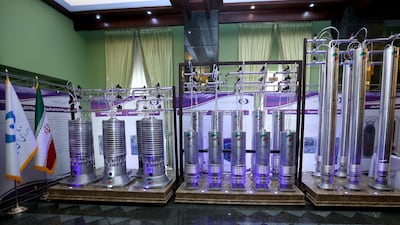
New generation Iranian centrifuges on display for Iran's National Nuclear Energy Day in Tehran, in April 2021. Iranian Presidency Office / Wana -

President Ebrahim Raisi, second right, is accompanied by Atomic Energy Organisation of Iran chief Mohammad Eslami, at Nuclear Technology Day in Tehran in April 2022. Iranian presidency / AFP -
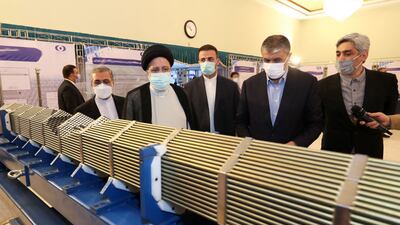
Mr Raisi and Mr Eslami at the April 2022 event. Iranian presidency / AFP -
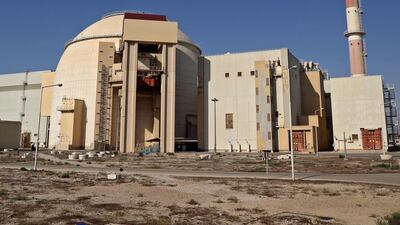
The Bushehr Nuclear Power Plant during a visit by Mr Raisi in October 2021. Iranian Presidency / AFP -
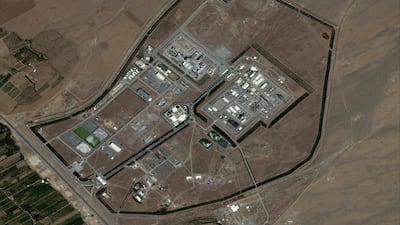
Iran's Arak Heavy Water Reactor complex, south of the capital Tehran in January 2020. Maxar Technologies / AFP -
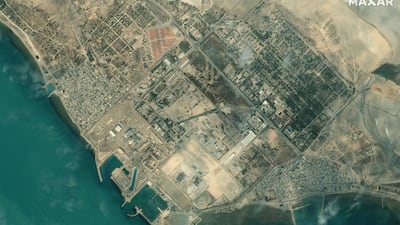
A satellite image of Iran's Bushehr Nuclear Power Plant in January 2020. Maxar Technologies / AFP -
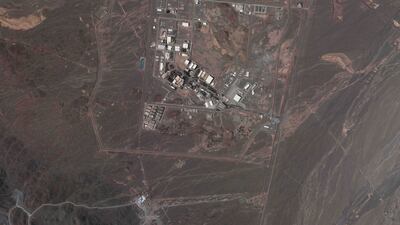
A satellite image of Iran's underground Natanz nuclear site in May 2022. Planet Labs PBC / AP -
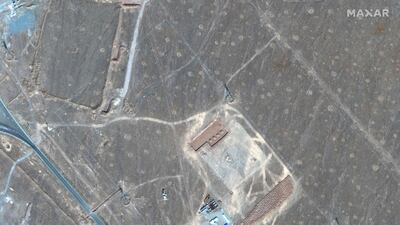
A satellite image in January 2020 of Iran's Fordow Fuel Enrichment Plant, north-east of the city of Qom. Maxar Technologies / AFP -
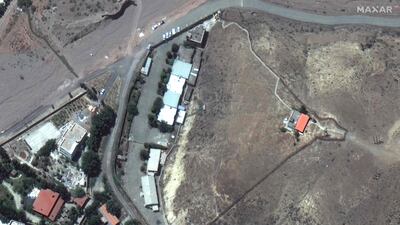
The Sanjarian nuclear centre, east of Tehran, in May 2021. Maxar Technologies / AFP


A nuclear agreement signed in 2015 between Tehran and global powers promised Iran sanctions relief in exchange for cutting back its nuclear programme.
But Iran started increasing its nuclear activity in 2019, a year after the US, under former president Donald Trump, pulled out of the landmark deal and reinstated sanctions.
Negotiations to revive the accord have stalled.
Mr Burns said Iran was "still a ways off … in terms of their ability to actually develop a weapon".
But he said advancements in enrichment and missile systems that would be able deliver a nuclear weapon were "growing at a worrisome pace".
Iran's nuclear sites - in pictures
-
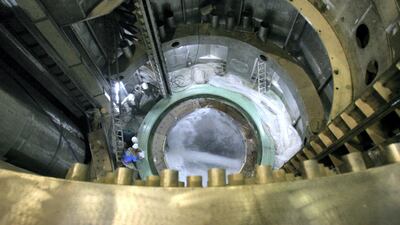
Russian contractors work at the Bushehr nuclear reactor site in 2007. The plant opened four years later. Bloomberg -
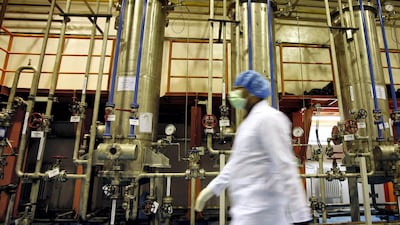
An Iranian technician at the International Atomic Energy Agency inspects the country's Isfahan plant in 2007. Tehran is no longer co-operating with the agency at nuclear sites across the country. EPA -

Workers wait to begin constructing a second reactor at the Bushehr nuclear power plant in 2019. AFP -
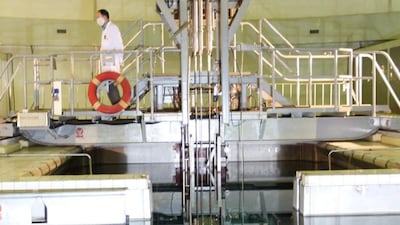
A metal-encased rod with 20 per cent enriched nuclear fuel is inserted into a reactor in Tehran in 2012. AFP -
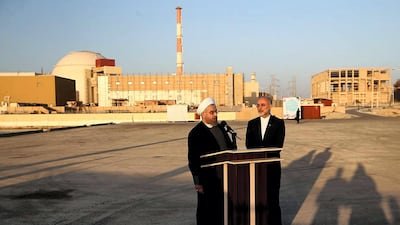
Fomer Iranian President Hassan Rouhani and the country's Atomic Energy Organisation chief Ali Akbar Salehi speak at the Bushehr nuclear site in 2015. AFP -
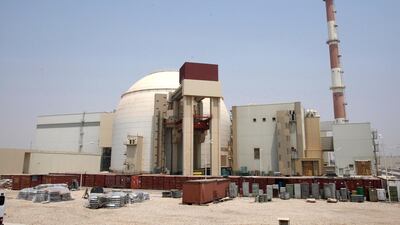
Iran's Bushehr nuclear plant has been restarted. EPA -
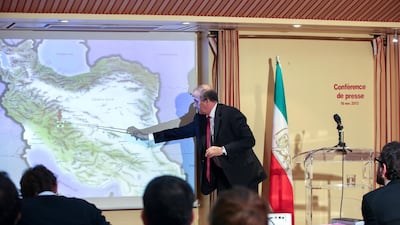
Mehdi Abrichamtchi, chairman of the Peace and Security Committee at the National Council of Resistance of Iran, shows journalists the location of a secret nuclear site in Iran in 2013. AFP -
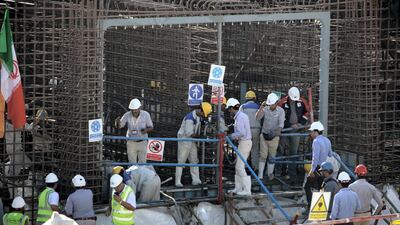
Workers prepare to begin the construction of a second reactor at the Bushehr site. AFP


Another point of concern is that Russia is proposing to help Iran's missile programme, Mr Burns said.
He said the US still believed that Moscow was also considering sending fighter jets to Iran.
Moscow and Tehran have expanded their military co-operation, with Iran shipping growing quantities of weaponry to Russia for use in the invasion of Ukraine.
Their co-operation is "moving at a pretty fast clip in a very dangerous direction", Mr Burns said.
"That creates obvious risks not only for the people of Ukraine — and we've seen the evidence of that already — but also risks to our friends and partners across the Middle East as well."

