

Former US first lady, Michelle Obama, said she detested being asked if she would run for president as she revealed her future plans in a BBC interview.
Mrs Obama, attorney, author and wife of former US President Barack Obama, spoke to the BBC to mark the release of her new book The Light We Carry.
The interviewer Naga Munchetty asked her: "Which question do you detest being asked?"
"Are you going to run for president?" answered Mrs Obama, who was in the White House with her husband from 2009 to 2017.
"Answer?" asked Munchetty.
"I detest it," replied Ms Obama. "No, I am not going to run."
Five years after the pair left the White House, Mrs Obama still polls favourably and a former adviser to Donald Trump said in February that it would put Republicans “in a very difficult position” if she were to run in 2024.
If incumbent Joe Biden decides not to stand for a second term, a 2021 poll found Mrs Obama and Vice President Kamala Harris led the field of survey options with 10 per cent of responders saying they backed the former first lady – more than double the next contender from the list of 2020 Democratic presidential hopefuls.
Ms Obama also revealed in the interview "it still hurts" that Mr Trump was the man to replace her husband in the White House.
In the book, Mrs Obama said the most anxious she had been was when her husband told her he wanted to run for president.
"It's strange to think I could have altered the course of history with my fear," she wrote.
She told the BBC it was "absolutely worth taking that leap of faith".
"I lived through the legacy of too many people, particularly African-American people, my grandfathers included, whose lives were constricted by their fear of something different," she said.
Speaking about her time in the White House, she said: "That's that point in time when you have to ask yourself, was it worth it?
"Did we make a dent? Did it matter? And when I'm in my darkest moment, my most irrational place, I could say, well, maybe not. Maybe we weren't good enough.
"But then I look around, and when there is more clarity, when I'm able to unpack those feelings and think more rationally, I think, well, my gosh, there's a whole world of young people who are thinking differently about themselves because of the work that we've done.
"Did everything get fixed in the eight years that we were there?” she added. “Absolutely not. That's not how change happens. But we laid a marker in the sand.
“We pushed the wheel forward a bit. But progress isn't about a steady climb upward. There are ups and downs and stagnation. That's the nature of change.
"And that's why the work that we're doing today is about empowering the next generation."
-
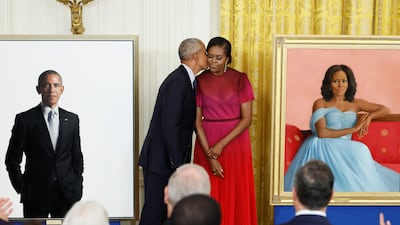
Former US president Barack Obama kisses former first lady Michelle Obama during the unveiling of their official White House portraits, painted by Robert McCurdy and Sharon Sprung, respectively. Reuters -
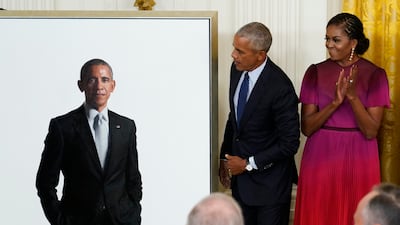
Mr Obama quipped that he resisted wearing a tan suit for his portrait. AP -
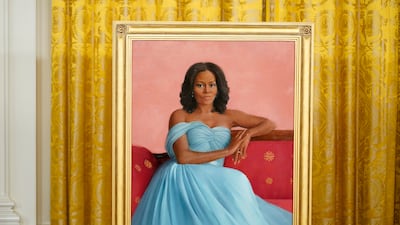
The former first lady chose artist Sharon Sprung to do her portrait. AP -
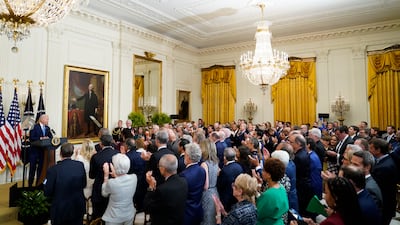
President Joe Biden receives a standing ovation as he speaks during the unveiling of the Obamas' official White House portraits. AP -
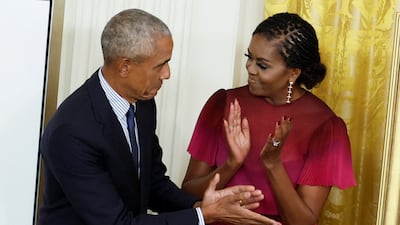
Ms Obama thanked her husband for his 'spicy' comments after following him to the podium. Reuters -
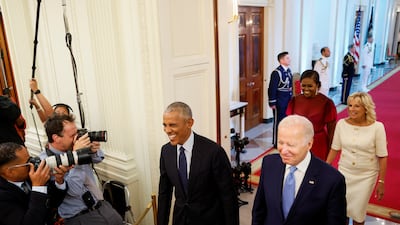
Mr Biden and first lady Jill Biden host the Obamas at the White House. Reuters -
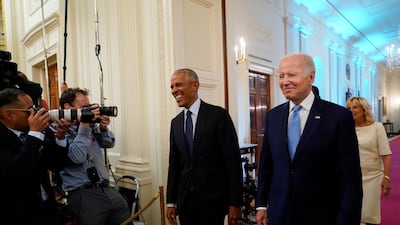
Mr Biden and Mr Obama arrive in the East Room of the White House for the unveiling. AP -
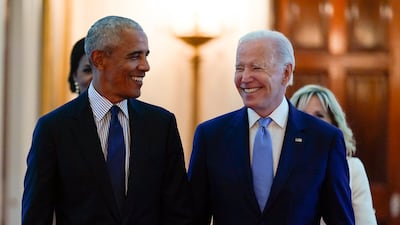
Mr Biden often refers to the former president as a friend. AP -
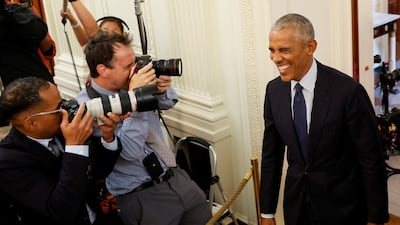
Mr Obama smiles for the camera. Reuters -
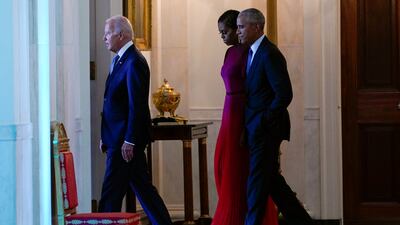
The Bidens and the Obamas attend the portrait unveiling ceremony at the White House. AP -
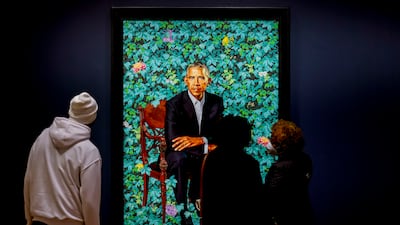
Visitors view the Smithsonian's National Portrait Gallery official portrait of Mr Obama by Kehinde Wiley at the High Museum of Art in Atlanta, Georgia. EPA -
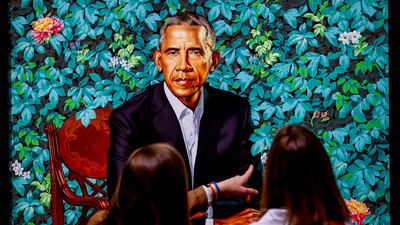
The portraits were viewed by thousands of people during their multi-city tour. EPA -
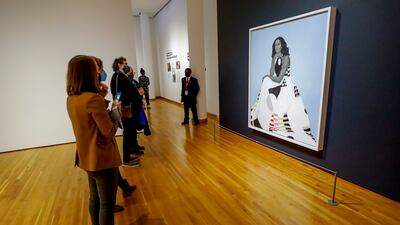
Visitors view the Smithsonian's National Portrait Gallery official portrait of Ms Obama at the High Museum of Art in Atlanta. EPA -
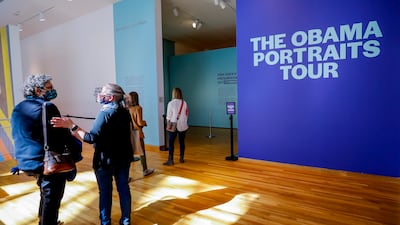
The Obama portraits tour entrance at the High Museum of Art in Atlanta. EPA -
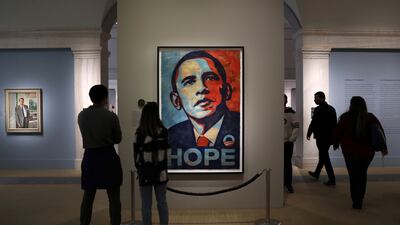
People view a portrait of Mr Obama by Shepard Fairey at the Smithsonian's National Portrait Gallery in Washington. Reuters



