

US prosecutors urged a jury to convict Oath Keepers founder Stewart Rhodes and four others for their roles in storming the US Capitol on January 6, 2021, saying they disrupted the peaceful transfer of power in the 2020 presidential election.
“They concocted a plan for an armed rebellion to shatter a bedrock of American democracy,” prosecutor Jeff Nestler said in an opening statement at the trial.
Mr Rhodes, Kelly Meggs, Thomas Caldwell, Jessica Watkins and Kenneth Harrelson are accused of plotting to forcefully prevent Congress from certifying Democratic President Joe Biden's 2020 electoral victory in a failed bid to keep then-president Donald Trump, a Republican, in power.
Trump supporters stormed the US Capitol after Mr Trump falsely claimed the election had been stolen from him through widespread fraud. Five people died during and shortly after the riot, and about 140 police officers were injured.
The five on trial face numerous felony charges, including seditious conspiracy — a Civil War-era statute that is rarely prosecuted and carries a statutory maximum sentence of 20 years in prison.
-
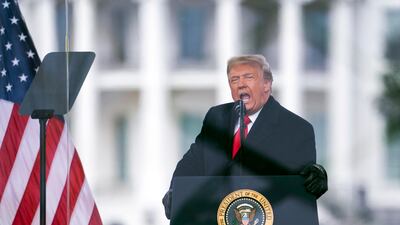
Donald Trump, the president at the time, speaks during a rally protesting the electoral college certification of Joe Biden as president in Washington on January 6, 2021. AP -
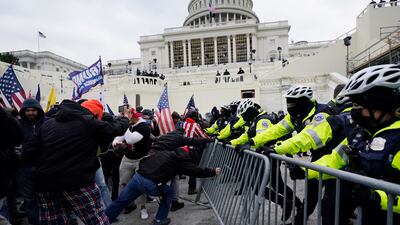
A mob loyal to Mr Trump tries to break through a police barrier at the Capitol. AP -
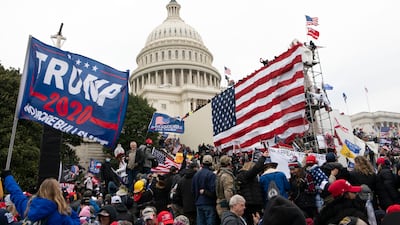
The mob waves pro-Trump flags in front of the Capitol building. AP -
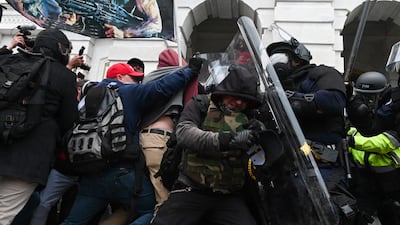
Riot police push back a crowd of rioters at the Capitol building. AFP -
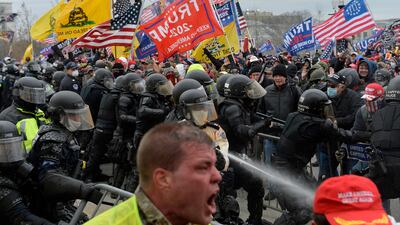
Trump supporters clash with police and security forces as people try to storm the US Capitol building. AFP -
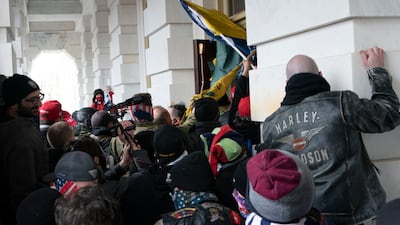
Insurrectionists loyal to Mr Trump try to open a door of the US Capitol building as they riot in Washington. AP -
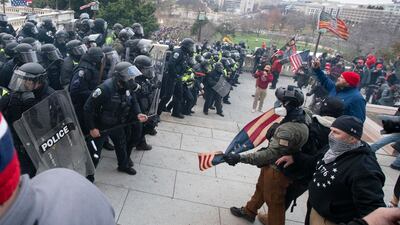
US Capitol Police push back rioters trying to enter the US Capitol. AP -
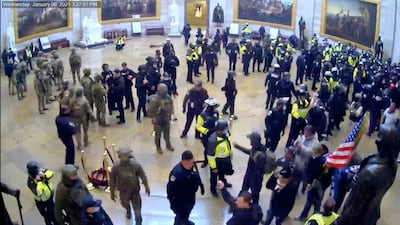
Police and rioters confront each other in the Rotunda of the Capitol. US Capitol Police via AP -
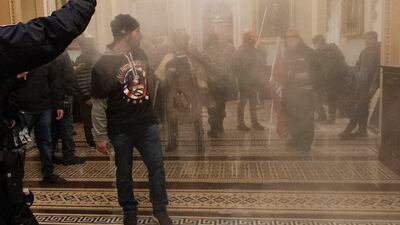
Smoke fills the hallway outside the Senate chamber of the Capitol. AP -
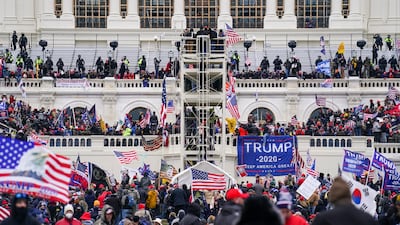
Insurrectionists loyal to Mr Trump breach the Capitol in Washington. AP -

Trump supporters, including Doug Jensen, centre, confront US Capitol Police in the hallway outside the Senate chamber at the Capitol. AP -
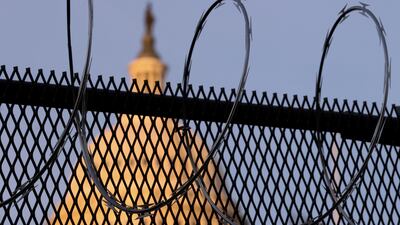
Newly installed razor wire tops the fence surrounding the US Capitol following the January 6 riot. Reuters -
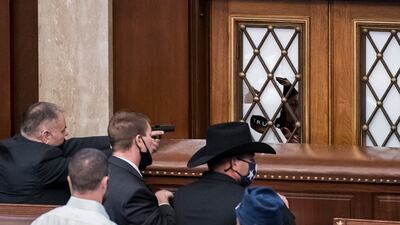
Security agents and members of Congress barricade the door to the House chamber as the violent mob breaches the Capitol. AP -
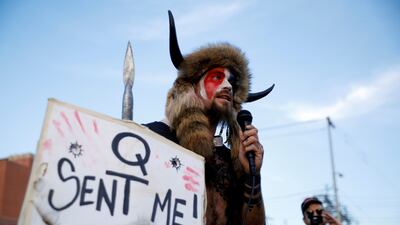
Rioter Jacob Chansley holds a sign referencing QAnon as supporters of Mr Trump gather to protest the early results of the 2020 presidential election. Reuters


Prosecutors have said the five accused trained and planned for January 6 and stockpiled weapons at a northern Virginia hotel outside the capital for a so-called quick reaction force that would be ready if called upon to transport arms into Washington.
As members of Congress met on January 6 to certify Mr Biden's electoral victory, some Oath Keepers rushed into the Capitol building, clad in paramilitary gear. They are not accused of carrying firearms on to Capitol grounds.
“On that day, as required, Congress met inside the Capitol building … These defendants seized upon that opportunity to disrupt Congress from meeting inside the Capitol building. That was their goal: to stop by whatever means necessary to stop the transfer of power including by taking up arms,” Mr Nestler told a jury of 12 members and four alternates.
The trial, which could last for six weeks or more, is expected to feature emotionally charged videos from the day of the attack, as well as text and audio messages exchanged between the group's members.
The government has characterised the Oath Keepers as a far-right anti-government group, some of whose members have ties to militias.
Some of the members, who include current and former military and law enforcement personnel, believe the federal government “has been co-opted by a cabal of elites trying to strip American citizens of their rights”, the indictment alleges.
Mr Rhodes, a Yale-educated lawyer and former US Army paratrooper, has disputed that characterisation, saying it's a non-partisan group whose members have pledged to defend the US Constitution.
Although Mr Trump's shadow will loom large over the trial, he is not expected to be a central figure in the case.
US District Judge Amit Mehta, who is presiding over the trial, previously restricted the accused from using a “public authority” defence, meaning they cannot claim they stormed the Capitol at Mr Trump's direction.

