


Russia is still stealing Ukrainian grain and delivering shipments to its allies despite the UN-brokered deal lifting Moscow’s blockade of Ukraine's Black Sea ports, a senior US official said on Friday.
Jim O’Brien, the US State Department’s head of the Office of Sanctions Co-ordination, said the stolen grain is not reaching its ultimate destination — the World Food Programme (WFP).
“That’s going for Russia's friends. There was one ship [the Razoni] that went to Syria,” Mr O’Brien said in a press briefing.
“Russia is stealing it and sending it to its political allies.”
Forty per cent of the WFP's grain is supplied by Ukraine.
This week, satellite images showed that the Razoni, the first vessel carrying Ukrainian grain to leave under a deal to unblock Black Sea ports following the Russian invasion, has ended up in Syria.
-

UN Secretary General Antonio Guterres, Ukrainian Infrastructure Minister Oleksandr Kubrakov, Turkish President Recep Tayyip Erdogan and Turkish Defence Minister Hulusi Akar attend a signing ceremony in Istanbul, Turkey. Reuters -

Ukrainian Infrastructure Minister Oleksandr Kubrakov, seated, at the signing ceremony. Reuters -

UN Secretary General Antonio Guterres, left, Russia's Defence Minister Sergei Shoigu, second left, Turkish President Recep Tayyip Erdogan, seated, second right, and Turkish Defence Minister Hulusi Akar at the signing ceremony. Reuters -
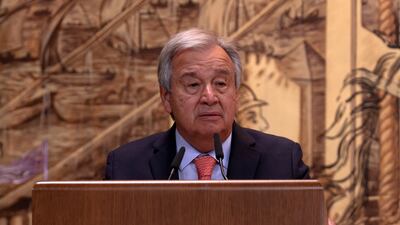
Mr Guterres speaks during the signing ceremony. Reuters -
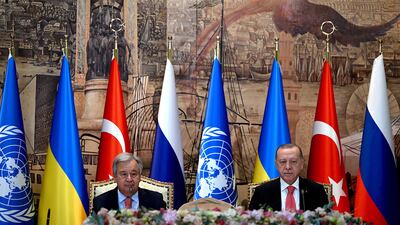
Mr Guterres and Mr Erdogan sit at the start of the signature ceremony for an agreement on the safe transportation of grain and foodstuffs from Ukrainian ports. AFP -
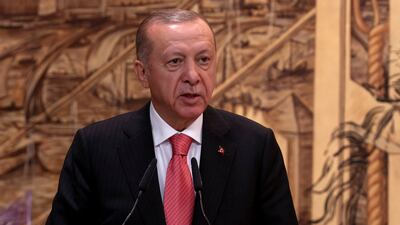
Mr Erdogan speaks at the signing ceremony. Reuters -
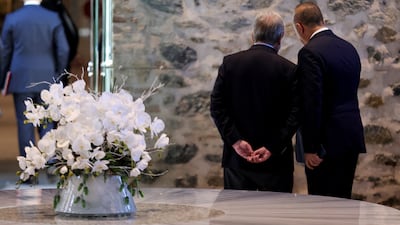
Mr Guterres and Turkish Foreign Minister Mevlut Cavusoglu stand together on the day of the deal signing in Istanbul. Reuters -
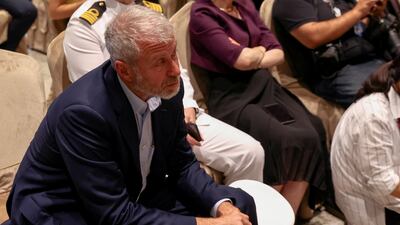
Roman Abramovich attends the ceremony in Istanbul. Reuters -
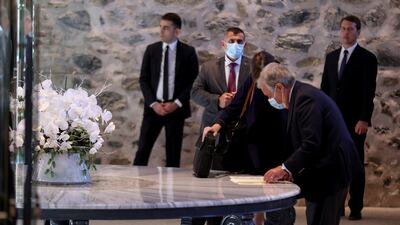
Mr Guterres said the deal would clear the way for grain shipments from three Ukrainian ports; Odesa, Chernomorsk and Yuzhny, stabilising runaway prices on the global market. Reuters -

The UN chief said a co-ordination centre would be set up in Istanbul to manage Black Sea traffic. Reuters -
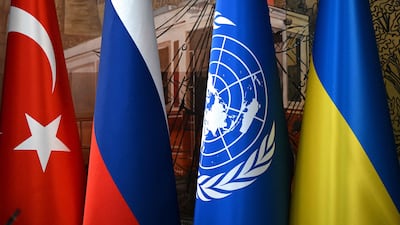
A Turkish national flag, a Russian national flag, a United Nations flag and a Ukrainian national flag in Istanbul, before the deal was signed. AFP


And on Thursday, Ukraine’s embassy in Beirut said in a statement to AFP that a Russian cargo ship carrying stolen Ukrainian grain, the SV KONSTANTIN, had also docked in the country.
Mr O'Brien said the US is working with UN humanitarian programmes to ensure the delivery of grain shipments.
Isobel Coleman, the deputy administrator for policy and programming at the US Agency for International Development (USAID) said Washington is allocating $68 million in additional funding to the WFP “to purchase, move and store up to 150,000 metric tonnes of Ukrainian wheat to support ongoing emergency food assistance in countries facing severe crises”.
Ms Coleman hailed the first shipment of humanitarian food aid that left the port of Odesa on Thursday, carrying 23,000 metric tonnes of wheat to Ethiopia.
She said Russia's five-month blockade of Ukraine's Black Sea ports has trapped more than 20 million tonnes of grain inside the country.
It is estimated that about eight million tonnes of grain have left Ukraine.
Ms Coleman called the reopening of Odesa and the resumption of humanitarian shipments “a huge moment”.
But despite the new agreement rolling back the blockade, US officials remain dubious of Russia's good faith.
“When you're dealing with Russia, you always need a Plan B and a Plan C and a Plan D,” she added.
“I wouldn't trust the Russians on many things at this point.”
US President Joe Biden's latest security assistance package for Ukraine includes surveillance drones and mine-resistance vehicles, a senior US defence official said on Friday.
The official, speaking on the condition of anonymity, said the package would be valued at $775m and also include additional ammunition and Howitzer systems. The additional aid was first reported by Reuters on Thursday.
In total, the US has now committed about $9.8 billion in security assistance to Ukraine since Mr Biden took office in January 2021.

