

A US company trying to resurrect the woolly mammoth also wants to bring the Tasmanian tiger back from extinction.
The animal, also called a thylacine, was a marsupial apex predator once widespread across Australia, Tasmania and New Guinea.
While it became extinct eIsewhere in its range thousands of years ago, the thylacine survived on the island of Tasmania.
But following decades of persecution by European settlers, who claimed it preyed on sheep, the marsupial was declared extinct in the 1930s.
The last known individual died at Hobart Zoo on September 7, 1936.
Colossal Biosciences has already said it wanted to combine genetic material from Asian elephants with frozen woolly mammoth DNA to bring back the giant creature.
The Dallas-based company was started by Harvard geneticist George Church and technology entrepreneur Ben Lamm in September 2021 with $15 million in seed funding.
It raised another $60 million six months after launching, despite doubts over the feasibility of resurrecting extinct species.
Winklevoss Capital Management, motivational speaker Tony Robbins and Paris Hilton are among its investors.
Colossal executives said bringing back the thylacine would help re-balance the Australian ecosystem, after decades of biodiversity loss.
Turning a cell into a living animal
The Tasmanian tiger had a wolf-like appearance and hunted other animals.
The shy marsupial had thick black stripes on its body and, fully grown, measured about 1.8 metres from its nose to the tip of its tail.
Colossal plans to take cells from the thylacine’s closest living relatives, such as the dunnart — an insect-eating marsupial the size of a mouse — and genetically engineer them with thylacine DNA.

“You’re actually putting all of those genomic changes into that living cell, and then in the end, you are left with a cell that is a thylacine cell, and you can turn that cell then back into a whole living animal,” said Andrew Pask, an evolutionary biologist who is leading Colossal’s efforts to revive the animal.
Critics have called such experiments a distraction and say if they succeed their effects on the climate and ecosystems would be unpredictable.
Thomas Gilbert, a paleo-geneticist at the University of Copenhagen in Denmark, tested the possibility of resurrecting the Christmas Island rat — also known as Maclear’s rat.
Mr Gilbert’s team had well-preserved DNA samples and abundant reference data from the animal’s cousin, the Norway rat.
Yet even with all that information, he said the researchers were unable to sequence the remaining 5 per cent of the Maclear’s rat’s genome — leaving out important attributes such as immunity and smell.
“If you have a million [genetic] differences between an elephant and a mammoth, you can’t necessarily change any one of those without there being a problem,” Mr Gilbert said.
“If I take a … Honda car, and if you try and put tractor tyres on it or truck tyres, it’s not going to work, right?”
-
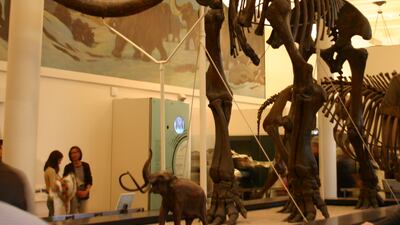
This specimen at the American Museum of Natural History in New York is believed to be a hybrid between Columbian and woolly mammoths. Photo: Ryan Somma -
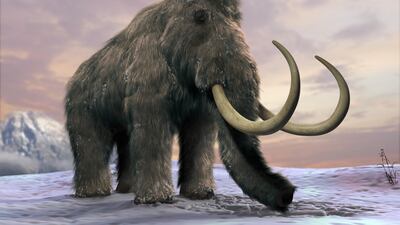
Ivory from woolly mammoth tusks has been used for various creations for centuries. Getty Images -

A skull of a woolly mammoth discovered by fishermen in May 1999 in the Netherlands. Photo: Celtic and Prehistoric Museum -
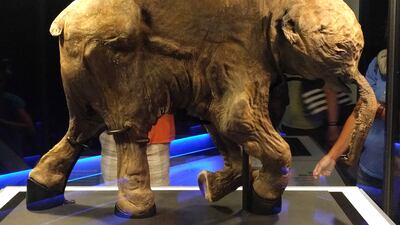
A woolly calf displayed at the Royal British Columbia Museum. Photo: Ruth Hartnup -
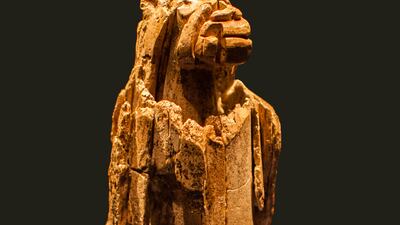
This artefact made from woolly mammoth ivory called the Lion-Man was found in the Hohlenstein-Stadel Cave, Germany. Photo: Dagmar Hollmann -
A mammoth tusk with carvings made in the 19th century in Yukon, Alaska, on display at the De Young Museum in San Francisco, California. Photo: BrokenSphere -

Venus of Brassempouy, a carving from mammoth ivory, on display at the Musee d'Archeologie Nationale in Saint-Germain-en-Laye, France. Photo: Dagmar Hollman -
A frozen calf named Yuka. Photo: Cyclonaut -
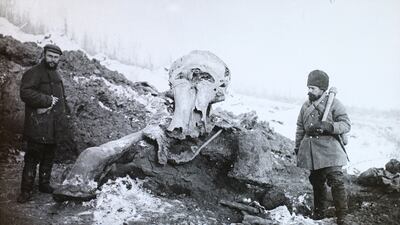
The Berezovka mammoth during excavation in 1901. Photo: Museum of Zoology in St Petersburg -
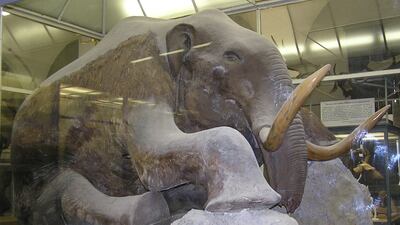
A model of the Berezovka mammoth partially covered by its skin at the Museum of Zoology in St Petersburg, Russia. Photo: Andrew Butko -

A leg with the skin and fur of a mammoth on display at the Museum of Natural History in Paris, France. Photo: Matt Mechtley -
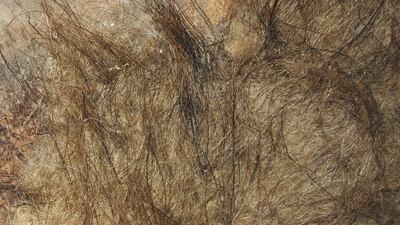
A close-up of preserved woolly mammoth fur on display at the Natural History Museum in Vienna, Austria. Photo: Tommy Arad -
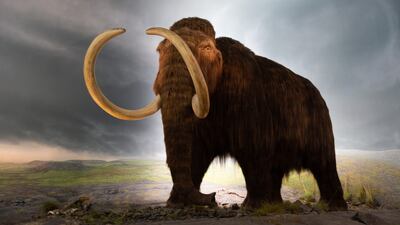
A recreation of a woolly mammoth at the Royal Victoria Museum, Victoria, British Columbia, Canada. Photo: Thomas Quine -
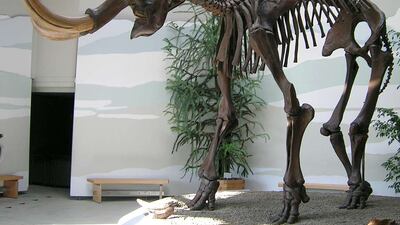
Mammoth remains on display at the Siegsdorf Natural History and Mammoth Museum in Siegsdorf, Germany. Photo: Lou Gruber -
A cast of remains at the State Museum of Natural History in Stuttgart, Germany. Photo: Ghedoghedo -
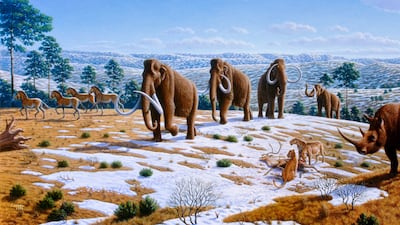
The image depicts a late Pleistocene landscape in northern Spain with woolly mammoths, equids, a woolly rhinoceros and European cave lions with a reindeer carcass. Photo: Mauricio Anton -
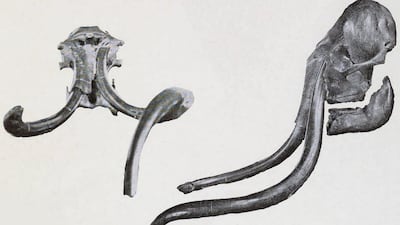
A woolly mammoth skull from Bzianka, Poland, with one downward spiralling tusk. Photo: Henryk Ferdynand Hoyer -
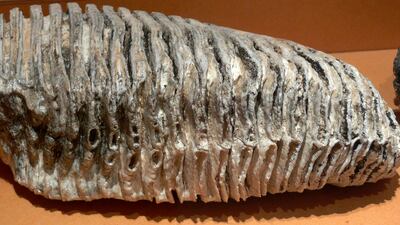
A mammoth molar featured in a display of artefacts at the Georges-Garret Museum in Vesoul, France. Photo: Remi Mathis -
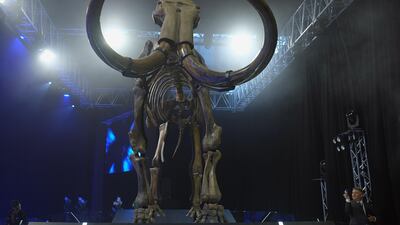
In 2015, a 15,000-year-old woolly mammoth was unveiled at Marina Mall in Abu Dhabi. Delores Johnson / The National -
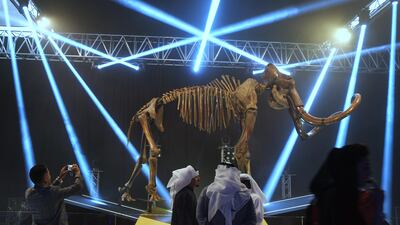
The woolly mammoth was roughly the same size as modern African elephants. Delores Johnson / The National -
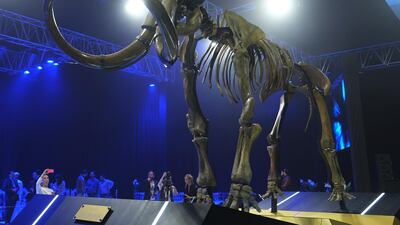
The woolly mammoth coexisted alongside early humans. This one lives in a mall. Delores Johnson / The National -
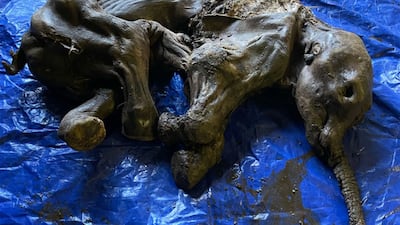
Miners in the Klondike gold fields of Canada's far north discovered the mummified remains of a baby woolly mammoth. Government of Yukon / AFP -
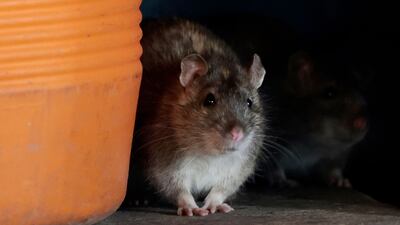
While some scientists are trying to bring the woolly mammoth back, others have studied how using gene editing can resurrect extinct animals such as the Christmas Island rat. Getty Images / AFP -
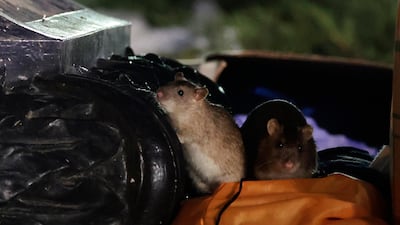
The team found they could reconstruct 95 per cent of the Christmas Island rat genome. Getty Images / AFP -
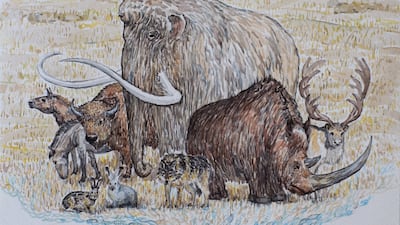
Climate change, not humans, caused the extinction of woolly mammoths. PA -
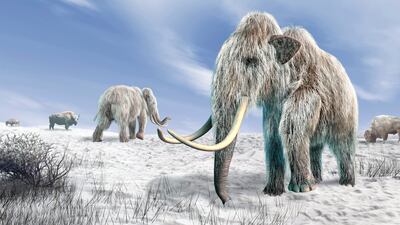
When icebergs melted, it became too wet for the mammoths to survive because their food source was wiped out. PA -
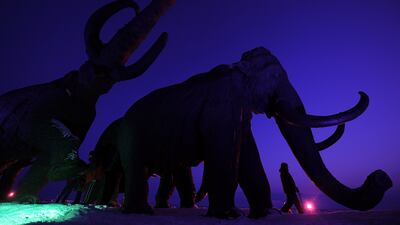
Giant bronze sculptures of mammoths on display during the World Biathlon Championships in the Siberian city of Khanty-Mansiysk. AFP -
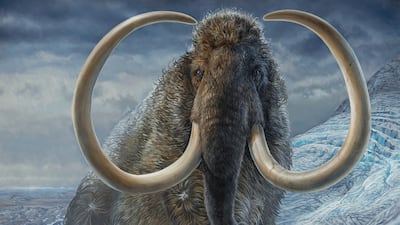
An imagined woolly mammoth on display at the University of Alaska Museum of the North in Fairbanks, Alaska. The Havens Studio / Reuters -
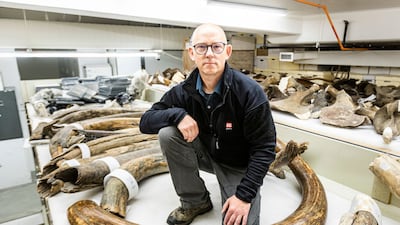
Mat Wooller, director of the Alaska Stable Isotope Facility, kneels among a collection of mammoth tusks at the University of Alaska Museum of the North. University of Alaska Fairbanks / AFP -

These woolly mammoth remains are a huge attraction at the Marina Mall in Abu Dhabi. Delores Johnson / The National -
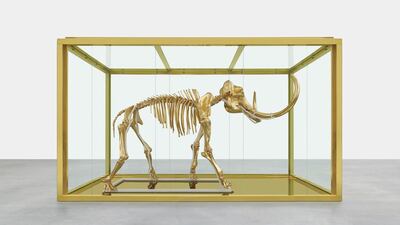
A gilded woolly mammoth skeleton was created to benefit the amfAR Cinema Against Aids in Cap d’Antibes, southern France. Prudence Cuming Associates / Damien Hirst / AP


But Michael Archer, a palaeontologist at the University of New South Wales in Sydney, said efforts aimed at de-extinction were necessary.
“It may well be enormously challenging and certainly a lot of work, but we can be certain of one thing — extinct animals will definitely stay extinct if we don’t try these things,” he said.
“Some projects are moving forward quickly. Others will take more time. In principle, there is no fundamental reason why de-extinction should not be possible now or in the near future.”
Colossal’s most recent round of funding drew investment from entertainment world figures, including Australian actor Chris Hemsworth.
“The Tassie tiger’s extinction had a devastating effect on our ecosystem and we are thrilled to support the revolutionary conservation efforts that are being made by Dr Pask and the entire Colossal team,” the Thor star said.

