

The US House voted to protect same-sex and interracial marriages on Tuesday, in a direct confrontation with the Supreme Court, whose conservative majority in overturning Roe v Wade abortion access has sparked concerns that other rights enjoyed by countless Americans may be in jeopardy.
The 267-157 vote in the House is part political strategy setting up an election-year roll call that will force all politicians, Republicans and Democrats, to go on the record with their views on the high-profile social issue.
It is also part of the legislative branch asserting its authority, pushing back against an aggressive court that appears intent on revisiting many settled US laws.
“As this Court may take aim at other fundamental rights, we cannot sit idly by,” Representative Jerrold Nadler, the chairman of the House Judiciary Committee, said in a statement.
The Respect for Marriage Act is almost certain to stall in the Senate, where most Republicans would surely block it.
It is one of several bills, including those enshrining abortion access, that Democrats are pushing to confront the court’s conservative majority. Another bill, guaranteeing access to contraceptive services, is set for a vote later this week.
The Respect for Marriage Act would repeal a leftover law still on the books from the Clinton-era that defines marriage as a heterogeneous relationship between man and woman.
It would also provide legal protection for interracial marriages by prohibiting any state from denying out-of-state marriage licences and benefits on the basis of sex, race, ethnicity or national origin.
The 1996 law, the Defence of Marriage Act, had basically been sidelined by Obama-era court rulings, including Obergefell v Hodges, which established the right of same-sex couples to marry nationwide, a landmark case for gay rights.
-

Abortion rights activists gather outside the US Supreme Court in Washington on June 24, 2022. AP -

Pro-life demonstrators celebrate outside the Supreme Court in Washington. AP -
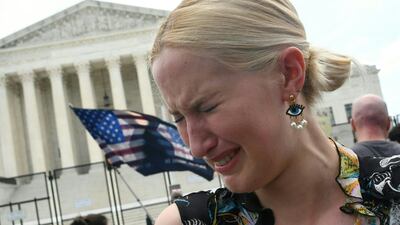
A pro-choice supporter cries outside the Supreme Court. AFP -

Pro-life campaigners celebrate outside the Supreme Court. AFP -

A demonstrator wears 'second class citizen' tape over her mouth outside the Supreme Court. Bloomberg -

An activist outside the Supreme Court. AP -

A woman reacts after hearing the abortion decision. AP -

Pro-life activists hug outside the Supreme Court. AFP -

A pro-life supporter reacts outside the Supreme Court. AFP -

Pro-life supporters hug outside the court. AFP -
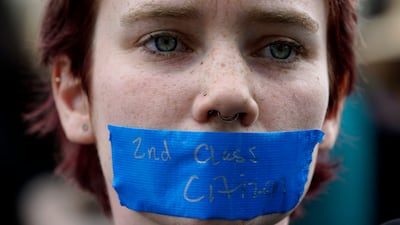
The Supreme Court has ended constitutional protections for abortion that had been in place nearly 50 years. AP -

People celebrate outside the Supreme Court after the conservative majority overturned Roe v Wade. AP -
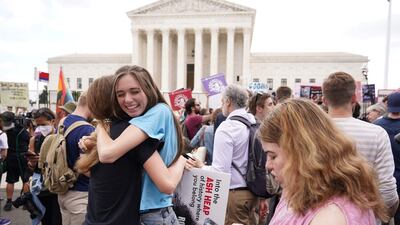
Pro-life supporters celebrate outside the court. AFP -
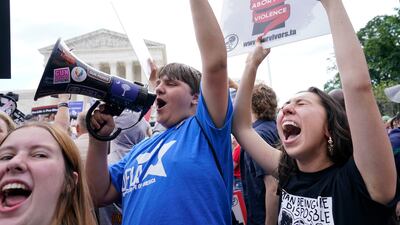
People celebrate outside the Supreme Court. AP -

Pro-choice demonstrators gather outside the Supreme Court. AFP


But last month, in doing away with the Roe v Wade constitutional right to an abortion, the conservative court majority put in place during the Donald Trump era left critics concerned there may be more to come.
In writing for the majority overturning Roe, Justice Samuel Alito argued for a more narrow interpretation of the rights guaranteed to Americans, saying the right to an abortion is not spelt out in the Constitution.
“We therefore hold that the Constitution does not confer a right to abortion,” Mr Alito wrote.
In a concurring opinion, conservative Justice Clarence Thomas went further, saying other rulings similar to Roe, including those around same-sex marriage and the right for couples to use contraception, should be reconsidered.
While Mr Alito insisted in the majority opinion that “this decision concerns the constitutional right to abortion and no other right,” others have taken notice.
Jim Obergefell, the plaintiff in the landmark ruling legalising same-sex marriage and now running as a Democrat for the Ohio House, said after the court’s ruling on abortion: “When we lose one right that we have relied on and enjoyed, other rights are at risk.”

