How much will Iran's drones help Russia in Ukraine?


Joyce Karam
  • English
  • Arabic

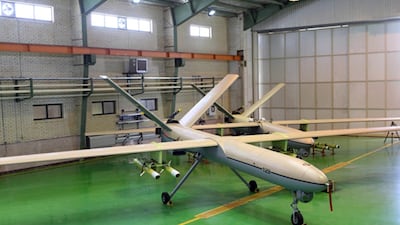
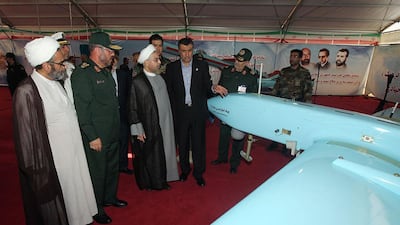
This week's announcement that Iran plans to provide Russia with “hundreds” of drones, some of them weapons-capable, for use in Ukraine shines a spotlight on Tehran’s well-established and fast-growing unmanned aerial vehicle (UAV) programme.

Iran has neither confirmed nor denied the US claim but Iranian Foreign Minister Hossein Amirabdollahian noted that Tehran has “various types of collaboration with Russia, including in the defence sector”.

He also said Tehran “won't help either of the sides involved in this war because we believe that it needs to be stopped”.

Any supplies from Iran’s drone programme could provide Moscow with a significant boost in Ukraine at a relatively low financial and combat cost.

Unlike Russia, which spent most of the Cold War building its nuclear and conventional weapons arsenals, Iran invested in a drone programme starting in the 1980s at the height of its war with Iraq.

Four decades later, Iran’s drone capability is unmatched in the Gulf region. A report from the Royal United Services Institute think tank showed that Tehran produces at least five families of drones: Shahed, Fotros, Ababil, Saeqeh and Mohajer.

On Friday, Iran announced its first drone division in the Indian Ocean and published images of drones being launched from a submarine. Reuters reported that Iran did not say how many vessels or drones were included in each unit, only that one ship could carry 50 drones.

Seth Frantzman, a Middle East analyst and author of Drone Wars, saw news of the proposed Iranian sale to Russia as an acknowledgement that Tehran’s UAV programme now has a global footprint.

“In the past, Iran provided drones to Venezuela, Ethiopia and also to militias and proxies in Lebanon, Syria, Iraq and Yemen,” Mr Frantzman told The National. “Now we are talking about Iran's drones proliferating globally to yet another war — in Europe.”

A drone is launched from an Iranian submarine during a drill in the Indian Ocean. AP

The expert assessed that sanctions had previously been a deterrent against sales of Iranian weaponry, leading to drones from the country not being produced in large numbers.

But that has changed in the past five years.

“We have seen an exponential increase in Iran’s construction of various types of drones in the Shahed, Ababil and Mohajer lines,” Mr Frantzman explained.

“Each of these lines of drones has a number of different types, including smaller kamikaze drones like the Shahed-136.”

Many of those drones come under the operational leadership of the Iranian Revolutionary Guard Corps (IRGC) and have been deployed in attacks against western and Gulf interests in the Gulf of Oman.

For Russia, Iranian drones represent a “cheap and expendable” means to pursue some of its air attacks in Ukraine.

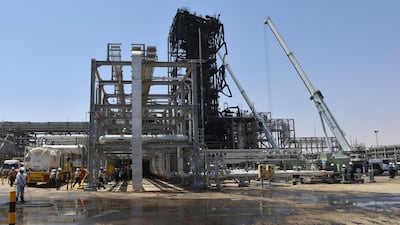
“This could be modelled on how Iran used drones and cruise missiles to attack Saudi Arabia’s Abqaiq facility in 2019, or how Azerbaijan used drones against Armenian forces in Karabakh in 2021 to suppress Armenian air defences and then systematically destroy their armour and artillery,” Mr Frantzman said.

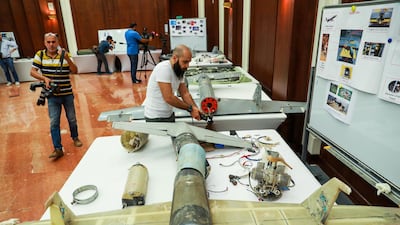
In June 2020, a UN report blamed Iran for supplying drones to Houthi rebel militias in Yemen, which were used to destroy critical oil infrastructure at Abqaiq.

In Ukraine, Russia could employ similar tactics against western-supplied weapons such as the US High Mobility Artillery Rocket Systems (Himars).

However, Ukraine receives its own drone supplies from Turkey and the US, and Washington could go a step further by supplying Ukraine with a system that disables drones.

Several anti-drone technologies exist and in February, The Defence Post reported that Naval Information Warfare Centre engineers are developing a system that detects, identifies and neutralises low-altitude weapons, including UAVs.

Further illustrating how far anti-drone technology has come, US President Joe Biden this week visited an Israeli Iron Beam laser unit that can take out UAVs and other incoming threats.

Mr Frantzman suspects the Ababil and Shahed-136 drones are most likely to make up the Iranian sale for Russia, granting Moscow more “loitering munitions that can be used in kamikaze attacks”.

“The Ababil-type drones often have ranges of several hundred kilometres,” he said.

Asked if such sale would be a game-changer, Mr Frantzman saw it as unlikely.

“Drones don’t win wars, however they can provide a country with a kind of instant air force,” he said.

The Ukrainian military said that Russia has lost more than 200 planes and 184 helicopters in the course of the invasion that started on February 24.

UAE currency: the story behind the money in your pockets

Indoor cricket World Cup:
Insportz, Dubai, September 16-23

UAE fixtures:
Men

Saturday, September 16 – 1.45pm, v New Zealand
Sunday, September 17 – 10.30am, v Australia; 3.45pm, v South Africa
Monday, September 18 – 2pm, v England; 7.15pm, v India
Tuesday, September 19 – 12.15pm, v Singapore; 5.30pm, v Sri Lanka
Thursday, September 21 – 2pm v Malaysia
Friday, September 22 – 3.30pm, semi-final
Saturday, September 23 – 3pm, grand final

Women
Saturday, September 16 – 5.15pm, v Australia
Sunday, September 17 – 2pm, v South Africa; 7.15pm, v New Zealand
Monday, September 18 – 5.30pm, v England
Tuesday, September 19 – 10.30am, v New Zealand; 3.45pm, v South Africa
Thursday, September 21 – 12.15pm, v Australia
Friday, September 22 – 1.30pm, semi-final
Saturday, September 23 – 1pm, grand final

The biog

Favourite Emirati dish: Fish machboos

Favourite spice: Cumin

Family: mother, three sisters, three brothers and a two-year-old daughter

Dust and sand storms compared

Sand storm

  • Particle size: Larger, heavier sand grains
  • Visibility: Often dramatic with thick "walls" of sand
  • Duration: Short-lived, typically localised
  • Travel distance: Limited 
  • Source: Open desert areas with strong winds

Dust storm

  • Particle size: Much finer, lightweight particles
  • Visibility: Hazy skies but less intense
  • Duration: Can linger for days
  • Travel distance: Long-range, up to thousands of kilometres
  • Source: Can be carried from distant regions
Who's who in Yemen conflict

Houthis: Iran-backed rebels who occupy Sanaa and run unrecognised government

Yemeni government: Exiled government in Aden led by eight-member Presidential Leadership Council

Southern Transitional Council: Faction in Yemeni government that seeks autonomy for the south

Habrish 'rebels': Tribal-backed forces feuding with STC over control of oil in government territory

Will the pound fall to parity with the dollar?

The idea of pound parity now seems less far-fetched as the risk grows that Britain may split away from the European Union without a deal.

Rupert Harrison, a fund manager at BlackRock, sees the risk of it falling to trade level with the dollar on a no-deal Brexit. The view echoes Morgan Stanley’s recent forecast that the currency can plunge toward $1 (Dh3.67) on such an outcome. That isn’t the majority view yet – a Bloomberg survey this month estimated the pound will slide to $1.10 should the UK exit the bloc without an agreement.

New Prime Minister Boris Johnson has repeatedly said that Britain will leave the EU on the October 31 deadline with or without an agreement, fuelling concern the nation is headed for a disorderly departure and fanning pessimism toward the pound. Sterling has fallen more than 7 per cent in the past three months, the worst performance among major developed-market currencies.

“The pound is at a much lower level now but I still think a no-deal exit would lead to significant volatility and we could be testing parity on a really bad outcome,” said Mr Harrison, who manages more than $10 billion in assets at BlackRock. “We will see this game of chicken continue through August and that’s likely negative for sterling,” he said about the deadlocked Brexit talks.

The pound fell 0.8 per cent to $1.2033 on Friday, its weakest closing level since the 1980s, after a report on the second quarter showed the UK economy shrank for the first time in six years. The data means it is likely the Bank of England will cut interest rates, according to Mizuho Bank.

The BOE said in November that the currency could fall even below $1 in an analysis on possible worst-case Brexit scenarios. Options-based calculations showed around a 6.4 per cent chance of pound-dollar parity in the next one year, markedly higher than 0.2 per cent in early March when prospects of a no-deal outcome were seemingly off the table.

Bloomberg

Company%20Profile
%3Cp%3E%3Cstrong%3ECompany%20name%3A%3C%2Fstrong%3E%20myZoi%3Cbr%3E%3Cstrong%3EStarted%3A%3C%2Fstrong%3E%202021%3Cbr%3E%3Cstrong%3EFounders%3A%3C%2Fstrong%3E%20Syed%20Ali%2C%20Christian%20Buchholz%2C%20Shanawaz%20Rouf%2C%20Arsalan%20Siddiqui%2C%20Nabid%20Hassan%3Cbr%3E%3Cstrong%3EBased%3A%3C%2Fstrong%3E%20UAE%3Cbr%3E%3Cstrong%3ENumber%20of%20staff%3A%3C%2Fstrong%3E%2037%3Cbr%3E%3Cstrong%3EInvestment%3A%3C%2Fstrong%3E%20Initial%20undisclosed%20funding%20from%20SC%20Ventures%3B%20second%20round%20of%20funding%20totalling%20%2414%20million%20from%20a%20consortium%20of%20SBI%2C%20a%20Japanese%20VC%20firm%2C%20and%20SC%20Venture%3C%2Fp%3E%0A
The five pillars of Islam

1. Fasting 

2. Prayer 

3. Hajj 

4. Shahada 

5. Zakat 

Mercer, the investment consulting arm of US services company Marsh & McLennan, expects its wealth division to at least double its assets under management (AUM) in the Middle East as wealth in the region continues to grow despite economic headwinds, a company official said.

Mercer Wealth, which globally has $160 billion in AUM, plans to boost its AUM in the region to $2-$3bn in the next 2-3 years from the present $1bn, said Yasir AbuShaban, a Dubai-based principal with Mercer Wealth.

Within the next two to three years, we are looking at reaching $2 to $3 billion as a conservative estimate and we do see an opportunity to do so,” said Mr AbuShaban.

Mercer does not directly make investments, but allocates clients’ money they have discretion to, to professional asset managers. They also provide advice to clients.

“We have buying power. We can negotiate on their (client’s) behalf with asset managers to provide them lower fees than they otherwise would have to get on their own,” he added.

Mercer Wealth’s clients include sovereign wealth funds, family offices, and insurance companies among others.

From its office in Dubai, Mercer also looks after Africa, India and Turkey, where they also see opportunity for growth.

Wealth creation in Middle East and Africa (MEA) grew 8.5 per cent to $8.1 trillion last year from $7.5tn in 2015, higher than last year’s global average of 6 per cent and the second-highest growth in a region after Asia-Pacific which grew 9.9 per cent, according to consultancy Boston Consulting Group (BCG). In the region, where wealth grew just 1.9 per cent in 2015 compared with 2014, a pickup in oil prices has helped in wealth generation.

BCG is forecasting MEA wealth will rise to $12tn by 2021, growing at an annual average of 8 per cent.

Drivers of wealth generation in the region will be split evenly between new wealth creation and growth of performance of existing assets, according to BCG.

Another general trend in the region is clients’ looking for a comprehensive approach to investing, according to Mr AbuShaban.

“Institutional investors or some of the families are seeing a slowdown in the available capital they have to invest and in that sense they are looking at optimizing the way they manage their portfolios and making sure they are not investing haphazardly and different parts of their investment are working together,” said Mr AbuShaban.

Some clients also have a higher appetite for risk, given the low interest-rate environment that does not provide enough yield for some institutional investors. These clients are keen to invest in illiquid assets, such as private equity and infrastructure.

“What we have seen is a desire for higher returns in what has been a low-return environment specifically in various fixed income or bonds,” he said.

“In this environment, we have seen a de facto increase in the risk that clients are taking in things like illiquid investments, private equity investments, infrastructure and private debt, those kind of investments were higher illiquidity results in incrementally higher returns.”

The Abu Dhabi Investment Authority, one of the largest sovereign wealth funds, said in its 2016 report that has gradually increased its exposure in direct private equity and private credit transactions, mainly in Asian markets and especially in China and India. The authority’s private equity department focused on structured equities owing to “their defensive characteristics.”

UAE currency: the story behind the money in your pockets
Moon Music

Artist: Coldplay

Label: Parlophone/Atlantic

Number of tracks: 10

Rating: 3/5

UAE currency: the story behind the money in your pockets

The Dictionary of Animal Languages
Heidi Sopinka
​​​​​​​Scribe

Updated: July 15, 2022, 6:04 PM