



The Biden administration plans to allocate more than $3 billion in infrastructure funding to finance electric vehicle (EV) battery manufacturing.
The funds will be allocated by the Department of Energy from the $1 trillion infrastructure bill President Joe Biden signed last year.
Among the initiatives will be the processing of minerals for use in large-capacity batteries and recycling those batteries, the agency said.
Mr Biden wants half of all new vehicles sold in the US to be electric by 2030, a goal he hopes will boost unionised manufacturing jobs in key election battleground states, help the US to compete with China in the fast-growing market and reduce carbon emissions.
His administration will also position the measures as a way to secure energy independence and cut long-term inflation exacerbated by Russia's invasion of Ukraine.
"As we face this Putin price hike on oil and gas, it's also important to note that electric vehicles will be cheaper over the long-haul for American families," said Mitch Landrieu, the White House infrastructure co-ordinator, referring to Russian President Vladimir Putin.
-

The exterior of the new electric SUV from Lotus, the mould-breaking Eletre. All photos: Lotus Cars -

The exterior of the new SUV from Lotus, the all-wheel drive Eletre. -

The interior of the new SUV from Lotus, the Eletre. The new model will be built in China. -

A rear view of the new SUV from Lotus, the 600 HP Eletre. -

The interior of the new SUV from Lotus, the Eletre. -

The interior of the new SUV from Lotus, the Eletre.


Ford Motor welcomed the announcement.
“This investment will strengthen our domestic battery supply chain, create jobs and help US manufacturers compete on the global stage,” said Steven Croley, the company's general counsel.
"We have a moment of opportunity to own this technology here in the US, and investments like the one announced today will help us to get there.”
The latest funding will help to establish and retrofit battery factories. The infrastructure law also allocated billions of dollars for the government to purchase electric buses and install EV chargers.
The Biden administration has been working with business leaders, including Tesla chief executive Elon Musk, General Motors chief executive Mary Barra and Ford chief Jim Farley.
But the funds will not go towards developing new domestic mines to produce the lithium, nickel, cobalt and other high-demand minerals needed to make batteries. Some of those projects face local opposition and are tied up in environmental and legal reviews being conducted by the Biden administration.
-
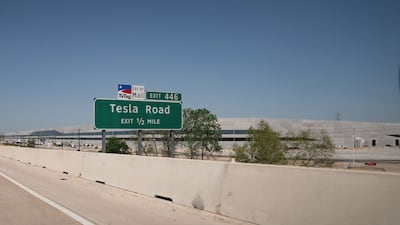
A Tesla Road exit sign on the Toll 130 motorway points to the new Gigafactory in Austin, Texas. AFP -

Workers set up for the grand opening party at the new Tesla Giga Texas plant in Austin, Texas. AFP -
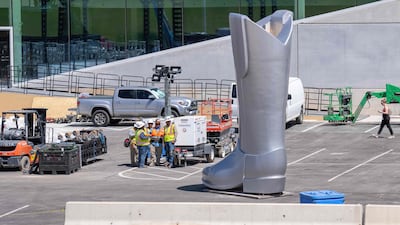
Tesla's unveiling of the new factory in Austin has highlighted corporate America's growing affinity for Texas, compared with California and other states that are considered to be less tax-friendly. AFP -

The parking lot at Tesla's Austin factory is packed with employees' cars. Bloomberg -

The construction site of the Tesla Gigafactory in Austin, Texas, in October 2021. Reuters -

A closer look at the construction site of the Tesla Gigafactory in Austin, Texas. Reuters -
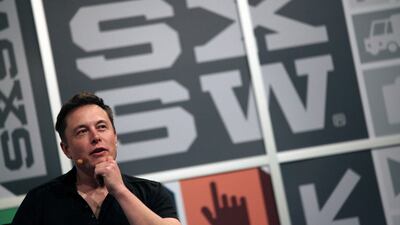
Elon Musk speaks at the South by Southwest Interactive festival in Austin, Texas. Reuters


"These resources are about the battery supply chain, which includes producing and recycling critical minerals without new extraction or mining. That's why we're all pretty excited about this," said Gina McCarthy, the White House's national climate adviser.
In March, Mr Biden invoked the Cold War-era Defence Production Act to support the production and processing of those minerals
He requested funding to support that initiative last week as part of a $33bn package on initiatives related to the Ukraine conflict.

