



Nasa's James Webb Space Telescope, designed to give the world an unprecedented glimpse into the earliest stages of the universe, reached its gravitational parking space on Monday in orbit around the Sun, almost 1.6 million kilometres from Earth.
The Space Telescope Science Institute in Baltimore fired its thrusters for five minutes in order to reach the so-called second Lagrange point, or L2, where it will have a wide view of the cosmos.
"Webb, welcome home!" said NASA Administrator Bill Nelson in a statement.
The mirrors on the $10 billion observatory still must be meticulously aligned and the infrared detectors sufficiently chilled before science observations can begin in June. But flight controllers in Baltimore were euphoric after chalking up another success.
“We’re one step closer to uncovering the mysteries of the universe. And I can’t wait to see Webb’s first new views of the universe this summer!” Mr Nelson said.
From its vantage point in space, Webb will follow a path in constant alignment with Earth, as the planet and telescope circle the Sun in tandem, enabling uninterrupted radio contact.
By comparison, Webb's 30-year-old predecessor, the Hubble Space Telescope, orbits the Earth from 547km away, passing in and out of the planet's shadow every 90 minutes.
The combined pull of the Sun and Earth at L2 can hold the telescope firmly in place so it takes little additional rocket thrust to keep Webb from drifting.
Utilised by several other deep space satellites over the years, an L2 position allows a "minimum amount of fuel to stay in orbit", Eric Smith, Nasa's programme scientist for Webb said.
The operations centre has also begun fine-tuning the telescope's primary mirror — an array of 18 hexagonal segments of gold-coated beryllium metal measuring 6.5 metres across — far larger than Hubble's main mirror.
Its size and design to operate mainly in the infrared spectrum will allow Webb to peer through clouds of gas and dust and observe objects at greater distances, thus farther back in time, than Hubble or any other telescope.
These features are expected to usher in a revolution in astronomy, giving the first view of infant galaxies dating to 100 million years after the Big Bang, the theoretical flashpoint that set the expansion of the known universe in motion an estimated 13.8 billion years ago.
Webb's instruments also make it ideal to search for signs of potentially life-supporting atmospheres around scores of newly documented exoplanets — celestial bodies orbiting distant stars — and to observe worlds much closer to home, such as Mars and Saturn's icy moon Titan.
It will take several more months of work to prepare Webb for its astronomical debut.
-
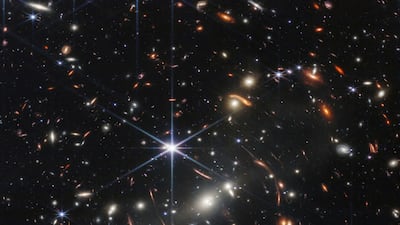
The first full-color image from Nasa's James Webb Space Telescope shows the galaxy cluster SMACS 0723. Photo: Nasa -
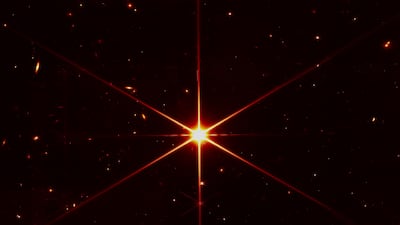
This image made available by Nasa on March 16, 2022 shows star 2MASS J17554042+6551277 used to align the mirrors of the James Webb Space Telescope, with galaxies and stars surrounding it. The hexagonal shape of Webb’s mirrors and its filters made the shimmering star look more red and spiky. The first science images aren't expected until July 12. Photo: Nasa -
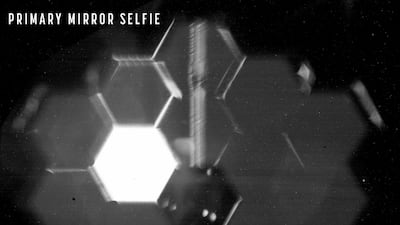
This photo provided by NASA shows a “selfie” created using a specialized pupil imaging lens inside of the NIRCam instrument that was designed to take images of the primary mirror segments instead of images of space. (NASA via AP) -
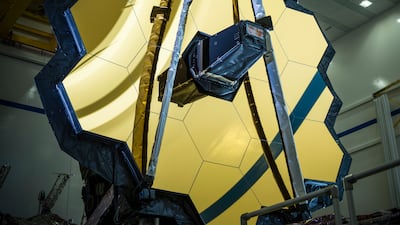
Webb is able to look back in time 13 billion years, a mere 100 million years after the Big Bang. AP -
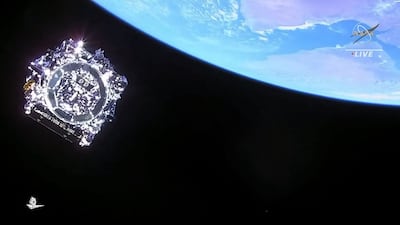
The James Webb Space Telescope separates from Arianespace's Ariane 5 rocket. AFP -
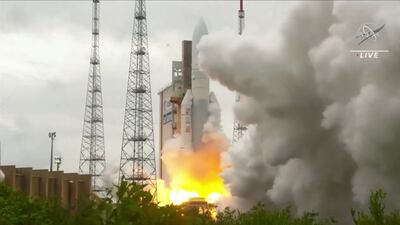
Arianespace's Ariane 5 rocket, with Nasa's James Webb Space Telescope on board, takes off from the Guiana Space Centre in Kourou, French Guiana, on December 25, 2021. Reuters -
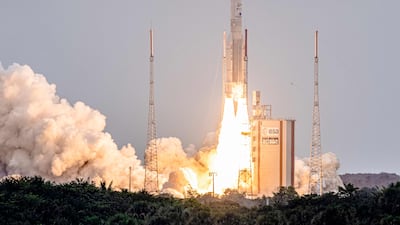
The James Webb Space Telescope will help answer fundamental questions about the universe, peering back in time 13 billion years. AFP -
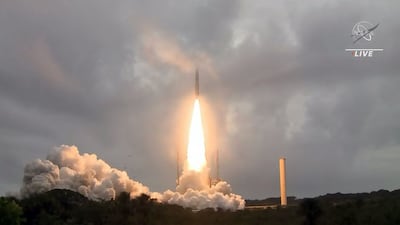
Three decades and billions of dollars in the making, the world's most powerful space telescope will take up its position 1.5 million kilometres from the Earth. AFP -
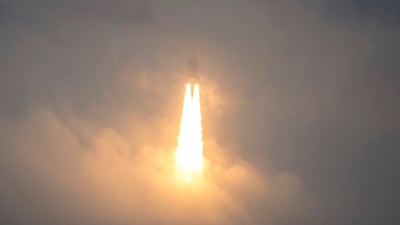
Nasa's James Webb Space Telescope is carried by rocket from Europe's Spaceport in French Guiana. AFP -

This combination of images from an animation made available by Nasa shows the unfolding of the components of the James Webb Space Telescope. Webb is so big that it had to be folded origami-style to fit into the nose cone of the Ariane rocket. AP


The 18 segments of its principal mirror, which had been folded together to fit inside the cargo bay of the rocket that carried the telescope to space, were unfurled with the rest of its structural components during a two-week period following Webb's launch on December 25.
Those segments were recently detached from fasteners that held them in place for the launch and slowly moved forward half an inch from their original configuration, allowing them to be adjusted into a single, unbroken, light-collecting surface.
The 18 segments now need to be aligned to achieve the mirror's proper focus, a process that will take three months to complete.
As the alignment progresses, ground teams will start activating the observatory's spectrograph, camera and other instruments. This will be followed by two months of calibrating the instruments themselves, Smith said.
If all goes smoothly, Webb should be ready to begin making observations by early summer, with initial images used to demonstrate the instruments function properly.
But Mr Smith said Webb's most ambitious work, including plans to train its mirror on objects farthest from Earth, will take longer to conduct so it will be a while till the world gets a look at such images.
The telescope is an international collaboration led by Nasa in partnership with the European and Canadian space agencies. Northrop Grumman Corp was the primary contractor.

