

US President Joe Biden's administration has officially withdrawn a rule that would have required workers at big companies to be vaccinated or face regular Covid-19 tests.
Despite the decision, the Occupational Safety and Health Administration (OSHA) “continues to strongly encourage the vaccination of workers against the continuing dangers posed by Covid-19 in the workplace”, a notice released on Tuesday said.
In early November, OSHA announced a vaccine-or-test mandate for companies with at least 100 employees. The rule — which would have affected more than 80 million workers — was originally set to go into effect on January 4.
But numerous states and business groups challenged the rule in court, and on January 13, the Supreme Court halted the plan. With a 6-3 ruling, the court’s conservative majority concluded that OSHA had overstepped its authority.
“OSHA has never before imposed such a mandate. Nor has Congress,″ the court’s majority wrote. “Indeed, although Congress has enacted significant legislation addressing the Covid-19 pandemic, it has declined to enact any measure similar to what OSHA has promulgated here.”
The justices left in place a vaccine mandate for healthcare providers who receive federal Medicare or Medicaid funding, a measure that affects 10.4 million workers.
The rules sparked legal challenges by conservative organisations, Republicans and some business groups.
Covid-19 has killed more than 850,000 people in the US and the outbreak continues to weigh on the country's economy.
Mr Biden unveiled in September a series of regulations aimed at increasing the US adult vaccination rate, which currently stands at about 74 per cent, government data show — among the lowest in the developed world.
OSHA indicated that the rule could return in some form. While it is no longer an enforceable standard, it remains a proposed rule, OSHA said. For now, the agency said it will prioritise the healthcare worker mandate.
David Michaels, an epidemiologist and former OSHA administrator who now teaches at George Washington University, said the agency could consider a new rule that would include other measures designed to prevent the spread of Covid-19 in workplaces, such as requiring face masks, distancing and better ventilation systems.
-
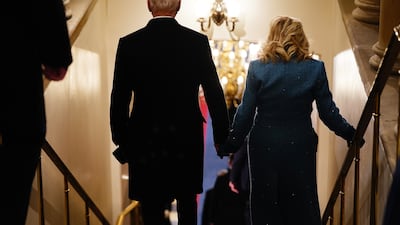
The inauguration of Joe Biden as the 46th president of the United States took place on January 20, 2021. EPA -
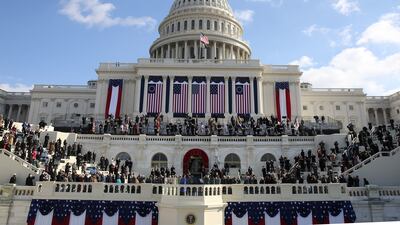
Vice President Kamala Harris, left, is sworn into office by Associate Justice of the Supreme Court, Sonia Sotomayor, right. EPA -
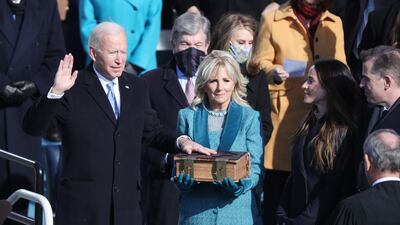
Joe Biden stands with his wife, Jill Biden, as he is given the oath of office by Chief Justice John Roberts of the Supreme Court. EPA -
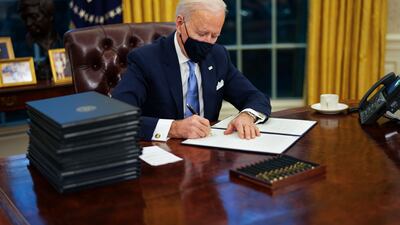
US President Joe Biden signs an executive order on Covid-19 during his first minutes in the Oval Office. EPA -
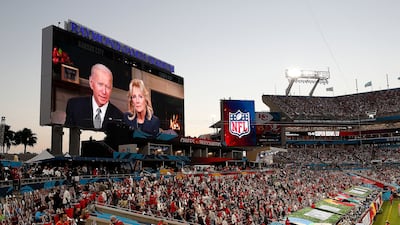
The US president and first lady address the National Football League Super Bowl LV between the Tampa Bay Buccaneers and the Kansas City Chiefs at Raymond James Stadium in Tampa, Florida, on February 7. EPA -
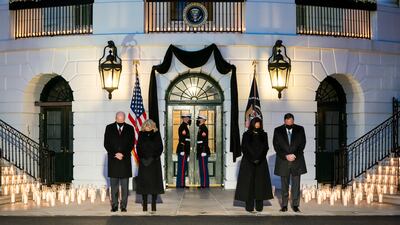
Mr Biden, left, Ms Biden, second left, Ms Harris, third left, and Second Gentleman Doug Emhoff hold a moment of silence outside the White House on February 22 for the 500,000 Americans who have died from Covid-19. EPA -
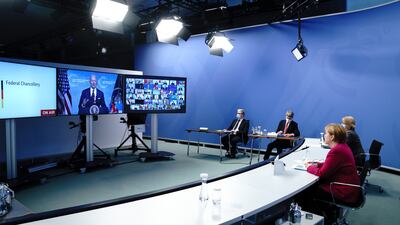
German Chancellor Angela Merkel takes part in the virtual international climate summit with Mr Biden on April 22 in Berlin, Germany. Getty Images -
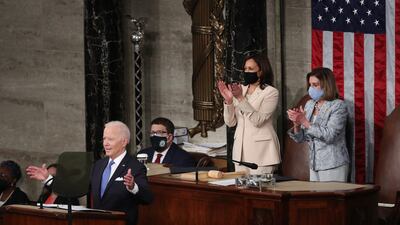
Mr Biden delivers his first address to a joint session of Congress on April 28 as Ms Harris, second right, and speaker of the United States House of Representatives Nancy Pelosi applaud. EPA -
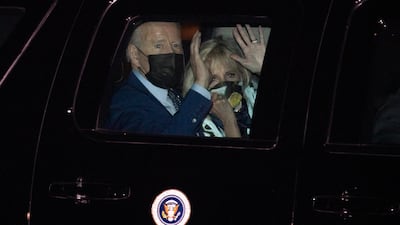
Mr Biden and the first lady are driven away following their arrival at the White House on April 29. EPA -
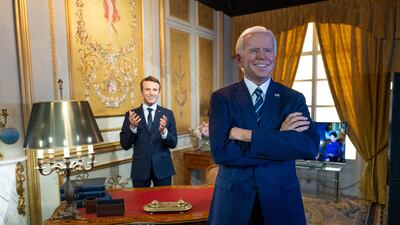
The president's wax figure is unveiled at Musee Grevin in Paris, France, on May 18. Getty Images -
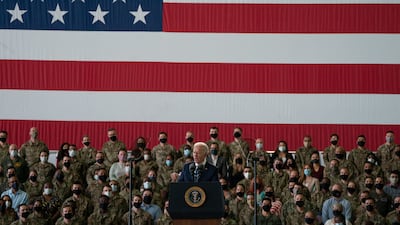
Mr Biden addresses US Air Force personnel on June 9 at RAF Mildenhall in Suffolk, England, ahead of the G7 summit in Cornwall. Getty Images -
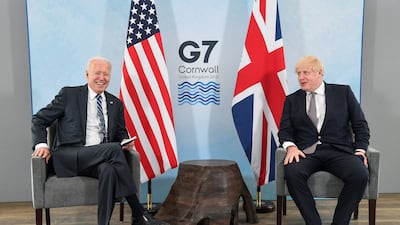
Britain's Prime Minister Boris Johnson speaks with Mr Biden during a meeting ahead of the G7 summit. Getty Images -
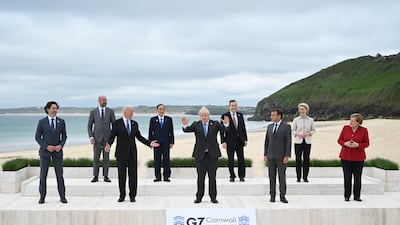
Left to right, Canadian Prime Minister Justin Trudeau, President of the European Council Charles Michel, Mr Biden, Japanese Prime Minister Yoshihide Suga, Mr Johnson, Italian Prime Minister Mario Draghi, French President Emmanuel Macron, President of the European Commission Ursula von der Leyen and Ms Merkel pose during the G7 Summit In Carbis Bay. Getty Images -
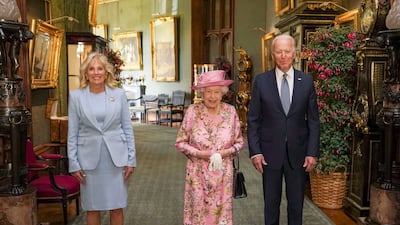
Queen Elizabeth II, centre, with Mr Biden and the first lady in the Grand Corridor at Windsor Castle on June 13. Getty Images -
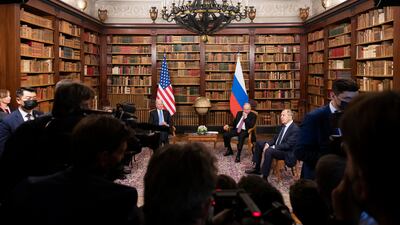
Mr Biden, Russian President Vladimir Putin and Russian Foreign Minister Sergei Lavrov meet during the US-Russia summit at Villa La Grange on June 16 in Geneva, Switzerland. Getty Images -
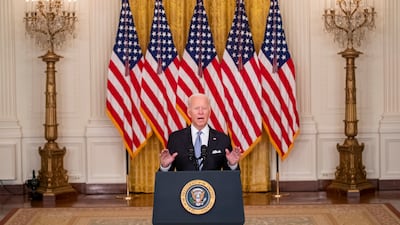
Mr Biden delivers remarks on Afghanistan in the East Room of the White House on August 16. EPA -
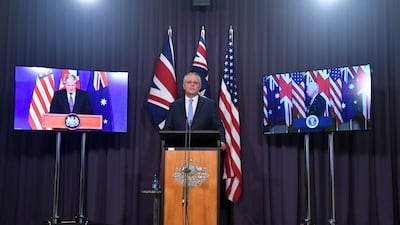
Mr Johnson, left, Australia's Prime Minister Scott Morrison, centre, and Mr Biden attend a press conference via audio visual link from Parliament House in Canberra, Australia. EPA -

President Biden receives his coronavirus booster vaccination in Washington on September 27. Reuters -
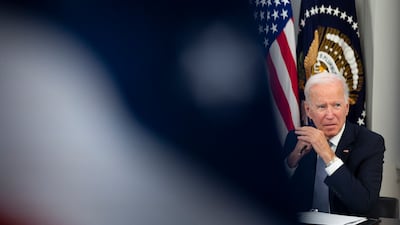
Mr Biden meets with members of his administration, business leaders and CEOs regarding the need to address the debt limit, on October 6. EPA -
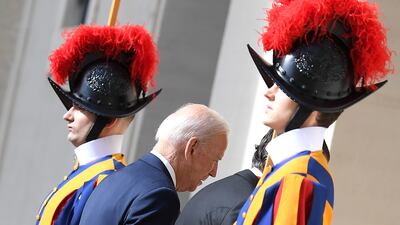
The US president walks past Swiss Guards as he arrives for a private audience with Pope Francis at the San Damaso courtyard in Vatican City on October 29. EPA -

Mr Biden arrives for the Cop26 UN Climate Summit on November 1 in Glasgow, Scotland. Getty Images -
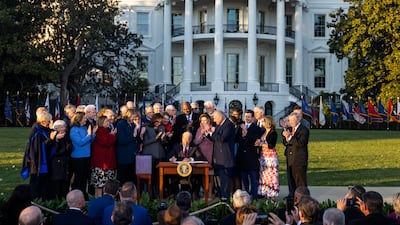
Mr Biden, surrounded by lawmakers, signs the bipartisan Infrastructure Investment and Jobs Act on the South Lawn of the White House on November 15. EPA -
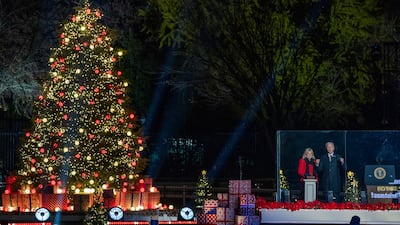
Mr Biden and his wife attend the 2021 National Christmas Tree lighting ceremony on the Ellipse in Washington on December 2. EPA -
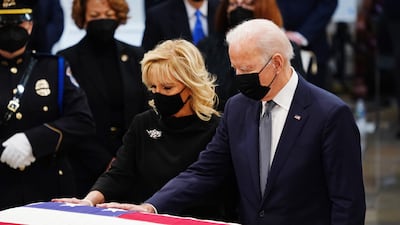
Mr and Mrs Biden at the casket of former senator Robert J Dole in Washington on December 9. EPA -

People walk past a big screen showing Mr Biden, left, and Chinese President Xi Jinping attending a virtual summit on November 16. EPA -
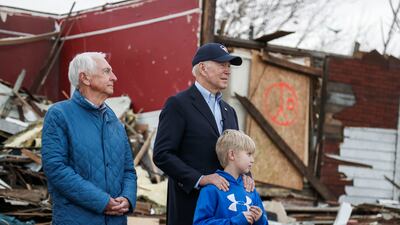
Mr Biden, centre, stands with former Kentucky governor Steve Beshear, left, and Dane Maddox as he inspects damage from a tornado that struck the state on December 10. EPA -
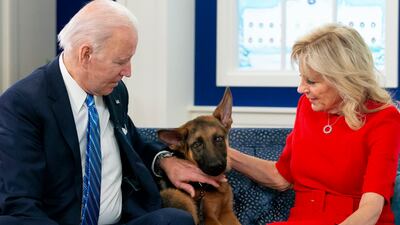
The president and the first lady pet their dog, a German Shepherd puppy named Commander, while virtually meeting with United States military service members on Christmas Day in the White House. EPA -

Mr Biden marks the one-year anniversary of the Capitol attack on January 6. EPA


News agencies contributed to this report

