The UAE, the US, Saudi Arabia and Britain expressed serious concerns on Wednesday over the situation in Sudan following last month's coup, calling for an immediate restoration of the civilian-led transitional government.
The four nations, known as the Quad of Sudan, said they stand “with the people of Sudan and emphasise the importance of supporting their aspirations for a democratic and peaceful nation".
“We endorse the international community’s serious concern with the situation in Sudan,” a joint statement read. “We call for the full and immediate restoration of its civilian-led transitional government and institutions.”
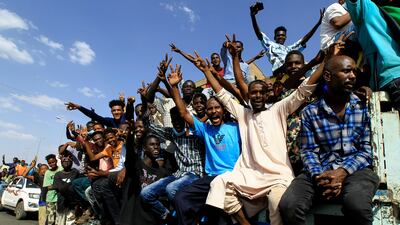
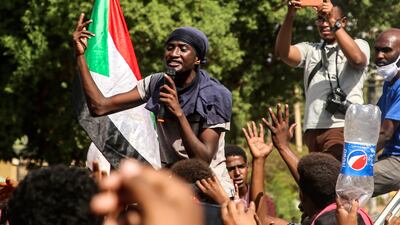
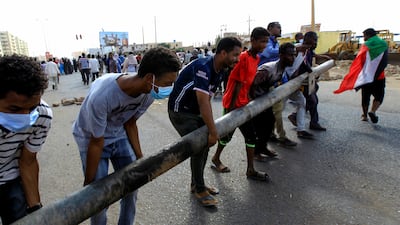
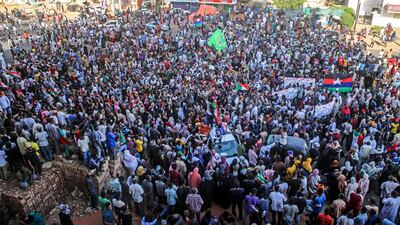
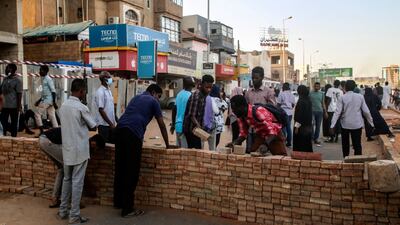
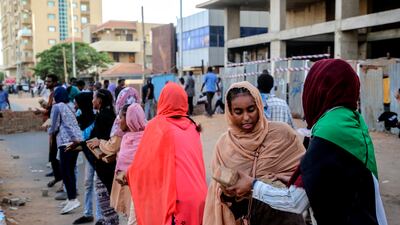
On Saturday, hundreds of thousands people protested across Sudan in rejection of the military power grab.
“The protests of October 30 demonstrated the depth of the Sudanese people’s commitment to advancing their country’s transition and we remain committed to helping them achieve these aspirations,” the statement read.
The Quad also called for all those detained in the coup to be released.
Sudanese Prime Minister Abdalla Hamdok remains under house arrest and others from his government have been detained.
Mr Hamdok has agreed to a conditional return as the head of a new government, a senior adviser to the ousted prime minister told The National on Wednesday.
His return is dependent on terms set by him, including the release of all political detainees and the reinstatement of the constitutional declaration, the adviser said.
The Quad called for dialogue between the various Sudanese factions and a commitment to the Juba Peace Agreement in restoring the civilian-led transitional government, which was meant to hold power until elections in 2023.
“This will help ensure Sudan reaches political stability and economic recovery so that it is able to continue the transitional period with the support of Sudan’s friends and international partners,” it said.
Both Saudi Arabia and the UAE hold political and economic leverage inside Sudan and have been involved in backchannel diplomacy to find a way forward after the coup.
Diplomatic efforts have so far focused on brokering a new arrangement between the military and the civilian leadership that could involve Mr Hamdok returning to power.
On Tuesday, US envoy to the Horn of Africa Jeffrey Feltman said Washington would support a Sudanese-brokered solution to the country's crisis.
For any resolution to work, Mr Feltman said “releasing all the detainees, allowing Prime Minister [Abdalla Hamdok] to do his job, [and] not be under house arrest are a priority”.
Sudan's top general and takeover leader, Gen Abdul Fattah Al Burhan, dissolved the Cabinet and the ruling military-civilian Sovereign Council, which had been charged with directing Sudan's transition to full civilian rule after the April 2019 overthrow of dictator Omar Al Bashir.
He also declared a state of emergency, detained Sudan's civilian leadership and suspended the work of a commission appointed by the civilian-led government in charge of dismantling the legacy of Al Bashir's 29-year rule.
The US suspended $700 million of assistance to Sudan following the coup.
Also on Wednesday, the tracking site Netblocks said internet access in Sudan has been limited for 10 days.

SUZUME
%3Cp%3EDirector%3A%20Makoto%20Shinkai%3C%2Fp%3E%0A%3Cp%3EStars%3A%20Nanoka%20Hara%2C%20Hokuto%20Matsumura%2C%20Eri%20Fukatsu%3C%2Fp%3E%0A%3Cp%3ERating%3A%204%2F5%3C%2Fp%3E%0A
How much do leading UAE’s UK curriculum schools charge for Year 6?
- Nord Anglia International School (Dubai) – Dh85,032
- Kings School Al Barsha (Dubai) – Dh71,905
- Brighton College Abu Dhabi - Dh68,560
- Jumeirah English Speaking School (Dubai) – Dh59,728
- Gems Wellington International School – Dubai Branch – Dh58,488
- The British School Al Khubairat (Abu Dhabi) - Dh54,170
- Dubai English Speaking School – Dh51,269
*Annual tuition fees covering the 2024/2025 academic year
Mercer, the investment consulting arm of US services company Marsh & McLennan, expects its wealth division to at least double its assets under management (AUM) in the Middle East as wealth in the region continues to grow despite economic headwinds, a company official said.
Mercer Wealth, which globally has $160 billion in AUM, plans to boost its AUM in the region to $2-$3bn in the next 2-3 years from the present $1bn, said Yasir AbuShaban, a Dubai-based principal with Mercer Wealth.
“Within the next two to three years, we are looking at reaching $2 to $3 billion as a conservative estimate and we do see an opportunity to do so,” said Mr AbuShaban.
Mercer does not directly make investments, but allocates clients’ money they have discretion to, to professional asset managers. They also provide advice to clients.
“We have buying power. We can negotiate on their (client’s) behalf with asset managers to provide them lower fees than they otherwise would have to get on their own,” he added.
Mercer Wealth’s clients include sovereign wealth funds, family offices, and insurance companies among others.
From its office in Dubai, Mercer also looks after Africa, India and Turkey, where they also see opportunity for growth.
Wealth creation in Middle East and Africa (MEA) grew 8.5 per cent to $8.1 trillion last year from $7.5tn in 2015, higher than last year’s global average of 6 per cent and the second-highest growth in a region after Asia-Pacific which grew 9.9 per cent, according to consultancy Boston Consulting Group (BCG). In the region, where wealth grew just 1.9 per cent in 2015 compared with 2014, a pickup in oil prices has helped in wealth generation.
BCG is forecasting MEA wealth will rise to $12tn by 2021, growing at an annual average of 8 per cent.
Drivers of wealth generation in the region will be split evenly between new wealth creation and growth of performance of existing assets, according to BCG.
Another general trend in the region is clients’ looking for a comprehensive approach to investing, according to Mr AbuShaban.
“Institutional investors or some of the families are seeing a slowdown in the available capital they have to invest and in that sense they are looking at optimizing the way they manage their portfolios and making sure they are not investing haphazardly and different parts of their investment are working together,” said Mr AbuShaban.
Some clients also have a higher appetite for risk, given the low interest-rate environment that does not provide enough yield for some institutional investors. These clients are keen to invest in illiquid assets, such as private equity and infrastructure.
“What we have seen is a desire for higher returns in what has been a low-return environment specifically in various fixed income or bonds,” he said.
“In this environment, we have seen a de facto increase in the risk that clients are taking in things like illiquid investments, private equity investments, infrastructure and private debt, those kind of investments were higher illiquidity results in incrementally higher returns.”
The Abu Dhabi Investment Authority, one of the largest sovereign wealth funds, said in its 2016 report that has gradually increased its exposure in direct private equity and private credit transactions, mainly in Asian markets and especially in China and India. The authority’s private equity department focused on structured equities owing to “their defensive characteristics.”
Dengue%20fever%20symptoms
%3Cp%3EHigh%20fever%20(40%C2%B0C%2F104%C2%B0F)%3Cbr%3ESevere%20headache%3Cbr%3EPain%20behind%20the%20eyes%3Cbr%3EMuscle%20and%20joint%20pains%3Cbr%3ENausea%3Cbr%3EVomiting%3Cbr%3ESwollen%20glands%3Cbr%3ERash%26nbsp%3B%3C%2Fp%3E%0A
COMPANY%20PROFILE
%3Cp%3E%3Cstrong%3ECompany%20name%3A%3C%2Fstrong%3E%20Clinicy%3Cbr%3E%3Cstrong%3EStarted%3A%3C%2Fstrong%3E%202017%3Cbr%3E%3Cstrong%3EFounders%3A%3C%2Fstrong%3E%20Prince%20Mohammed%20Bin%20Abdulrahman%2C%20Abdullah%20bin%20Sulaiman%20Alobaid%20and%20Saud%20bin%20Sulaiman%20Alobaid%3Cbr%3E%3Cstrong%3EBased%3A%3C%2Fstrong%3E%20Riyadh%3Cbr%3E%3Cstrong%3ENumber%20of%20staff%3A%3C%2Fstrong%3E%2025%3Cbr%3E%3Cstrong%3ESector%3A%3C%2Fstrong%3E%20HealthTech%3Cbr%3E%3Cstrong%3ETotal%20funding%20raised%3A%3C%2Fstrong%3E%20More%20than%20%2410%20million%3Cbr%3E%3Cstrong%3EInvestors%3A%3C%2Fstrong%3E%20Middle%20East%20Venture%20Partners%2C%20Gate%20Capital%2C%20Kafou%20Group%20and%20Fadeed%20Investment%3C%2Fp%3E%0A
The most expensive investment mistake you will ever make
When is the best time to start saving in a pension? The answer is simple – at the earliest possible moment. The first pound, euro, dollar or dirham you invest is the most valuable, as it has so much longer to grow in value. If you start in your twenties, it could be invested for 40 years or more, which means you have decades for compound interest to work its magic.
“You get growth upon growth upon growth, followed by more growth. The earlier you start the process, the more it will all roll up,” says Chris Davies, chartered financial planner at The Fry Group in Dubai.
This table shows how much you would have in your pension at age 65, depending on when you start and how much you pay in (it assumes your investments grow 7 per cent a year after charges and you have no other savings).
|
Age
|
$250 a month
|
$500 a month
|
$1,000 a month
|
|
25
|
$640,829
|
$1,281,657
|
$2,563,315
|
|
35
|
$303,219
|
$606,439
|
$1,212,877
|
|
45
|
$131,596
|
$263,191
|
$526,382
|
|
55
|
$44,351
|
$88,702
|
$177,403
|
The biog
Name: Greg Heinricks
From: Alberta, western Canada
Record fish: 56kg sailfish
Member of: International Game Fish Association
Company: Arabian Divers and Sportfishing Charters
Email sent to Uber team from chief executive Dara Khosrowshahi
From: Dara
To: Team@
Date: March 25, 2019 at 11:45pm PT
Subj: Accelerating in the Middle East
Five years ago, Uber launched in the Middle East. It was the start of an incredible journey, with millions of riders and drivers finding new ways to move and work in a dynamic region that’s become so important to Uber. Now Pakistan is one of our fastest-growing markets in the world, women are driving with Uber across Saudi Arabia, and we chose Cairo to launch our first Uber Bus product late last year.
Today we are taking the next step in this journey—well, it’s more like a leap, and a big one: in a few minutes, we’ll announce that we’ve agreed to acquire Careem. Importantly, we intend to operate Careem independently, under the leadership of co-founder and current CEO Mudassir Sheikha. I’ve gotten to know both co-founders, Mudassir and Magnus Olsson, and what they have built is truly extraordinary. They are first-class entrepreneurs who share our platform vision and, like us, have launched a wide range of products—from digital payments to food delivery—to serve consumers.
I expect many of you will ask how we arrived at this structure, meaning allowing Careem to maintain an independent brand and operate separately. After careful consideration, we decided that this framework has the advantage of letting us build new products and try new ideas across not one, but two, strong brands, with strong operators within each. Over time, by integrating parts of our networks, we can operate more efficiently, achieve even lower wait times, expand new products like high-capacity vehicles and payments, and quicken the already remarkable pace of innovation in the region.
This acquisition is subject to regulatory approval in various countries, which we don’t expect before Q1 2020. Until then, nothing changes. And since both companies will continue to largely operate separately after the acquisition, very little will change in either teams’ day-to-day operations post-close. Today’s news is a testament to the incredible business our team has worked so hard to build.
It’s a great day for the Middle East, for the region’s thriving tech sector, for Careem, and for Uber.
Uber on,
Dara
More from Neighbourhood Watch