How West Virginia lost the vaccination war


Willy Lowry
  • English
  • Arabic

Dr Clay Marsh sits in his first-floor office at West Virginia University and stares at two large monitors displaying the state’s latest Covid-19 case numbers and vaccination rates.

Neither are good. The state is coming out of a brutal third wave in which local hospitals ran out of beds and intensive care units filled up with severe cases of the disease.

“It's been really tough,” said Dr Marsh, who is heading West Virginia’s efforts against Covid-19.

“It's also tough because this was something that we knew was coming and we started to kind of sound the alarm bells, you know, a month and a half before we really even had that many cases of the Delta variant.”

Despite ample warning about the Delta variant and its high levels of transmissibility, the state's vaccination rate of about 40 per cent left West Virginians extremely susceptible.

It swept through the rural, mountainous state, infecting as many as 2,300 people in a single day, a shockingly high number in a state of about 1.8 million residents.

West Virginia’s elderly population, many with underlying health conditions, is especially susceptible to more serious cases of Covid-19.

To date, more than 4,000 people there have died from the virus.

A recent study on Covid-19 by Wallethub — which examined data on state vaccination rates, rates of transmission, positive testing, hospital admission and death — showed West Virginia was one of the least safe states to live in during the pandemic.

The study also showed that West Virginia has the highest death rate from Covid-19 in the country.

What went wrong?

In February, West Virginia, long associated with poverty and health problems, shocked experts across the country by becoming the first state to vaccinate the entire population of nursing home residents and, at one point, by having the second-highest vaccination rate in the country, closely trailing Alaska.

It was also the only state to opt out of the federal government’s vaccine programme, which united with major US pharmacy chains Walgreens and CVS to inoculate residents of long-term care homes.

Instead of running their programme through major pharmacies, West Virginia went local, using the deep roots that small-town pharmacies have in their communities.

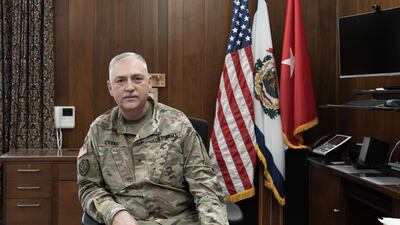
  • Brig Gen Bill Crane, head of the West Virginia National Guard, at his desk. Willy Lowry / The National
    Brig Gen Bill Crane, head of the West Virginia National Guard, at his desk. Willy Lowry / The National
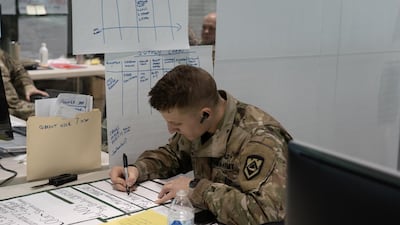
  • A West Virginia National Guardsman takes notes inside the state's joint inter-agency task force for the Covid-19 Vaccine. Willy Lowry / The National
    A West Virginia National Guardsman takes notes inside the state's joint inter-agency task force for the Covid-19 Vaccine. Willy Lowry / The National
  • West Virginia National Guardsmen pass notes inside the state's joint interagency task force for the Covid-19 vaccine. Willy Lowry / The National
    West Virginia National Guardsmen pass notes inside the state's joint interagency task force for the Covid-19 vaccine. Willy Lowry / The National
  • A West Virginia National Guardsman writes on a poster board inside the state's joint interagency task force for the Covid-19 Vaccine. Willy Lowry / The National
    A West Virginia National Guardsman writes on a poster board inside the state's joint interagency task force for the Covid-19 Vaccine. Willy Lowry / The National
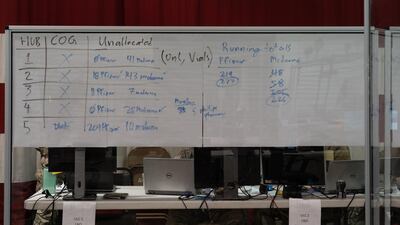
  • A white board inside the joint interagency task force shows unallocated vaccine numbers at the state's five hubs. Willy Lowry / The National
    A white board inside the joint interagency task force shows unallocated vaccine numbers at the state's five hubs. Willy Lowry / The National
  • The West Virginia National Guard have transformed their armoury building's gymnasium into a joint interagency task force for the Covid-19 vaccine. Willy Lowry / The National
    The West Virginia National Guard have transformed their armoury building's gymnasium into a joint interagency task force for the Covid-19 vaccine. Willy Lowry / The National
  • A West Virginian waits outside Covid-19 vaccine clinic near Morgantown, West Virginia. Willy Lowry / The National
    A West Virginian waits outside Covid-19 vaccine clinic near Morgantown, West Virginia. Willy Lowry / The National
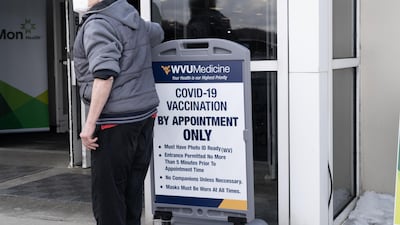
  • A sign saying "Vaccines by appointments only" outside a strip mall near Morgantown, West Virginia. Willy Lowry / The National
    A sign saying "Vaccines by appointments only" outside a strip mall near Morgantown, West Virginia. Willy Lowry / The National
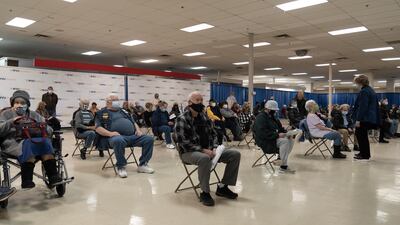
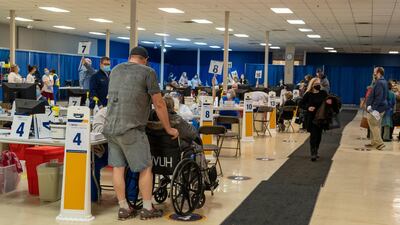
  • People wait inside a former Sears department store outside of Morgantown after receiving a dose of the Covid-19 vaccine. Willy Lowry / The National
    People wait inside a former Sears department store outside of Morgantown after receiving a dose of the Covid-19 vaccine. Willy Lowry / The National
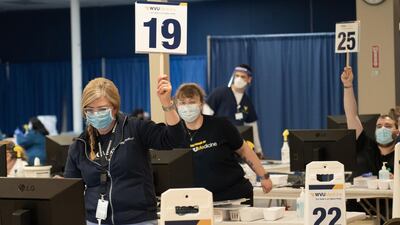
  • Healthcare workers hold up numbers showing they are ready administer more doses of the Covid-19 vaccine at a clinic outside of Morgantown, West Virginia. Willy Lowry / The National
    Healthcare workers hold up numbers showing they are ready administer more doses of the Covid-19 vaccine at a clinic outside of Morgantown, West Virginia. Willy Lowry / The National
  • West Virginia University has transformed an old Sears department store into a major Covid-19 vaccine clinic. Willy Lowry / The National
    West Virginia University has transformed an old Sears department store into a major Covid-19 vaccine clinic. Willy Lowry / The National
  • A healthcare worker injects a West Virginian with a dose of the Covid-19 vaccine. Willy Lowry / The National
    A healthcare worker injects a West Virginian with a dose of the Covid-19 vaccine. Willy Lowry / The National
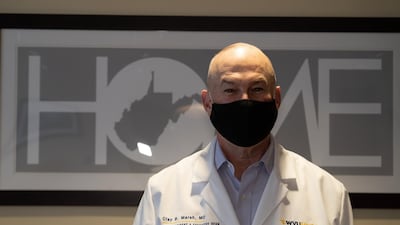
  • Dr Clay Marsh, West Virginia's Covid-19 chief, in front of a map of West Virginia inside his Morgantown office. Willy Lowry / The National
    Dr Clay Marsh, West Virginia's Covid-19 chief, in front of a map of West Virginia inside his Morgantown office. Willy Lowry / The National
  • Dr Clay Marsh, West Virginia's Covid-19 chief, works at his office at West Virginia University in Morgantown. Willy Lowry / The National
    Dr Clay Marsh, West Virginia's Covid-19 chief, works at his office at West Virginia University in Morgantown. Willy Lowry / The National
  • A healthcare worker at a vaccine side inspects a dose of the Covid-19 vaccine. Willy Lowry / The National
    A healthcare worker at a vaccine side inspects a dose of the Covid-19 vaccine. Willy Lowry / The National
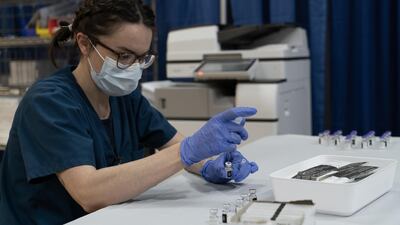
  • A healthcare worker prepares a dose of the Covid-19 vaccine. Willy Lowry / The National
    A healthcare worker prepares a dose of the Covid-19 vaccine. Willy Lowry / The National
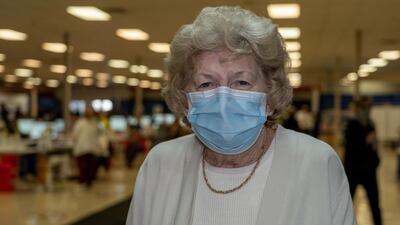
  • Alice Dean, 80, received her second dose of the Covid-19 vaccine at clinic outside of Morgantown, West Virginia. Willy Lowry / The National
    Alice Dean, 80, received her second dose of the Covid-19 vaccine at clinic outside of Morgantown, West Virginia. Willy Lowry / The National
  • West Virginia University has transformed an old Sears department store into a major Covid-19 vaccine clinic. Willy Lowry / The National
    West Virginia University has transformed an old Sears department store into a major Covid-19 vaccine clinic. Willy Lowry / The National
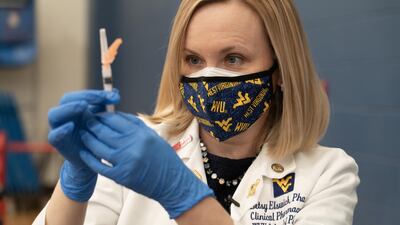
  • Betsy Elswick, a pharmacist at West Virginia University in Morgantown inspects a vial of vaccine. Willy Lowry / The National
    Betsy Elswick, a pharmacist at West Virginia University in Morgantown inspects a vial of vaccine. Willy Lowry / The National

At first, this approach was highly successful. With the help of the West Virginia National Guard, who are in charge of logistics and the distribution of the vaccine, local pharmacists were able to administer shots at an extremely fast pace, even in difficult-to-reach areas.

But eventually, the state ran out of willing patients.

West Virginia was once the epicentre of American coal production, home to millionaires and thriving towns. Today, however, coal production has slowed to a trickle and the economy is struggling. Locals pride themselves on their rural roots and possess a fierce independent streak that often manifests itself as a deep mistrust of Washington.

The State’s Republican governor, Jim Justice, has tried everything apart from mandates to convince people to be inoculated.

In June, he offered residents the chance to win a hunting rifle in exchange for being vaccinated.

Then, in August, Mr Justice launched a vaccine lottery called “Do it for Babydog”, named after his 1-year-old English bulldog, to incentivise people to take the shot.

Jim Justice and his dog, Babydog, flip the coin to begin the American football game at Mountaineer Field at Milan Puskar Stadium. Phot: USA TODAY Sports

“If you won’t do it for me, if you won’t do it for your family, you’ve got to get vaccinated for Babydog,” Mr Justice said.

“She wants you vaccinated so badly.”

But efforts have been mostly in vain and as the months went by, the hope state officials had of seeing a majority of West Virginians vaccinated slowly faded.

Dr Marsh admits a huge portion of the state is unlikely to change its mind.

“We know that in our country, people enjoy the right to make decisions about what they want to do and don't want to do,” Dr Marsh told The National.

“In the current environment, we respect that right. And even though for us, we know the consequences of not being fully vaccinated as potentially getting severely ill with Covid-19, going to the hospital [and possibly] dying.”

The Covid-19 chief and his team continue to work tirelessly to offer the vaccine to as many people as possible.

Dr Clay Marsh, West Virginia's Covid head, at his office in Morgantown, West Virginia. Willy Lowry / The National

Dr Krista Capehart, an associate professor at West Virginia University's School of Pharmacy in Morgantown, recalls travelling more than three hours along rugged roads, one way, to vaccinate a few people at a coal mine.

“When you get into rural areas, they need to have that connection and understand that people do care,” she said.

“They need to have that one-on-one connection; they need their questions answered.”

Dr Capehart said many are hesitant to take the vaccine and have been filled with misinformation, leading them to question whether the shot will really protect them.

Mr Justice has lashed out at conspiracy theorists.

“For God’s sake, how difficult is this to understand?” he said during a September press conference.

“Why in the world do we have to come up with these crazy ideas — and they’re crazy ideas — that the vaccine has something in it and it's tracing people wherever they go?”

But it’s not only conspiracy theories that officials have to combat — it's apathy as well.

“Mostly, it's just an inconvenience,” said a student at West Virginia University who hasn’t yet been vaccinated. “I’m not going to go out of my way to go get it.”

Apathy combined with a belief in the need to defend civil liberties has stymied not only West Virginia's vaccination efforts but those of the country as a whole. Only 58 per cent of Americans are vaccinated, which is above the world average but far behind many G20 countries.

With hope this frail, Dr Marsh often turns to the parable of the starfish for motivation.

In the story, a young boy on a beach sees dozens of stranded starfish and slowly starts throwing them back in the water. When an adult tells him to give up, that there is no way he can save them all, the boy says, “You may be right, but for the ones that we do help, it will make a big difference.”


The bio

His favourite book - 1984 by George Orwell

His favourite quote - 'If you think education is expensive, try ignorance' by Derek Bok, Former President of Harvard

Favourite place to travel to - Peloponnese, Southern Greece

Favourite movie - The Last Emperor

Favourite personality from history - Alexander the Great

Role Model - My father, Yiannis Davos


Company Profile

Name: Thndr
Started: 2019
Co-founders: Ahmad Hammouda and Seif Amr
Sector: FinTech
Headquarters: Egypt
UAE base: Hub71, Abu Dhabi
Current number of staff: More than 150
Funds raised: $22 million

SRI LANKA SQUAD

Upul Tharanga (captain), Dinesh Chandimal, Niroshan Dickwella
Lahiru Thirimanne, Kusal Mendis, Milinda Siriwardana
Chamara Kapugedara, Thisara Perera, Seekuge Prasanna
Nuwan Pradeep, Suranga Lakmal, Dushmantha Chameera
Vishwa Fernando, Akila Dananjaya, Jeffrey Vandersay

Company profile

Name: Tharb

Started: December 2016

Founder: Eisa Alsubousi

Based: Abu Dhabi

Sector: Luxury leather goods

Initial investment: Dh150,000 from personal savings


COMPANY%20PROFILE
%3Cp%3E%3Cstrong%3EName%3A%3C%2Fstrong%3E%20PlanRadar%3Cbr%3E%3Cstrong%3EStarted%3A%20%3C%2Fstrong%3E2013%3Cbr%3E%3Cstrong%3ECo-founders%3A%20%3C%2Fstrong%3EIbrahim%20Imam%2C%20Sander%20van%20de%20Rijdt%2C%20Constantin%20K%C3%B6ck%2C%20Clemens%20Hammerl%2C%20Domagoj%20Dolinsek%3Cbr%3E%3Cstrong%3EBased%3A%20%3C%2Fstrong%3EVienna%2C%20Austria%3Cbr%3E%3Cstrong%3ESector%3A%20%3C%2Fstrong%3EConstruction%20and%20real%20estate%3Cbr%3E%3Cstrong%3ECurrent%20number%20of%20staff%3A%20%3C%2Fstrong%3E400%2B%3Cbr%3E%3Cstrong%3EInvestment%20stage%3A%20%3C%2Fstrong%3ESeries%20B%3Cbr%3E%3Cstrong%3EInvestors%3A%3C%2Fstrong%3E%20Headline%2C%20Berliner%20Volksbank%20Ventures%2C%20aws%20Gr%C3%BCnderfonds%2C%20Cavalry%20Ventures%2C%20Proptech1%2C%20Russmedia%2C%20GR%20Capital%3C%2Fp%3E%0A
The Sheikh Zayed Future Energy Prize

This year’s winners of the US$4 million Sheikh Zayed Future Energy Prize will be recognised and rewarded in Abu Dhabi on January 15 as part of Abu Dhabi Sustainable Week, which runs in the capital from January 13 to 20.

From solutions to life-changing technologies, the aim is to discover innovative breakthroughs to create a new and sustainable energy future.

Ten tax points to be aware of in 2026

1. Domestic VAT refund amendments: request your refund within five years

If a business does not apply for the refund on time, they lose their credit.

2. E-invoicing in the UAE

Businesses should continue preparing for the implementation of e-invoicing in the UAE, with 2026 a preparation and transition period ahead of phased mandatory adoption. 

3. More tax audits

Tax authorities are increasingly using data already available across multiple filings to identify audit risks. 

4. More beneficial VAT and excise tax penalty regime

Tax disputes are expected to become more frequent and more structured, with clearer administrative objection and appeal processes. The UAE has adopted a new penalty regime for VAT and excise disputes, which now mirrors the penalty regime for corporate tax.

5. Greater emphasis on statutory audit

There is a greater need for the accuracy of financial statements. The International Financial Reporting Standards standards need to be strictly adhered to and, as a result, the quality of the audits will need to increase.

6. Further transfer pricing enforcement

Transfer pricing enforcement, which refers to the practice of establishing prices for internal transactions between related entities, is expected to broaden in scope. The UAE will shortly open the possibility to negotiate advance pricing agreements, or essentially rulings for transfer pricing purposes. 

7. Limited time periods for audits

Recent amendments also introduce a default five-year limitation period for tax audits and assessments, subject to specific statutory exceptions. While the standard audit and assessment period is five years, this may be extended to up to 15 years in cases involving fraud or tax evasion. 

8. Pillar 2 implementation 

Many multinational groups will begin to feel the practical effect of the Domestic Minimum Top-Up Tax (DMTT), the UAE's implementation of the OECD’s global minimum tax under Pillar 2. While the rules apply for financial years starting on or after January 1, 2025, it is 2026 that marks the transition to an operational phase.

9. Reduced compliance obligations for imported goods and services

Businesses that apply the reverse-charge mechanism for VAT purposes in the UAE may benefit from reduced compliance obligations. 

10. Substance and CbC reporting focus

Tax authorities are expected to continue strengthening the enforcement of economic substance and Country-by-Country (CbC) reporting frameworks. In the UAE, these regimes are increasingly being used as risk-assessment tools, providing tax authorities with a comprehensive view of multinational groups’ global footprints and enabling them to assess whether profits are aligned with real economic activity. 

Contributed by Thomas Vanhee and Hend Rashwan, Aurifer

The Gandhi Murder
  • 71 - Years since the death of MK Gandhi, also christened India's Father of the Nation
  • 34 - Nationalities featured in the film The Gandhi Murder
  • 7 - million dollars, the film's budget 
Dust and sand storms compared

Sand storm

  • Particle size: Larger, heavier sand grains
  • Visibility: Often dramatic with thick "walls" of sand
  • Duration: Short-lived, typically localised
  • Travel distance: Limited 
  • Source: Open desert areas with strong winds

Dust storm

  • Particle size: Much finer, lightweight particles
  • Visibility: Hazy skies but less intense
  • Duration: Can linger for days
  • Travel distance: Long-range, up to thousands of kilometres
  • Source: Can be carried from distant regions
The rules on fostering in the UAE

A foster couple or family must:

  • be Muslim, Emirati and be residing in the UAE
  • not be younger than 25 years old
  • not have been convicted of offences or crimes involving moral turpitude
  • be free of infectious diseases or psychological and mental disorders
  • have the ability to support its members and the foster child financially
  • undertake to treat and raise the child in a proper manner and take care of his or her health and well-being
  • A single, divorced or widowed Muslim Emirati female, residing in the UAE may apply to foster a child if she is at least 30 years old and able to support the child financially
Specs

Engine: 51.5kW electric motor

Range: 400km

Power: 134bhp

Torque: 175Nm

Price: From Dh98,800

Available: Now

Who's who in Yemen conflict

Houthis: Iran-backed rebels who occupy Sanaa and run unrecognised government

Yemeni government: Exiled government in Aden led by eight-member Presidential Leadership Council

Southern Transitional Council: Faction in Yemeni government that seeks autonomy for the south

Habrish 'rebels': Tribal-backed forces feuding with STC over control of oil in government territory

Company%C2%A0profile
%3Cp%3E%3Cstrong%3ECompany%20name%3A%20%3C%2Fstrong%3Eamana%3Cbr%3E%3Cstrong%3EStarted%3A%20%3C%2Fstrong%3E2010%3Cbr%3E%3Cstrong%3EFounders%3A%3C%2Fstrong%3E%20Karim%20Farra%20and%20Ziad%20Aboujeb%3Cbr%3E%3Cstrong%3EBased%3A%20%3C%2Fstrong%3EUAE%3Cbr%3E%3Cstrong%3ERegulator%3A%20%3C%2Fstrong%3EDFSA%3Cbr%3E%3Cstrong%3ESector%3A%20%3C%2Fstrong%3EFinancial%20services%3Cbr%3E%3Cstrong%3ECurrent%20number%20of%20staff%3A%20%3C%2Fstrong%3E85%3Cbr%3E%3Cstrong%3EInvestment%20stage%3A%20%3C%2Fstrong%3ESelf-funded%3Cbr%3E%3C%2Fp%3E%0A
The President's Cake

Director: Hasan Hadi

Starring: Baneen Ahmad Nayyef, Waheed Thabet Khreibat, Sajad Mohamad Qasem 

Rating: 4/5

Ultra processed foods

- Carbonated drinks, sweet or savoury packaged snacks, confectionery, mass-produced packaged breads and buns 

- margarines and spreads; cookies, biscuits, pastries, cakes, and cake mixes, breakfast cereals, cereal and energy bars;

- energy drinks, milk drinks, fruit yoghurts and fruit drinks, cocoa drinks, meat and chicken extracts and instant sauces

- infant formulas and follow-on milks, health and slimming products such as powdered or fortified meal and dish substitutes,

- many ready-to-heat products including pre-prepared pies and pasta and pizza dishes, poultry and fish nuggets and sticks, sausages, burgers, hot dogs, and other reconstituted meat products, powdered and packaged instant soups, noodles and desserts.

Updated: October 24, 2021, 4:48 AM