
Thousands of people were under evacuation orders on Friday and many others were on notice to be ready to flee as a destructive bushfire raged in a drought-stricken forest in California’s far north.
A woman suspected of starting the Fawn Fire was under arrest, authorities said.
The fire in the Mountain Gate area north of the city of Redding covered over 23 square kilometres and was 10 per cent contained, the California Department of Forestry and Fire Protection, or Cal Fire, reported.
“Approximately 4,000 Shasta County residents are evacuated at this time with 30,000 residents affected,” the Shasta County Sheriff’s Office said on Thursday night.
Cal Fire said at least 25 structures had burnt. Photos and video showed some homes blazing but the number of residences lost was not known. Damage inspection teams were conducting assessments, Cal Fire said.
The fire erupted at 4.45pm on Wednesday and grew explosively in hot and gusty weather Thursday in the region 322 kilometres north of San Francisco. Weather on Friday was expected to remain hot but with light winds.
Alexandra Souverneva, 30, of Palo Alto was placed under arrest on suspicion of starting the fire, Cal Fire said.
-
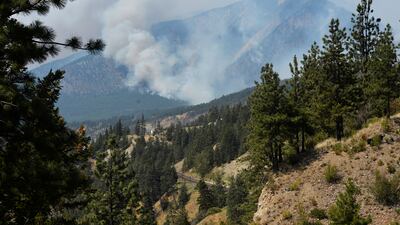
A wildfire burns outside of the town of Lytton, where a wildfire raged through and forced everyone to evacuate, in British Columbia, Canada, July 1, 2021. -
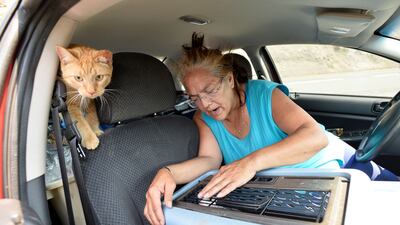
Martha Van Dyke of Lytton sits in her car with her cats, Tigger and Kona, after a wildfire that raged through her town forced residents to evacuate, outside of Lytton, British Columbia. -

Structures destroyed by a wildfire are seen in Lytton, British Columbia. -

A wildfire burns outside of the town of Lytton. -

The roughly 1,000 residents of Lytton had to abandon their homes with just a few minutes notice Wednesday evening, after searing the previous day under a record high of 121. 2 F (49. 6 C). -

The sign for the town of Lytton, where a wildfire raged through and forced residents to evacuate, is seen in Lytton, British Columbia. -
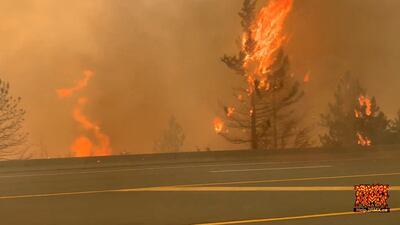
Trees burn along a street during a wildfire in Lytton, British Columbia, June 30, 2021 in this still image obtained from a social media video. -
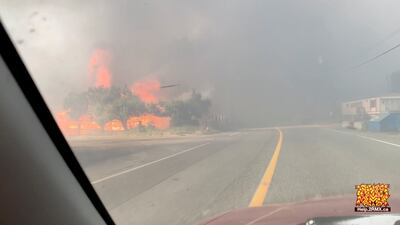
Flames are seen along a street during a wildfire in Lytton, British Columbia in this still image obtained from a social media video. -
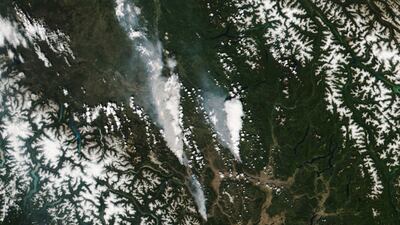
A handout satellite image made available by the National Aeronautics and Space Administration (NASA) shows the McKay Creek fire, left; the Sparks Lake fire, right; and smaller fire, visible just south of the town of Lytton, British Columbia. -
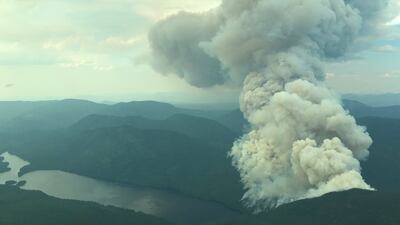
The plume of smoke from wildfire C31056, near McKinley Lake and about 35 kilometres east of Horsefly, British Columbia. -

Two plumes of smoke from the Long Loch wildfire (K51040) and the Derrickson Lake wildfire (K51041), British Columbia. -

A wildfire is seen from an airplane, in Lytton, British Columbia. -
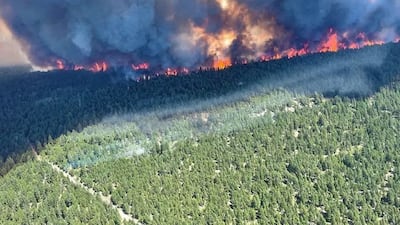
The Sparks Lake wildfire, British Columbia, is seen from the air on June 29, 2021.


Workers at a quarry reported seeing a woman acting strangely and trespassing on Wednesday. Cal Fire said Ms Souverneva later walked out of the brush near the fire line, approached firefighters and told them she was dehydrated and needed medical help.
During an interview with Cal Fire and law enforcement, officers came to believe Ms Souverneva was responsible for setting the fire, officials said. She was booked into the Shasta County Jail. It wasn’t immediately known if she has a lawyer.
Ms Souverneva, who had a lighter in her pocket when she approached firefighters, was charged on Friday with felony arson to wildland with an enhancement due to the declared state of emergency California is under, said Shasta County District Attorney Stephanie Bridgett.
She is also being investigated for starting other fires in Shasta County and throughout the state, Ms Bridgett said.
The Fawn Fire is the latest destructive fire to send Californians fleeing this year. Fires have burnt over 9,300 square kilometres so far in 2021, destroying more than 3,200 homes, commercial properties and other structures.
Those fires include two big forest blazes growing in the heart of California’s giant sequoia country on the western slope of the Sierra Nevada.
Smoke from those fires raised air quality concerns in the San Joaquin Valley below the Sierra and also darkened skies over greater Los Angeles on Thursday. South coast air regulators issued a smoke advisory but said the heaviest smoke would remain in the upper atmosphere and impacts on surface air quality would be in local mountain ranges.
Historic drought tied to climate change is making fires harder to fight and they have killed millions of trees in California alone. Scientists say climate change has made the West much warmer and drier in the past 30 years and will continue to make weather more extreme and fires more frequent and destructive.

