


US President Joe Biden is still facing immense political blowback weeks after his chaotic military withdrawal from Afghanistan, but he already finds himself with even fewer options to ameliorate the crisis than he had before the Taliban takeover.
Republicans in Congress see ripe political fodder to use against the Democratic president, even going so far as to hire a special investigator to look into the withdrawal. Meanwhile, Biden administration officials are being forced to contend with more limited criticism from the president’s own party.
Even as the Biden administration continues to fly American citizens and Afghans who assisted the US military out of the country, the president must weigh what Washington’s future relationship with the Taliban will look like, how to maintain counter-terrorism capabilities in Afghanistan and how to continue delivering sorely needed humanitarian aid.
“The policy options were bad before and they’re even more limited now,” Scott Worden, director for Afghanistan and Central Asia at the US Institute of Peace, told The National.
“With the removal of troops and Taliban takeover of Afghanistan, the US leverage of the situation is even less than it was before August 15.
“The US interests in Afghanistan remain the same, which is ultimately protecting the homeland from terrorism threats.”
Although Office of National Intelligence Director Avril Haines said on Monday that countries such as Syria and Somalia pose a larger threat to the US, Afghanistan is still on Washington’s radar as it monitors the potential reconstitution of terrorist groups such as Al Qaeda and ISIS in the country.
However, she noted that the US withdrawal has made it more difficult for the US to collect accurate intelligence on these groups.
“Now, our ability to both detect terrorism threats through covert means or otherwise is vastly diminished and our ability to respond to those threats that we do detect are mostly limited because over-the-horizon operations, while theoretically possible, are difficult to achieve,” said Mr Worden.
-
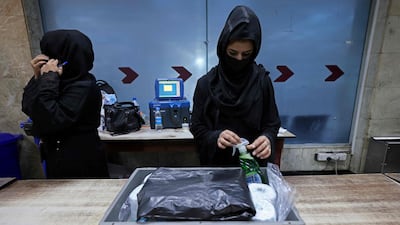
Afghan women airport workers are pictured at a security checkpoint of the airport in Kabul. AFP -
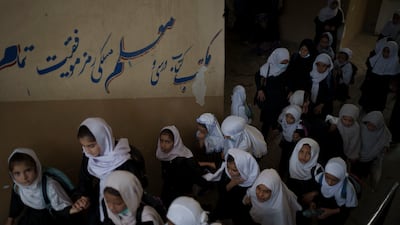
Girls walk upstairs as they enter a school before class in Kabul. AP -
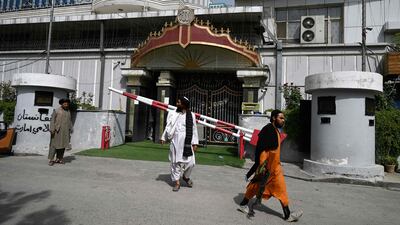
Taliban fighters outside the home of the Afghan warlord Abdul Rashid Dostum in the Sherpur neighbourhood of Kabul. AFP -
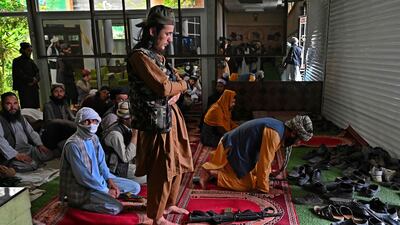
Taliban fighters offer noon payers inside the home of Afghan warlord Abdul Rashid Dostum in the Sherpur neighbourhood of Kabul. AFP -
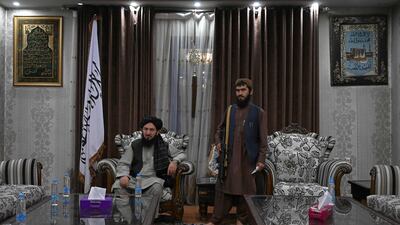
Qari Salahuddin Ayoubi, left, one of the military commanders of the Taliban, watches after an interview with AFP inside the home of the Afghan warlord Abdul Rashid Dostum in the Sherpur neighborhood of Kabul. AFP -

Taliban fighters take their selfie inside the home of the Afghan warlord Abdul Rashid Dostum in the Sherpur neighbourhood of Kabul. AFP -

A vendor sells balloons on a road in Kabul. EPA -
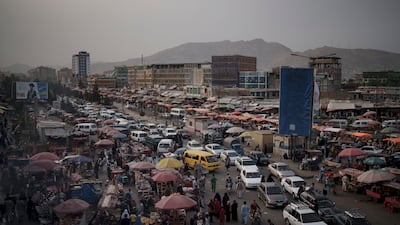
Cars wait in traffic as Afghans shop in a local market in Kabul. AP


As it withdrew its forces from Afghanistan, the US negotiated to use other countries such as Tajikistan and Uzbekistan as bases to continue counter-terrorism operations.
But the Biden administration failed to reach any agreements, meaning that any aerial strikes will have to come from US bases in the Arabian Gulf, necessitating a multi-hour trip to targets in Afghanistan.
In the meantime, Pakistan is set to expand its influence in the region, while Chinese and Russian engagement with the Taliban could provide it with a veneer of international legitimacy, further limiting US diplomatic options at the UN.
“The Biden administration really has to be working with the region more and has to figure out a way to balance the need for stability within Afghanistan for basic governance to be accomplished — so you don’t have a humanitarian crisis — with the need to apply political pressure on the Taliban to adhere to their counter-terrorism commitments and to their basic commitments on human rights,” said Mr Worden.
Critics of Mr Biden’s withdrawal on Capitol Hill have eagerly highlighted the new counter-terrorism limitations in Afghanistan.
When Secretary of State Antony Blinken testified on Afghanistan before Congress this week, he also faced questions from Democrat Ilhan Omar and Republican Rand Paul over reports that the target of a drone strike — which reportedly killed several children last month — may have been a US aid worker and not an ISIS operative.
Conservative members of the House also called on Mr Blinken to resign during his testimony but much of the Republican push against the Biden administration is shaping up around hard-line calls to formally designate the Taliban as a terrorist group.
Four Republican senators sent a letter to Mr Biden to that effect on Thursday. One of the letter’s signatories, Dan Sullivan, has also signed on to a Republican bill that would require Mr Blinken to designate the Taliban as a foreign terrorist organisation and label Afghanistan a state sponsor of terrorism.
“If the US were to designate the Taliban as a terrorist organisation, that would effectively shut off the ability of the US to be engaged,” Jason Campbell, a researcher at the Rand Corporation who previously served as country director for Afghanistan at the Pentagon under the Trump administration, told The National.
“It becomes more of a political concern in Washington as opposed to what is the best way to move forward on this.”
-

The UAE sent an aircraft carrying emergency food and medical aid to Afghanistan in September 2021. All photos: Wam -

The UAE plane carried urgent medical and food aid to Afghanistan as part of its contribution to provide the basic and necessary needs of thousands of Afghan families. -

The aid will help meet the basic needs of thousands of Afghan families, especially the most vulnerable groups such as women, children and the elderly. -

The urgent assistance comes within the framework of the humanitarian role played by the UAE to provide full support to Afghan people in the current circumstances. -

The aid was sent on September 3, 2021, to assist thousands of Afghan families, especially the most vulnerable, such as women, children and the elderly.


Naming the Taliban a terrorist organisation could also inhibit badly need foreign aid to Afghanistan by triggering severe restrictions on assistance under the law.
But James Risch, the top Republican on the Senate Foreign Relations Committee, characterised Mr Blinken’s announcement this week of an additional $64m in humanitarian aid for Afghanistan as “deeply, deeply concerning".
For their part, Democrats have largely defended the Biden administration’s withdrawal. A Pew Research Centre poll from late August found that 54 per cent of Americans supported the withdrawal, with 70 per cent of Democrats versus 34 per cent of Republicans approving of the decision.
And while Mr Blinken has defended the withdrawal by arguing that Mr Biden was bound by an agreement negotiated and agreed to by Mr Trump, a small number of Democrats on Capitol Hill are pushing back.
Bob Menendez, the chairman of the Foreign Relations Committee, threatened to subpoena Defence Secretary Lloyd Austin after he refused to testify before his Senate panel on the issue on Wednesday.
And Democrat Tom Malinowski said it was “a mistake for the Biden administration to pick up where President Trump left off".
Mr Campbell acknowledged the Biden administration's argument that it inherited the May 1 deadline to withdraw the remaining US forces from Afghanistan from Mr Trump. But he noted “that doesn’t necessarily absolve all actors along the way".
The expert left his role co-ordinating Afghanistan policy at the Pentagon a week before Mr Trump appointed Zalmay Khalilzad as special envoy to negotiate with the Taliban. Mr Khalilzad remains in that role under the Biden administration.
“The issue that put the United States on a path to a messy exit from Afghanistan was the announcement in December 2018 that the US was going to be pulling half of its troops,” said Mr Campbell.
“That really divorced the US drawdown, which was the Taliban’s top priority, from tangible progress in any sort of peace process.”

