


It is early afternoon on a Friday in August at the bottom of London’s Blackstock Road near Finsbury Park, a neighbourhood finely poised between immigrants and gentrifiers.
Shopkeepers, many of them immigrants from Muslim countries, are lowering shutters. Men are slowly, quietly making their way towards the Finsbury Park Mosque.
In Kabul this same day, Friday prayers come against a background of fear and chaos as thousands of Afghans surround the airport trying to escape the new Taliban regime.
Outside the Cafe Salaam, 50 metres from the mosque’s entrance, four men are having a chat. A reporter asks, “Have you been following what’s going on in Afghanistan this last week?”
The youngest of the men says, “Dramas keep happening in the Middle East.”
“Where are you from?”
“I arrived from Algeria in 2006.”
“Do you mind if I ask you your name?”
Silence.
“Abu? …”
The men look at me and laugh.
“Come on, it’s Abu something.”
“Abu Biden,” says the oldest of the four.
“You don’t have children?” a reporter persists with the Algerian.
“Yes, I have children … My name is Yacoub. I came here in the back of a lorry. I have a lot of help when I get here. I get my education. This country is good to me.”
I explain why I am asking questions outside Finsbury Park Mosque. Twenty years ago, the scene at Friday prayers would have been completely different.
Hundreds, perhaps more, would have crowded the street around the mosque. Police were everywhere to control the crowds, because the mosque’s imam was Abu Hamza Al Masri, and under his leadership, the place had became a recruitment and propaganda centre for terrorism.
Weapons training reportedly took place on its premises. On the first anniversary of 9/11, Al Masri hosted a conference titled “A Towering Day in History”, praising the attack on the World Trade Centre. The hijackers were called the “Magnificent 19".
Yacoub nods. “It’s different now. We don’t believe in Abu Hamza.”
Neither does the current mosque leadership. They declined to be interviewed about 9/11 and sent an email statement instead.
-
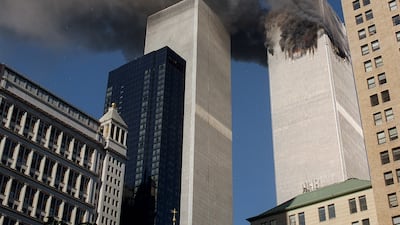
Smoke billows from the North Tower of the World Trade Centre in New York City after terrorists crashed a plane into the building on September 11, 2001. AP Photo -

The plane was thought to have hit the North Tower between floors 93 and 99 sparking a fierce fire on those storeys from which people desperately tried to escape. Reuters -
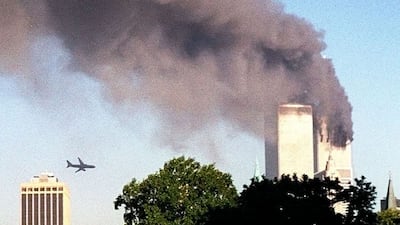
American Airlines flight 175 closes in on the south face of the South Tower of the World Trade Centre as the North Tower burns. Shutterstock -
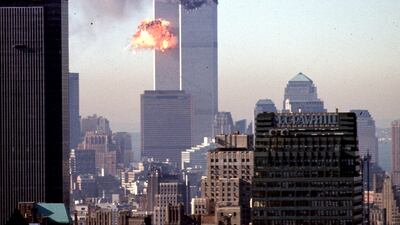
The moment of impact. AFP -
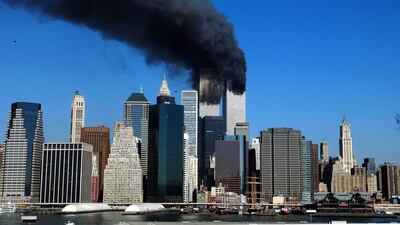
With both towers ablaze, pandemonium ensues in Manhattan in the building and on the ground. AFP -
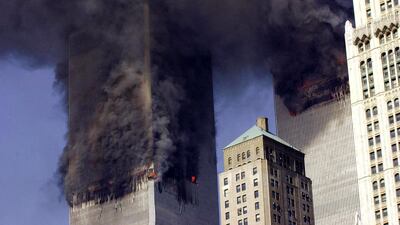
The cloudless, blue sky gave little portent of the dark, history-changing day that was to come but would remain etched on the memory of those involved and beyond. AFP -
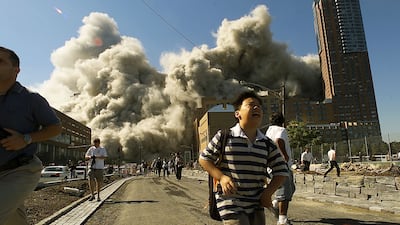
People run for their lives as the North Tower of World Trade Centre collapses. The South Tower had come down 29 minutes earlier. Getty Images -

Emergency personnel tend to injured people in Liberty Park, New Jersey, as the enormity of the day's events slowly begin to hit home. Reuters -
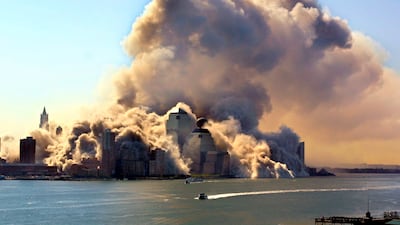
The World Trade Centre disappears in a thick cloud of smoke as the second tower implodes. AP Photo -
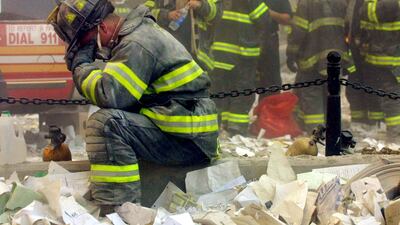
Firefighter Gerard McGibbon, of Engine 283 in Brownsville, Brooklyn, prays after the buildings collapse. Getty Images -

Smoke pours from the site and drifts across the New York sky. Reuters


“As a mosque, we have nothing to do with this anniversary and therefore we won't be able to speak about it. The current trustees became trustees of the mosque from 2005 and had no involvement before that year.”
This is a story about then and now.
Then
The atmosphere surrounding Britain’s Muslim community following 9/11 was confused and feverish. Most Britons were completely ignorant of life among Britain’s Muslim minority.
Some reporters knew about the goings on at the Finsbury Park Mosque. In the late 1990s, our fax machines would regularly receive pronouncements from Al Muhajiroun, a group connected to the mosque, led by a rabble-rousing teacher named Omar Bakri Mohammed, Syrian-born and thrown out of several Middle Eastern countries, including Saudi Arabia, for agitation against governments.
Bakri had turned up in London in the mid-'80s and had developed a following around England teaching his interpretation of the Quran. Actually, it was more indoctrination than teaching and he found many willing students because the Muslim community in the early part of this century was going through a period of transition.
A few years after 9/11, Tariq Modood, University of Bristol professor of sociology and founder of the Centre for the Study of Ethnicity and Citizenship, explained the transition in this way:
“Britain’s Muslim community’s main point of origin was in South Asia, Pakistan and Bangladesh. They had arrived in the UK in the '50s and '60s. They practised an Islam derived more from folk customs of rural Pakistan rather than the Quran. Their educated children began reading the Quran for themselves — but in English — and they saw critical differences in their parents’ practice and what they understood the Quran was saying.”
For many children of immigrants, there was the inevitable dynamic of second-generation psychology: a sense of alienation, being neither British nor Pakistani.
Adding to this sense of alienation was the fact that Britain was experiencing a new wave of Muslim immigration.
The new arrivals came from North Africa, Prof Modood explained, and “the combination of South Asian manpower and Middle Eastern politics” created potential converts to Bakri's extremist worldview.
In 2004, I attended a few of Bakri’s teaching sessions and interviewed him. It wasn’t difficult - he operated out in the open and seemed to welcome press interest. His message was clear and simple: martyrdom, “self-sacrifice operations”, were the highest calling for a Muslim. His rhetoric was seductive and pushed the limits of free speech to its boundary with treason.
I asked him about the irony that he could not speak so freely in Saudi Arabia or Syria, and he gleefully told me that he saw it as a religious test for Britain and the West.
“You have your own religion which believes in freedom and democracy. I benefit from that, no doubt about it, but I don’t give it any legitimacy. Now, if you are going to stop me speaking, I have defeated you ideologically because you don’t practise what you preach and that’s what I want to prove. It is really a Catch-22.”
His stay-out-of-jail card was what he called “a covenant of security”, a promise his acolytes had given not to commit acts of terror in the UK.
That ended on July 7, 2005, when 52 people were killed in a series of suicide bombing attacks in London. The bombers' leader had links to Bakri and Al Muhajiroun.
In one of the little mysteries of this era, Bakri was not detained following the attacks. A month later, he left Britain for a holiday in Lebanon and his residence status in the UK was terminated.
Now
Twenty years is a long time. The radical preachers are in prison: Al Masri in the US, Bakri in Lebanon. An associate of theirs, Anjem Choudhary, has only recently been released from a British jail and had a ban on public speaking lifted.
Periodically, their baleful work explodes. A lone-wolf attacker drives into a crowd or stabs some people to death on a London bridge or murders an off-duty soldier. Invariably, the attackers have a connection to Bakri and Al Muhajiroun.
So, Muslims in Britain are still stigmatised by the radical preachers’ activities.
“The level of publicly expressed hostility to Muslims is much greater than recorded by all surveys,” Prof Modood says. “There is a lot of racism on social media, Islamophobia in mainstream media is much higher.
“Linked to this is the surveillance and regulation that Muslims are subjected to, not just by the security services … but in schools,” he adds.
Tufyal Choudhury, of the Bingham Centre for the Rule of Law, notes that for young Muslims today, 9/11 is ancient history. More recent events occupy their minds.

“It has been much quieter for young Muslim activists because of the significant downscaling of the war in Syria,” Mr Choudhury says.
The Syrian war threw renewed negative focus on the community when reports of young British Muslims travelling to Syria to fight with ISIS surfaced. Most notorious were Mohammed Emwazi, aka Jihadi John – recorded beheading American journalists James Foley and Steven Sotloff in ISIS-held Syrian territory – and three East London schoolgirls who went to Syria and married ISIS fighters.
All are now dead except Shamima Begum, who is stateless and living in a refugee camp in Kurdish-held northern Syria.
“The younger generation is far more politically engaged because they have to be. The focus is on them in terms of terrorism and counter-terrorism,” Mr Choudhury adds.
Yet the pace of integration among young Muslims has increased, Mr Choudhury notes.
More are going into higher education, particularly women. “This has led to broader scope in their political activism,” he points out.
“Muslims are very active in student union politics. A Muslim woman recently served as president of the National Union of Students. They have built a range of alliances – a form of integration – with other organisations like [Black Lives Matter] and LGBT groups.”
Muslim representation is increasing at the national level as well, albeit more slowly. On 9/11, there were only two Muslim members of the UK Parliament. Today, there are 18.
Other high-profile Muslim politicians include London Mayor Sadiq Khan, Health Secretary Sajid Javid and Scottish Labour Party leader Anas Sarwar.
And the small, quiet group of worshippers strolling on a Friday from Blackstock Road to the Finsbury Park Mosque, joking with a stranger holding a notebook, are perhaps the best examples of change since September 11, 2001.

