
Boko Haram militants do not buy guns and ammunition on the black market to fuel their decade-long insurgency in West Africa – they simply nab weapons from the armies sent to fight against them, a study has revealed.
Set for publication next month, the report calls on the Multinational Joint Task Force (MNJTF) of West African armies tackling Boko Haram to better protect their arsenals and stop guns falling into insurgents’ hands.
“Boko Haram has been able to continue fighting this past decade as a result of weapons, ammunition and materiel seized during raids on convoys and bases of the government-backed forces fighting them,” said study author Eric Berman, who shared details of the report with The National.
“Much needs to be done in guarding caches and boosting the morale of anti-insurgency troops so militants cannot arm themselves and prolong conflicts.”
The report, to be published by the International Peace Information Service research group, echoes findings from other African conflicts by the Small Arms Survey, which tracks illicit weapons flows.
The militants have since 2015 seized weapons in dozens of attacks, in some cases making off with hundreds of guns, hundreds of thousands of rounds of ammunition and small convoys of off-road attack vehicles, Mr Berman said.
Other military booty includes battle tanks, artillery, armoured personnel carriers and mine-resistant vehicles. The true scale of the seizures is unknown, because military chiefs typically keep quiet about missing materiel.
In the most recent incident, at least 26 Chadian soldiers were killed and 14 others wounded in the early hours of Thursday by suspected Boko Haram assailants in an attack on their patrol around the Lake Chad area. It is not clear whether weapons were seized.
In some cases, whole battalions are overrun, like in Boko Haram’s rout of a military base and 700 troops in Jilli, Yobe state, in July 2018. In others, rebels hit patrols of a dozen soldiers and scarper after loading up with guns and ammunition.
-
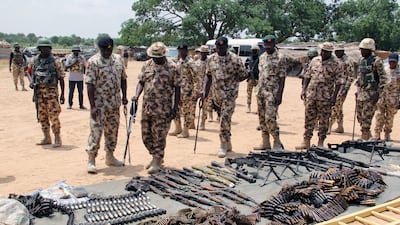
Military commanders inspect arms and ammunitions recovered from Boko Haram militants in Nigeria. -

Niger Army soldier takes a breather during security patrol near the Nigerian border on the hunt for Boko Haram militants. -
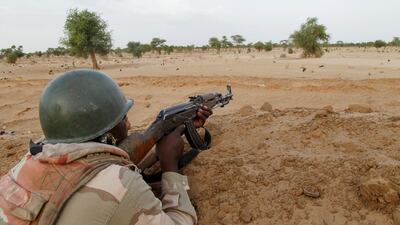
The area around Diffa, Niger, has experienced fighting between Boko Haram and African security forces. -

A car burns at the scene of a militant attack on a church outside the Nigerian captial of Abuja. At least 27 people were killed in five bomb attacks claimed by Boko Haram. -
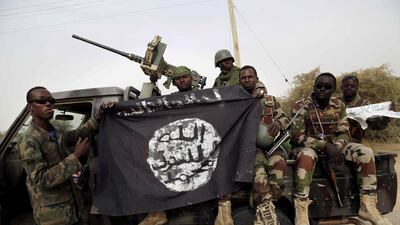
Nigerian soldiers hold up a Boko Haram flag seized in the town of Damasak in 2015. -
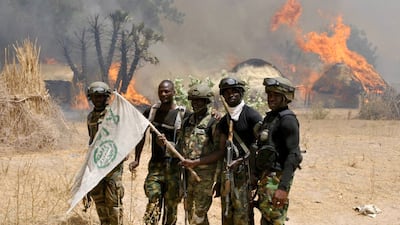
Nigerian soldiers are seen after an operation against Boko Haram in Borno, Nigeria, in 2016. -
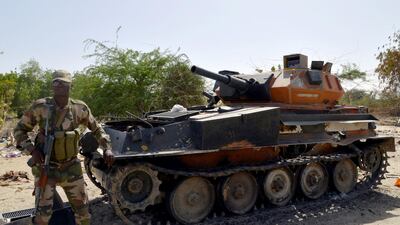
A soldier from the Niger army stands next to a burnt out tank belonging to Boko Haram. -
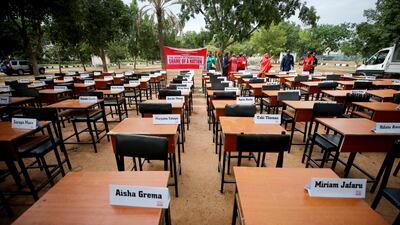
Names of missing Chibok schoolgirls kidnapped by Boko Haram are displayed in Abuja, Nigeria. -
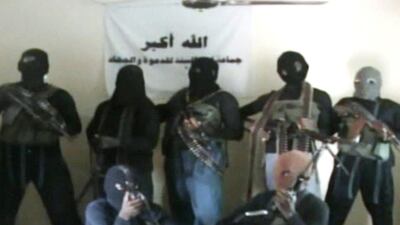
A screengrab from a video reportedly released by Boko Haram shows seven members in an undisclosed location. -

A screengrab from a video released in 2018 shows Boko Haram leader Abubakar Shekau amid a surge in violence in Nigeria. He was recently reported as having been killed. -

A screengrab from a video released in 2014 shows Abubakar Shekau, who had voiced support for ISIS. He was recently reported as having been killed.


Weapons airdrops to resupply government troops fall into the wrong hands. Convoys are raided. Underpaid soldiers from morale-sapped units are prone to abandoning their posts – and their weapons – in the face of an attacking militia.
Militants post videos online of gloating fighters on top of battle tanks pilfered from Nigeria’s army – replacing striped flags with Boko Haram’s black-and-white logo. Hauls have raised the group’s prowess, as well as its firepower.
The MNJTF coalition members, Niger, Cameroon, Chad and Nigeria, need to better protect caches and raise troop morale, while international bodies such as the UN, African Union and the EU should use their leverage to push for change, the report says.
“We need tighter rules and enhanced oversight by bodies authorising peace operations as well as arms transfers, especially to recipients whose security forces are active in conflict zones,” Mr Berman said.
The problem of extremists seizing arms from government-backed foes is not limited to West Africa, he said. Somalia’s Al Shabab group and insurgents fighting against the G5 Sahel force of Burkina Faso, Chad, Mali, Mauritania and Niger also stage weapons-seizure raids.

Officials from the UN and African governments told The National they were aware of the worrying trend of Boko Haram, Al Shabab and other African militant groups seizing weapons caches and have called for action.
Martin Kimani, Kenya's ambassador to the UN and chairman of an international group tracking small arms, called it a “very real problem” that Nairobi was using its two-year seat on the UN Security Council to tackle.
“Terrorist and insurgent organisations are gaining part of their weaponry from attacking state institutions, [including] police stations with armouries, deliberately seeking new weaponry and better weaponry,” Mr Kimani said.
“A lot more that needs to be done in terms of stockpile management within the peacekeeping environment.”
Ivor Fung, a UN deputy director on disarmament, emphasised the importance of arms manufacturers tagging weapons during their production so that they can be traced after they fall into “the wrong hands”.
The insurgency initiated by Boko Haram in 2009 has left more than 36,000 dead, mainly in Nigeria, while three million people across the region have been uprooted, the UN has said.
The group seeks to create a hardline Islamic state in Nigeria free of western influence, but has been dogged by infighting and splintered into rival factions, known by the acronyms JAS and the ISIS-aligned ISWAP.

