


The US Congress on Wednesday cleared another significant hurdle in repealing two key authorisations that allowed for the 2003 invasion of Iraq and the 1991 Gulf War to defend Kuwait against Saddam Hussein’s invasion.
Republicans Todd Young and Rand Paul sided with Democrats on the Senate Foreign Relations Committee over objections from numerous members of their own party to advance the repeal legislation introduced by Democrat Tim Kaine.
“The two authorisations supporting military action to counter the malignant activity of an Iraq governed by Saddam Hussein were rendered unnecessary more than a decade ago when he was toppled and executed and a new government of Iraq was constituted,” Mr Kaine said before the vote.
“Iraq is now a partner of the United States and both nations want that relationship to continue as was evidenced by the recent positive meeting between President [Joe] Biden and Prime Minister [Mustafa Al Kadhimi].”
The Foreign Relations Committee vote to advance the repeal legislation sets the stage for a full vote on the Senate floor later this year.
Repealing the authorisations would not require Mr Biden to withdraw the approximately 2,500 troops who remain stationed in Iraq as they are officially there under a separate 2001 military authorisation that Congress passed after the September 11 attacks.
-
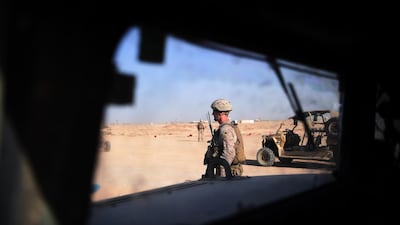
US Marines keep watch as unseen Afghan National Army soldiers participate in an IED (improvised explosive device) training exercise at the Shorab Military Camp in 2017. AFP -
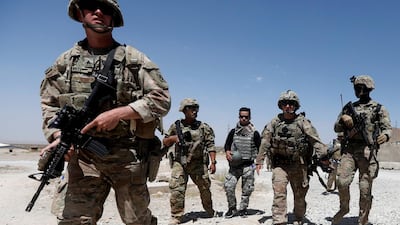
US troops patrol at an Afghan army Base in Logar province on August 7, 2018. Reuters -
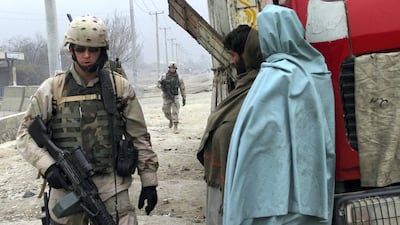
US soldiers patrol a street in central Kabul December 11, 2004. Reuters -
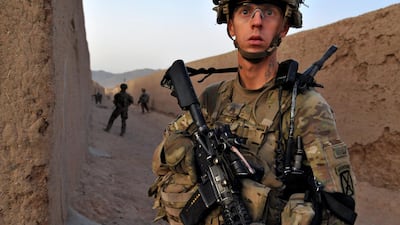
US troops under Afghanistan's International Security Assistance Force, and Afghan National Army soldiers conduct a joint security patrol in the centre of Kandalay village. AFP -
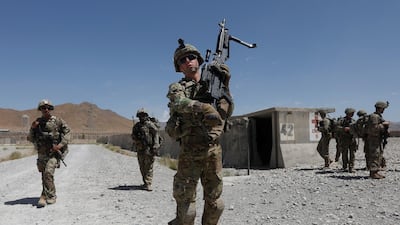
US troops patrol at an Afghan National Army (ANA) base in Logar province, Afghanistan in 2018. Reuters -
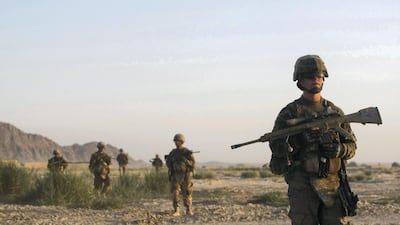
US Army soldiers patrol in the village of Chariagen in the Panjwai district of Kandahar province southern Afghanistan in 2011. Reuters -
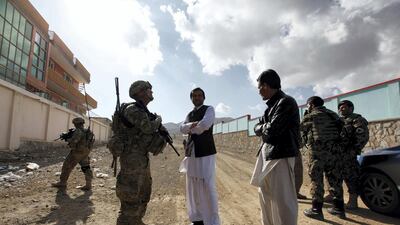
Afghan residents chat with US. Army Lieutenant Steven Gibbs as he patrols with his platoon in Pul-e Alam, a town in Logar province, eastern Afghanistan in 2011. Reuters -
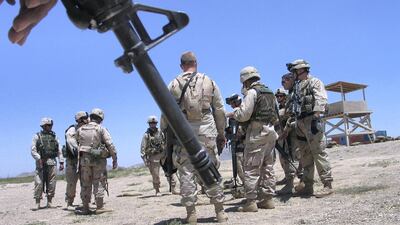
US soldiers gather during an exercise at the Kandahar airbase in Afghanistan in 2005. Reuters -
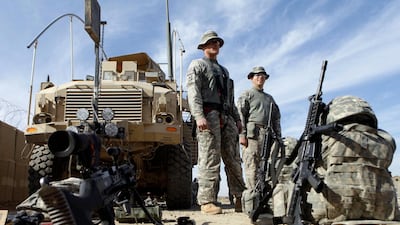
U.S. Army soldiers with 1st Brigade, 1st Cavalry Division stand near their armored vehicles before they start their journey home at Contingency Operating Site Kalsu, south of Baghdad, Iraq. AP -

A handout photo made available by the US Marine Corps shows US Marines inside the perimeter of Al Asad Air Base in Iraq. EPA -
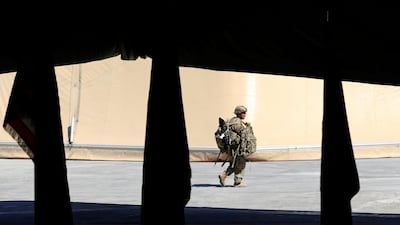
A US soldier is seen during a handover ceremony of Taji military base from US-led coalition troops to Iraqi security forces, in the base north of Baghdad, Iraq August 23, 2020. Reuters -

US soldiers have been in Iraq for nearly two decades. AFP -
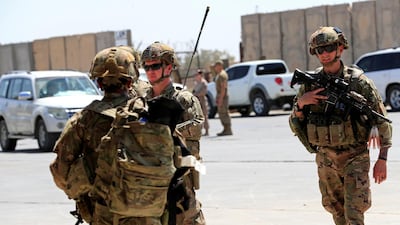
US soldiers are seen during a handover ceremony of Taji military base from US-led coalition troops to Iraqi security forces, in the base north of Baghdad, Iraq on August 23, 2020. Reuters


However, a repeal would ensure that no president can use it as a legal basis for future military action in Iraq, as former presidents Donald Trump and Barack Obama both did to go after Iranian interests in the country.
The House of Representatives passed a repeal of the 2002 Iraq war authorisation — but not the 1991 Gulf War authorisation — by a 268-161 vote in June, with 49 Republicans joining Democrats on the measure.
The House vote came after the White House voiced support for the repeal, indicating that Mr Biden would sign the legislation.
Six Republican senators — conservatives and centrists alike — have co-sponsored Mr Kaine’s repeal legislation, suggesting it has a high chance of clearing the Senate’s 60-vote threshold and ultimately making its way to the White House for Mr Biden’s signature.
But numerous Republicans, including those in leadership, oppose repealing the 2002 Iraq war authorisation, arguing that it sends the wrong message to Iran.
“The purpose of this is to communicate our resolve in the region, and particularly as it affects Iran,” James Risch, the top Republican on the Foreign Relations Committee, said before the vote.
Mr Trump used the 2002 authorisation as part of his legal justification for killing Qassem Soleimani and Iraqi Popular Mobilisation Forces commander Abu Mahdi Al Muhandis in Baghdad last year.
However, the Biden administration maintains that the 2002 authorisation is irrelevant to its ability to launch future strikes on Iran-backed Iraqi militias as the US constitution gives the president the authority to launch defensive military action in response to attacks on American troops.
Mr Biden has already claimed these authorities twice this year to launch attacks on Iran-backed militias in Iraq and Syria.
Under US law, Congress must authorise military action abroad except in cases of imminent self-defence — though presidents from both parties have frequently launched strikes in countries such as Libya and Syria without congressional authorisation.
Several high-profile Democrats have criticised Mr Biden's strikes in Iraq and Syria as outside the bounds of the US constitution, while many Republicans have voiced support for them.

