


The US is considering a broad set of options to respond to the crisis in Lebanon, including sanctions on corrupt figures, sending cash and non-perishable aid to the Lebanese Army and directing humanitarian assistance to non-government organisations.
In a joint statement released on Friday by the US Secretaries of State and Treasury, Antony Blinken and Janet Yellen, the Biden administration welcomed the EU's adoption of a new sanctions regime.
"As an increasing number of Lebanese suffer from the country’s worsening economic crisis, it is critical that Lebanese leaders heed their people’s repeated calls for an end to widespread corruption and government inaction and form a government that can initiate the reforms critical to address the country’s dire situation," the joint statement read.
"The United States looks forward to future co-operation with the EU in our shared efforts."
On Friday, the EU announced it adopted a framework for sanctions that would focus on corruption and “persons and entities who are responsible for undermining democracy or the rule of law” in Lebanon.
With Lebanon experiencing a power vacuum, rampant fuel and medicine shortages, and with the local currency in free fall, US President Joe Biden's government finds itself forced to think outside the box to manage the situation and prevent the country from becoming a failed state.
The threat of sanctions, one Arab diplomatic source said, was aimed at both speeding up the formation of a new government and showing a US-EU united front on the issue.
This week, Lebanese business tycoon Najib Mikati became the third prime minister-designate to attempt to break the year-long paralysis in forming a government.
US officials have dealt with Mr Mikati before, when he served as prime minister in 2005 and 2011, and are privately welcoming the pick. But publicly, the US is withholding judgment.
“The US renews its calls to quickly form a government that’s empowered and that’s also committed to implementing critical reforms,” State Department spokeswoman Jalina Porter said this week.
Behind the scenes, diplomatic sources told The National the Biden team was in close discussions with European and Arab leaders regarding sanctions, operational means to prevent a complete collapse in Beirut.
This includes non-security-related aid to the Lebanese Armed Forces.
The Pentagon confirmed to The National that it was exploring new options.
“The Department of Defence is working closely with interagency and international partners exploring ways to provide additional emergency support to the" Lebanese Armed Forces, Pentagon spokeswoman Cindi King said.
The Biden administration had already planned to provide $120 million in aid to the Lebanese military in 2021, an increase from the $105m that was initially proposed for this year.
In June, the US gave the Lebanese Armed Forces $59m in cash as a reimbursement for counter-terrorism efforts under Section 1226 and is in the process of delivering three US Coastguard protector-class coastal patrol boats to the country.
Aram Nerguizian, a senior associate at the Centre for Strategic and International Studies, said Lebanon's currency crisis was forcing the armed forces to find new ways to sustain itself.
The monthly salary of a Lebanese soldier has dropped nine-fold to an average of $90 a month, Commander of the Lebanese Armed Forces Gen Joseph Aoun said in June. Fuel and electricity shortages are further straining the military's operational capabilities.
“Hard cash transfers are a massive boost to the LAF,” said Mr Nerguizian.
He told The National that a cost adjustment in the aid to the military would need to be between $27m to $50m to bring it to a “moderately stable” place in 2022.
He said that besides the US, the Lebanese armed forces are looking to countries such as Egypt for help. Gen Aoun visited Cairo this week to meet President Abdel Fattah El Sisi.
Beyond the aid to the army, the US is looking into other ways to support the Lebanese people, western diplomatic sources said.
Mona Yacoubian, a former US official and senior fellow at the United States Institute of Peace, said that in addition to military aid, cash-based humanitarian assistance as well as bolstering aid to the education sector and small and medium-sized enterprises should be considered.
-
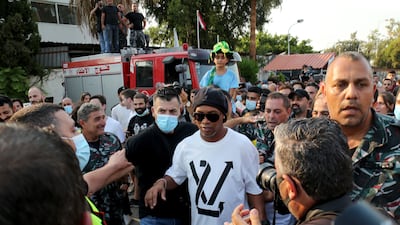
Brazilian footballer Ronaldinho, centre, pays his respects to Lebanese civil defence personnel killed during the port explosion in the capital on August 4, 2020. -
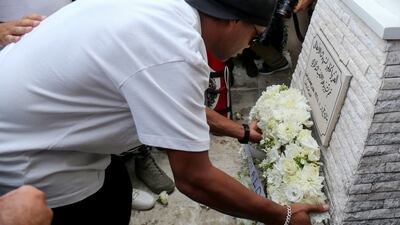
Ronaldinho lays flowers in memory of fire crew members killed during the Beirut port explosion. -

Children hold pictures of Ronaldinho and football shirts as they eagerly await the arrival of the Brazilian sports star. -
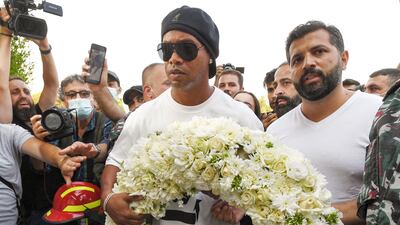
The port blast explosion that killed 211 ripped through the heart of Lebanon's capital. -
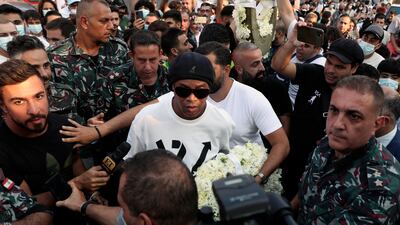
Ronaldinho is in Beirut to show solidarity with Lebanon on the first anniversary of the blast. -

A fan holds a poster of former soccer star Ronaldinho as the city tries to rebuild the port amid Lebanon's worsening economic crisis.


But she also called for “concerted pressure on the political class to form a government, implement immediate reforms and insist 2022 [parliamentary] elections are held on time".
However, without a government that is willing to enact reforms, Ms Yacoubian said “the international community is limited [in its options] to providing urgent humanitarian aid directly to the Lebanese people but not much more".
On sanctions particularly, the US is following the EU's lead, said Chris Abi-Nassif, director of the Lebanon programme at the Middle East Institute.
“The US will not take the lead on imposing sanctions … but it is endorsing the targeted EU sanctions framework to increase pressure on domestic leaders to form an independent and competent government,” Mr Abi-Nassif told The National.
He also pushed for more proactive US diplomacy in Lebanon. Aside from routine meetings with US ambassador Dorothy Shea and visits from Pentagon officials, the State Department has not sent a senior official to engage with the government since April.
Mr Abi-Nassif described it as critical to provide aid directly to Lebanese households.
“Due to Lebanon's notorious corruption and patronage system, bypassing the central government when it comes to aid provision remains essential," he said.
“In the presence of proper vetting, humanitarian assistance can take the form of direct cash transfers to Lebanon's most fragile households as well as cash or in-kind support to struggling hospitals and educational institutions."
The World Bank recently ranked Lebanon’s situation among the three worst economic crises in the world in the past 150 years.

