


A victory by the Houthi rebels in Yemen’s Marib province could cause a mass departure of 500,000 people and huge government losses in oil and gas revenue, an aid group said on Monday.
A study by the humanitarian analytics group Acaps rated the chances of the Houthis gaining full control of Marib city and province as “unlikely but possible”, and said defeat would be disastrous for the internationally recognised government.
The Iran-backed rebels in February increased efforts to seize Marib, the government’s last stronghold in northern Yemen, and fighting has intensified in recent days there and in nearby Al Bayda province.
A Houthi win in Marib could “tip the balance” in Yemen’s nearly seven-year war, Acaps said.
“Taking control of the city and of oil and gas facilities would provide significant additional income to the Houthis, while ridding the internationally recognised government of its last foothold in the north, resulting in additional humanitarian needs,” the 12-page report said.
Houthi gains in Marib city and nearby areas would force 500,000 more people from their homes, including many Yemenis who were displaced from other parts of the country in previous bouts of conflict.
Seizing Marib’s oil and gas centres would earn the Houthis as much as $5.5 million from in revenue each day, researchers said, while the government would lose more than $19.5m each month in crude sales.
Worse still, the Houthis would probably divert energy to areas under their control and the government would have to import more fuel and gas to cover local demand, adding pressure to foreign currency reserves, hurting the Yemeni rial and driving up food prices.
Yemeni government troops and allied tribesmen have vowed to defend Marib and are backed by an Arab coalition led by Saudi Arabia, which intervened in Yemen in 2015. Both sides have sent reinforcements to Marib and hundreds have been killed.
Ahmed Al Humayqani, deputy governor of Al Bayda province, told AFP on Sunday that the Houthis had seized control of two districts in his province, forcing about 80 per cent of residents there to flee.
Mr Al Humayqani said the districts “fell without a major military confrontation” and he urged aid “organisations to intervene urgently to help alleviate people’s suffering”.

Last month Martin Griffiths, then the UN’s envoy to Yemen, said Marib was “of huge importance” but would not necessarily determine the outcome of the conflict.
“I don't think a [Houthi victory in Marib] leads to the complete erosion of the government,” Mr Griffiths said in answer to a question from The National.
“It’ll be another battle lost, but there are a lot of resources and forces sadly enough who can yet fight battles.”
UN spokesman Farhan Haq said on Monday that heavy rains and “serious flooding” were adding to Yemen's misery in parts of Hodeidah, Al Jawf and Sanaa as aid workers worked to provide locals with shelter, food, water and essential household items.
-
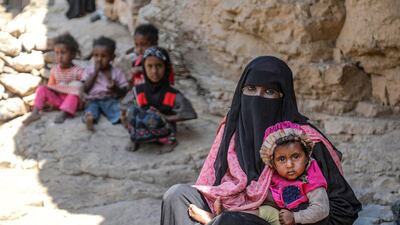
A woman holds a child as she sits near other children outside a cave where a Yemeni family has sought refuge due to poverty and lack of housing, west of the suburbs of Yemen's third city of Taez. AFP -

Women wait to receive supplemental nutrition shakes at malnutrition treatment ward of al-Sabeen hospital in Sanaa, Yemen. Reuters -

Yemeni women pick the rounded flesh leaves of Ghulaf to use as a main meal at the mountain village of Bani al-Qallam, some 100 km south west of Sanaa, Yemen. EPA -
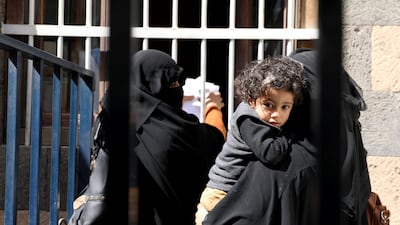
Women and a boy wait for foodstuff assistance vouchers at an aid distribution center in Sanaa, Yemen. Reuters -
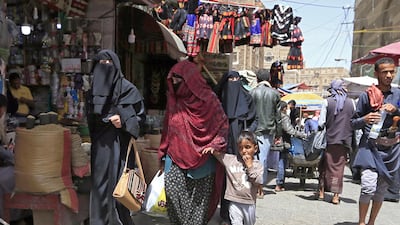
Yemeni women walk past shops in the old city market of the capital Sanaa. AFP -
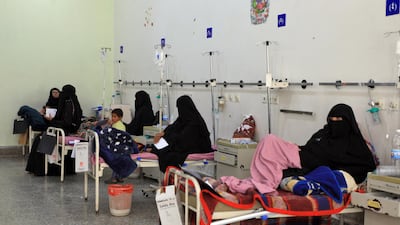
Women sit with their children receiving treatment at al-Sabeen Maternity and Child Hospital in the Yemeni capital Sanaa. AFP -
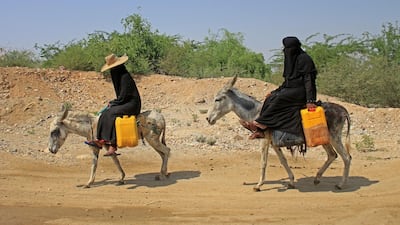
Yemeni women commute on donkeys carrying jerrycans of water at a camp for internally displaced people by conflict in the northern Hajjah province. AFP


“More rain and storms are expected in much of the country over the next 24 hours, including medium to heavy rainfall in flood-prone areas, including in Taez governorate,” Mr Haq said.
Conflict flared in Yemen in 2014 when Iran-backed Houthi rebels overran the capital Sanaa and early the next year drove out the country's internationally recognised leadership.
The following year, Saudi Arabia led a military intervention to restore the ousted government.
The war has forced millions of Yemenis to flee their homes, claimed hundreds of thousands of lives and ruined the economy.
Four fifths of Yemenis rely on aid in what the UN calls the world's worst humanitarian crisis.

