


Follow for live UN General Assembly coverage
Somaya Faruqi, captain of the world-famous Afghan Girls Robotic team that was forced to flee Taliban-controlled Afghanistan, hopes to one day return and teach the next generation of women engineers.
Sitting in a classroom with a robot behind her, Ms Faruqi spoke passionately to a high-level panel at the UN General Assembly in New York on Friday.
“Education means everything for me because a country can improve by the new generation who are educated,” she said.
But that future is in jeopardy.
Following the Taliban’s swift capture of Kabul in August, the world has waited with bated breath to see if the hard-won gains of women and girls over the past 20 years would be upheld.
Before the Taliban takeover, more than a quarter of members of Parliament and a fifth of civil servants were women.
Women made major strides in the education sector, making up 35 per cent of the public teaching force before the Taliban returned, and about 3.5 million girls were enrolled in schools, compared to only 9,000 in 1999.
-

Members of an all-girl Afghan robotics team pose for a picture at the laboratory of Qatar's Texas A&M university in the capital Doha. All photos: AFP -
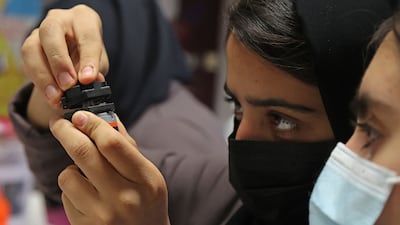
The Taliban banned women from work and education, confining them to homes during their brutal rule of Afghanistan between 1996 and 2001. After once more taking control of the country, they said this week that girls would be allowed to return to school (although they have so far been effectively excluded) with a spokesman for the militants calling for ‘more time’ to make a decision. -
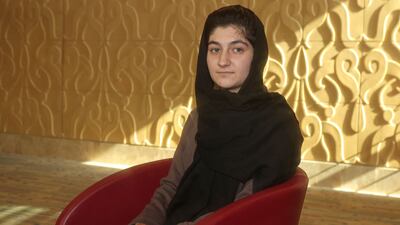
Ayda Haydarpour, 17, said it was difficult to properly follow events in Afghanistan but she plans to return some day and harbours ambitions to open the first STEM (science, technology, engineering, and mathematics) school in the country. -
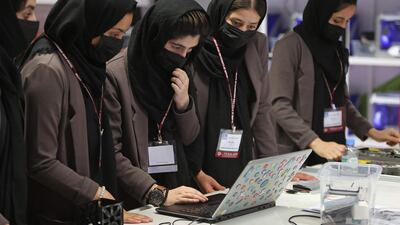
Now, back in education and working on a world robotics competition, the girls are plagued by uncertainty but they hope to return to Afghanistan when it is safe. -
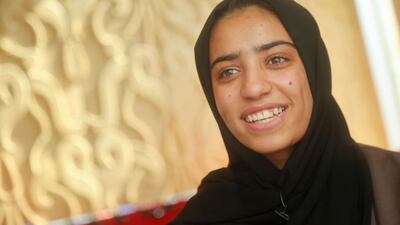
Somaya Faroqi, leader of the girls' robotics team, said it was 'so sad because we lost our family, our robotics coaches, our life' by leaving their homeland so abruptly. -
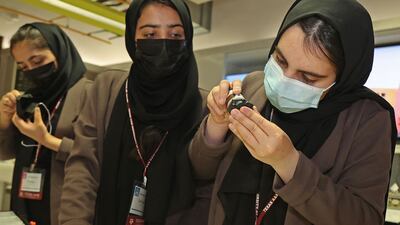
A laboratory manager at the university in Doha said the girls' skills were at 'a really high level' despite their recent ordeal. -
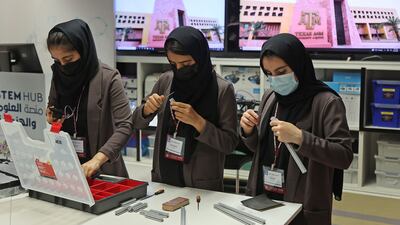
Some of their teammates remain in Afghanistan while others flew to Mexico and the UAE. But the nine girls in Qatar meet after school to work on their entries for the First Global Challenge robotics competition. -
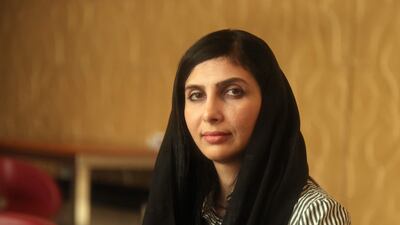
Roya Mahboob, founder of an Afghan software company, helped to put the robotics team together and they then developed a low-cost ventilator at the height of the pandemic. -
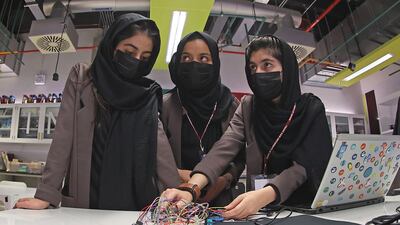
The girls made headlines in 2017 after being denied visas to take part in a robotics competition in Washington, but then-president Donald Trump stepped in and they were allowed to travel. They are now working on their latest competition entry.


Last week, the Taliban said classes would resume for boys in year seven and above, but they made no mention of girls going back to school, effectively locking a large portion of Afghanistan's children out of the classroom.
Many of the side events at this year’s UNGA have focused on ways the international community can help preserve the gains Afghan women and girls have made.
“You can be assured that we will continue to amplify your voices and make it a zero condition that girls must have an education before the recognition of any government that comes in,” the UN's Deputy Secretary General Amina Mohammed said.
Ms Mohammed said that in addition to leveraging the international recognition that the Taliban seek, the global community must also work to get girls online so they can continue to have safe access to education, while negotiations with the militant group continue.
Shaharzad Akbar, chairwoman of the Afghanistan Independent Human Rights Commission, pleaded with Afghans and the international community not to let the Taliban’s actions be “normalised".
“Don't pretend that it's part of Afghan culture, or part of Islam, or religion to have women oppressed and deprived of their basic human rights,” she told the panel.
Malala Yousafzai urged Afghan women to continue to “stand up” for their rights. The Pakistani activist was attacked and nearly killed by the Taliban in 2012 for demanding that she be allowed to go to school.
“It proved to me that the Taliban were scared of the voice of women and girls. They did not want to hear women and girls speak out for equality and they did not want to see women being educated,” she said of her own experience with the group.
While the Taliban may control the country, this Afghanistan is very different from the one they first took over in 1996, said Fawzia Koofi, an Afghan politician who was part of the US-backed negotiations with the group.
Ms Koofi, who fled to Qatar after the Taliban took over, said the group must understand that there is a whole generation that is full of hope and dreams for themselves and their country.

