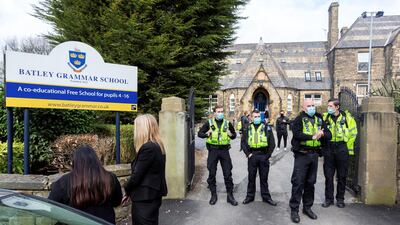
Police were called to Batley Grammar School following protests. SWNS

UK's Batley Grammar School reinstates teacher who showed pupils Prophet Mohammed cartoons


Nicky Harley
  • English
  • Arabic

A teacher who was suspended from an English school after showing pupils satirical cartoons of the Prophet Mohammed has been reinstated.

The drawings, taken from French magazine Charlie Hebdo, were shown to students in a religious studies lesson at Batley Grammar School in West Yorkshire in March.

On Wednesday, the Trust published the report's findings and revealed the religious studies teacher would be reinstated.

"We accept the recommendations of the independent expert investigation and will put them into practice immediately," it told The National.

"The investigation recommends that the issues raised can be effectively dealt with through additional management guidance and training.

"The findings are clear, that the teaching staff involved did not use the resource with the intention of causing offence, and that the topics covered by the lesson could have been effectively addressed in other ways. In the light of those conclusions, the suspensions put in place while the investigation was under way will now be lifted.

"The Trust deeply regrets the distress caused by the use of this resource."

Gary Kibble, headmaster of Batley Grammar School, apologised to parents for the “completely inappropriate” showing of the cartoons.

He said the school had removed the images from the religious studies coursework.

The Trust confirmed it would no longer be using the material in its schools.

"The Trust is clear that it is not necessary for staff to use the material in question to deliver the learning outcomes on the subject of blasphemy," it said.

"Additional guidance and training will also be provided to teaching staff to help them to take full account of the needs of different student cohorts and their contexts when planning the delivery of lessons.

"The Trust will not avoid addressing challenging subject matter in its classrooms but it is committed to ensuring that offence is not caused and that this is always done with care and sensitivity, enabling students to build empathy, mutual respect and understanding."

The incident came after French schoolteacher Samuel Paty was killed by an extremist in October in the Paris suburbs after he showed students the Charlie Hebdo cartoons during a lesson on free speech.


MEYDAN RESULTS

6.30pm Baniyas (PA) Group 2 Dh125,000 (Dirt) 1,400m

Winner ES Ajeeb, Sam Hitchcock (jockey), Ibrahim Aseel (trainer).          

7.05pm Maiden (TB) Dh165,000 (D) 1,200m

Winner  Galaxy Road, Antonio Fresu, Musabah Al Muhairi.

7.40pm Maiden (TB) Dh165,000 (D) 1,400m

Winner  Al Modayar, Fernando Jara, Ali Rashid Al Raihe.

8.15pm Handicap (TB) Dh170,000 (D) 1,900m

Winner  Gundogdu, Xavier Ziani, Salem bin Ghadayer.

8.50pm Rated Conditions (TB) Dh240,000 (D) 1,600m

Winner George Villiers, Tadhg O’Shea, Satish Seemar.

9.25pm Handicap (TB) Dh175,000 (D)1,200m

Winner  Lady Parma, Connor Beasley, Satish Seemar

10pm Handicap (TB) Dh165,000 (D) 1,400m

Winner Zaajer, Fernando Jara, Ali Rashid Al Raihe

Ten tax points to be aware of in 2026

1. Domestic VAT refund amendments: request your refund within five years

If a business does not apply for the refund on time, they lose their credit.

2. E-invoicing in the UAE

Businesses should continue preparing for the implementation of e-invoicing in the UAE, with 2026 a preparation and transition period ahead of phased mandatory adoption. 

3. More tax audits

Tax authorities are increasingly using data already available across multiple filings to identify audit risks. 

4. More beneficial VAT and excise tax penalty regime

Tax disputes are expected to become more frequent and more structured, with clearer administrative objection and appeal processes. The UAE has adopted a new penalty regime for VAT and excise disputes, which now mirrors the penalty regime for corporate tax.

5. Greater emphasis on statutory audit

There is a greater need for the accuracy of financial statements. The International Financial Reporting Standards standards need to be strictly adhered to and, as a result, the quality of the audits will need to increase.

6. Further transfer pricing enforcement

Transfer pricing enforcement, which refers to the practice of establishing prices for internal transactions between related entities, is expected to broaden in scope. The UAE will shortly open the possibility to negotiate advance pricing agreements, or essentially rulings for transfer pricing purposes. 

7. Limited time periods for audits

Recent amendments also introduce a default five-year limitation period for tax audits and assessments, subject to specific statutory exceptions. While the standard audit and assessment period is five years, this may be extended to up to 15 years in cases involving fraud or tax evasion. 

8. Pillar 2 implementation 

Many multinational groups will begin to feel the practical effect of the Domestic Minimum Top-Up Tax (DMTT), the UAE's implementation of the OECD’s global minimum tax under Pillar 2. While the rules apply for financial years starting on or after January 1, 2025, it is 2026 that marks the transition to an operational phase.

9. Reduced compliance obligations for imported goods and services

Businesses that apply the reverse-charge mechanism for VAT purposes in the UAE may benefit from reduced compliance obligations. 

10. Substance and CbC reporting focus

Tax authorities are expected to continue strengthening the enforcement of economic substance and Country-by-Country (CbC) reporting frameworks. In the UAE, these regimes are increasingly being used as risk-assessment tools, providing tax authorities with a comprehensive view of multinational groups’ global footprints and enabling them to assess whether profits are aligned with real economic activity. 

Contributed by Thomas Vanhee and Hend Rashwan, Aurifer

What is safeguarding?

“Safeguarding, not just in sport, but in all walks of life, is making sure that policies are put in place that make sure your child is safe; when they attend a football club, a tennis club, that there are welfare officers at clubs who are qualified to a standard to make sure your child is safe in that environment,” Derek Bell explains.

Race card

1.30pm: Handicap (PA) Dh 50,000 (Dirt) 1,400m

2pm: Handicap (TB) Dh 84,000 (D) 1,400m

2.30pm: Maiden (TB) Dh 60,000 (D) 1,200m

3pm: Conditions (TB) Dh 100,000 (D) 1.950m

3.30pm: Handicap (TB) Dh 76,000 (D) 1,800m

4pm: Maiden (TB) Dh 60,000 (D) 1,600m

4.30pm: Handicap (TB) Dh 68,000 (D) 1,000m

Sukuk explained

Sukuk are Sharia-compliant financial certificates issued by governments, corporates and other entities. While as an asset class they resemble conventional bonds, there are some significant differences. As interest is prohibited under Sharia, sukuk must contain an underlying transaction, for example a leaseback agreement, and the income that is paid to investors is generated by the underlying asset. Investors must also be prepared to share in both the profits and losses of an enterprise. Nevertheless, sukuk are similar to conventional bonds in that they provide regular payments, and are considered less risky than equities. Most investors would not buy sukuk directly due to high minimum subscriptions, but invest via funds.

How to protect yourself when air quality drops

Install an air filter in your home.

Close your windows and turn on the AC.

Shower or bath after being outside.

Wear a face mask.

Stay indoors when conditions are particularly poor.

If driving, turn your engine off when stationary.

While you're here