Supporters of WikiLeaks founder Julian Assange protest outside the High Court in London. Reuters

Julian Assange launches last-ditch UK appeal against US extradition


Simon Rushton
  • English
  • Arabic

WikiLeaks founder Julian Assange mounted a final UK legal challenge on Tuesday to prevent his extradition to the US on spying charges.

His lawyers argued that American authorities are seeking to punish him for exposing serious criminal acts by the US state.

American prosecutors want to put Mr Assange, 52, on trial on 18 counts relating to the release by WikiLeaks of vast troves of confidential US military records and diplomatic cables. They argue the leaks put the lives of US agents in danger and there is no excuse for his criminality.

Mr Assange himself was not in court because of an illness.

His lawyer Edward Fitzgerald said there was a risk that Mr Assange “will suffer a flagrant denial of justice” if he is sent to the US.

At the two-day High Court hearing, his lawyers are asking judges to grant a new appeal, his last legal roll of the dice in Britain.

Julian Assange's wife said the WikiLeaks founder is a political prisoner and 'his life is at risk'. AFP

"Mr Assange is being prosecuted for engaging in ordinary journalistic practices of obtaining and publishing classified information which is true and of public interest," Mr Fitzgerald, Mr Assange's lead lawyer, told the court.

He said, if convicted, Mr Assange could be given a sentence as long as 175 years, and likely to be at least 30 to 40 years.

Another lawyer, Mark Summers, said there was also evidence that there had been a "truly breathtaking plan" to kidnap or murder Mr Assange while he was in the Ecuadorean embassy in London, and former US president Donald Trump had asked for "detailed options" to kill him.

"Senior CIA officials requested plans, the president himself requested on being provided with options on how to do it and sketches were even drawn up," the lawyer said.

Protesters gathered outside the Royal Courts of Justice in London before the hearing. Hundreds of golden ribbons with the words "Free Julian Assange now!" were tied to the main fence and the surrounding gates and trees.

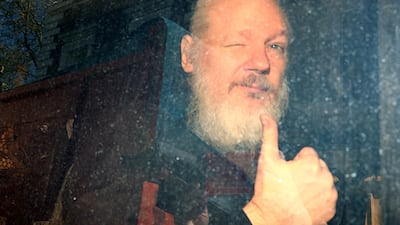
  • WikiLeaks founder Julian Assange arrives at Westminster Magistrates' Court after he was arrested in London in April 2019. Reuters
    WikiLeaks founder Julian Assange arrives at Westminster Magistrates' Court after he was arrested in London in April 2019. Reuters
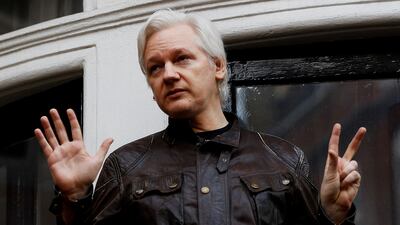
  • Mr Assange on the balcony of the Ecuadorian embassy in London, in May 2017. Reuters
    Mr Assange on the balcony of the Ecuadorian embassy in London, in May 2017. Reuters
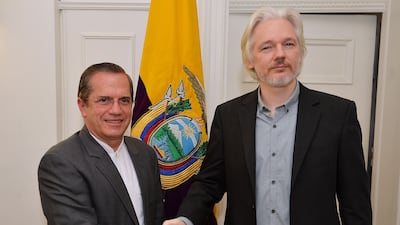
  • The WikiLeaks founder shakes hands with Ecuadorian Foreign Minister Ricardo Patino after a press conference, at which he confirmed he "will be leaving the embassy soon", in August 2014. Getty Images
    The WikiLeaks founder shakes hands with Ecuadorian Foreign Minister Ricardo Patino after a press conference, at which he confirmed he "will be leaving the embassy soon", in August 2014. Getty Images
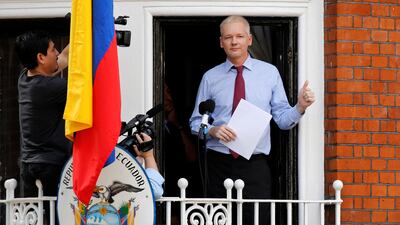
  • Mr Assange prepares to speak from the balcony of Ecuador's embassy in August 2012. Reuters
    Mr Assange prepares to speak from the balcony of Ecuador's embassy in August 2012. Reuters
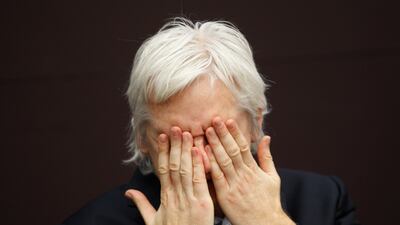
  • He covers his eyes during a news conference in central London, in December 2011. AP Photo
    He covers his eyes during a news conference in central London, in December 2011. AP Photo
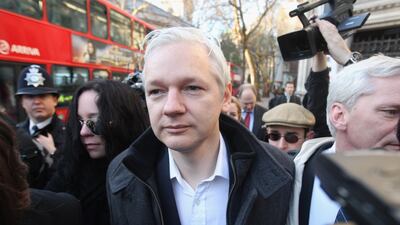
  • Mr Assange arrives at the High Court in London in December 2011. Getty Images
    Mr Assange arrives at the High Court in London in December 2011. Getty Images
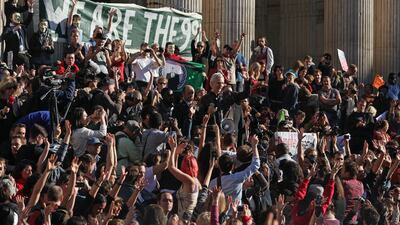
  • Protesters cheer as Mr Assange, centre, speaks outside St Paul's Cathedral during the 'Occupy London' protest in October 2011. Getty Images
    Protesters cheer as Mr Assange, centre, speaks outside St Paul's Cathedral during the 'Occupy London' protest in October 2011. Getty Images
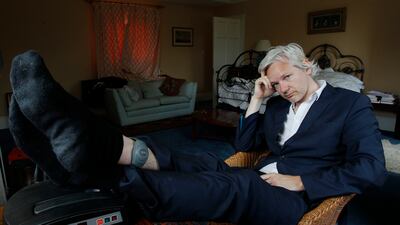
  • Wearing an ankle tag, Mr Assange at the house where he was required to stay in Suffolk, England, in June 2011. AP Photo
    Wearing an ankle tag, Mr Assange at the house where he was required to stay in Suffolk, England, in June 2011. AP Photo
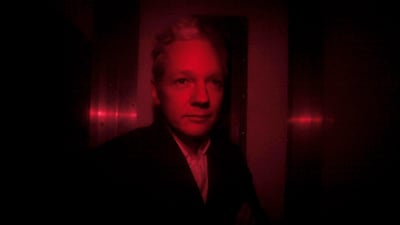
  • Mr Assange arrives at Westminster Magistrates' Court in a prison van with red windows in December 2010. Getty Images
    Mr Assange arrives at Westminster Magistrates' Court in a prison van with red windows in December 2010. Getty Images
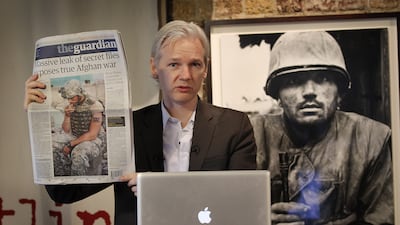
  • He holds up a copy of 'The Guardian' newspaper in London in July 2010, after WikiLeaks published 90,000 secret US military records. Getty Images
    He holds up a copy of 'The Guardian' newspaper in London in July 2010, after WikiLeaks published 90,000 secret US military records. Getty Images
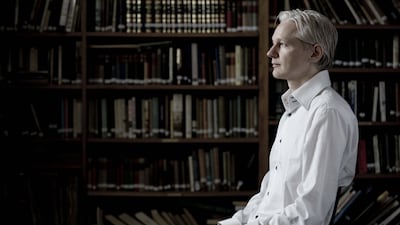
  • The Australian is photographed for a portrait in May 2010 in Melbourne. Getty Images
    The Australian is photographed for a portrait in May 2010 in Melbourne. Getty Images
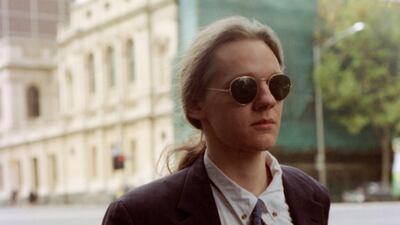
  • A young Julian Assange leaves a Melbourne court after facing charges of computer hacking in May 1995. Getty Images
    A young Julian Assange leaves a Melbourne court after facing charges of computer hacking in May 1995. Getty Images

Mr Assange’s wife, Stella, compared his case to that of Alexei Navalny, the Russian opposition activist who died in prison on Friday while serving a three-decade sentence.

"Julian is a political prisoner and his life is at risk. What happened to Navalny can happen to Julian," she told reporters outside court where a large crowd called for his release.

If Mr Assange wins this case, a full appeal hearing will be held to again consider his challenge.

If he loses, his only remaining option would be at the European Court of Human Rights and Mrs Assange said his lawyers would apply to the European judges for an emergency injunction if necessary.

WikiLeaks first came to prominence in 2010 when it published a US military video showing a 2007 attack by Apache helicopters in Baghdad that killed a dozen people, including two Reuters news staff.

It then released thousands of secret classified files and diplomatic cables that laid bare often highly critical US appraisals of world leaders.

His supporters include Amnesty International, media groups and politicians including Australian Prime Minister Anthony Albanese, who last week voted in favour of a motion calling for his return to Australia.


Ten tax points to be aware of in 2026

1. Domestic VAT refund amendments: request your refund within five years

If a business does not apply for the refund on time, they lose their credit.

2. E-invoicing in the UAE

Businesses should continue preparing for the implementation of e-invoicing in the UAE, with 2026 a preparation and transition period ahead of phased mandatory adoption. 

3. More tax audits

Tax authorities are increasingly using data already available across multiple filings to identify audit risks. 

4. More beneficial VAT and excise tax penalty regime

Tax disputes are expected to become more frequent and more structured, with clearer administrative objection and appeal processes. The UAE has adopted a new penalty regime for VAT and excise disputes, which now mirrors the penalty regime for corporate tax.

5. Greater emphasis on statutory audit

There is a greater need for the accuracy of financial statements. The International Financial Reporting Standards standards need to be strictly adhered to and, as a result, the quality of the audits will need to increase.

6. Further transfer pricing enforcement

Transfer pricing enforcement, which refers to the practice of establishing prices for internal transactions between related entities, is expected to broaden in scope. The UAE will shortly open the possibility to negotiate advance pricing agreements, or essentially rulings for transfer pricing purposes. 

7. Limited time periods for audits

Recent amendments also introduce a default five-year limitation period for tax audits and assessments, subject to specific statutory exceptions. While the standard audit and assessment period is five years, this may be extended to up to 15 years in cases involving fraud or tax evasion. 

8. Pillar 2 implementation 

Many multinational groups will begin to feel the practical effect of the Domestic Minimum Top-Up Tax (DMTT), the UAE's implementation of the OECD’s global minimum tax under Pillar 2. While the rules apply for financial years starting on or after January 1, 2025, it is 2026 that marks the transition to an operational phase.

9. Reduced compliance obligations for imported goods and services

Businesses that apply the reverse-charge mechanism for VAT purposes in the UAE may benefit from reduced compliance obligations. 

10. Substance and CbC reporting focus

Tax authorities are expected to continue strengthening the enforcement of economic substance and Country-by-Country (CbC) reporting frameworks. In the UAE, these regimes are increasingly being used as risk-assessment tools, providing tax authorities with a comprehensive view of multinational groups’ global footprints and enabling them to assess whether profits are aligned with real economic activity. 

Contributed by Thomas Vanhee and Hend Rashwan, Aurifer

Results:

First Test: New Zealand 30 British & Irish Lions 15

Second Test: New Zealand 21 British & Irish Lions 24

Third Test: New Zealand 15 British & Irish Lions 15

THE BIO

Favourite car: Koenigsegg Agera RS or Renault Trezor concept car.

Favourite book: I Am Pilgrim by Terry Hayes or Red Notice by Bill Browder.

Biggest inspiration: My husband Nik. He really got me through a lot with his positivity.

Favourite holiday destination: Being at home in Australia, as I travel all over the world for work. It’s great to just hang out with my husband and family.


The specs

Engine: 5.0-litre V8

Power: 480hp at 7,250rpm

Torque: 566Nm at 4,600rpm

Transmission: 10-speed auto

Fuel consumption: L/100km

Price: Dh306,495

On sale: now

Quick pearls of wisdom

Focus on gratitude: And do so deeply, he says. “Think of one to three things a day that you’re grateful for. It needs to be specific, too, don’t just say ‘air.’ Really think about it. If you’re grateful for, say, what your parents have done for you, that will motivate you to do more for the world.”

Know how to fight: Shetty married his wife, Radhi, three years ago (he met her in a meditation class before he went off and became a monk). He says they’ve had to learn to respect each other’s “fighting styles” – he’s a talk it-out-immediately person, while she needs space to think. “When you’re having an argument, remember, it’s not you against each other. It’s both of you against the problem. When you win, they lose. If you’re on a team you have to win together.” 

EVIL%20DEAD%20RISE
%3Cp%3E%3Cstrong%3EDirector%3A%20%3C%2Fstrong%3ELee%20Cronin%3Cbr%3E%3Cstrong%3EStars%3A%20%3C%2Fstrong%3EAlyssa%20Sutherland%2C%20Morgan%20Davies%2C%20Lily%20Sullivan%3Cbr%3E%3Cstrong%3ERating%3A%3C%2Fstrong%3E%205%2F5%3C%2Fp%3E%0A
Who's who in Yemen conflict

Houthis: Iran-backed rebels who occupy Sanaa and run unrecognised government

Yemeni government: Exiled government in Aden led by eight-member Presidential Leadership Council

Southern Transitional Council: Faction in Yemeni government that seeks autonomy for the south

Habrish 'rebels': Tribal-backed forces feuding with STC over control of oil in government territory

Updated: February 20, 2024, 8:17 PM