



The stand-off in the Red Sea is one of the global flashpoints that are creating economic winners and losers as a result of conflicts.
The Israel-Gaza war, the Houthi attacks on shipping in the Red Sea, and the fallout from the Russian war in Ukraine are wreaking an impact stretching far beyond the primary conflict zones.
Until February 2022, Europe accounted for more than 60 per cent of Russia's oil exports, giving Moscow a lucrative income stream. With European states banning the import of Russian oil as part of sanctions measures, Asia and Africa became the leading destinations for its sale.
To compensate for the loss of volumes in the European markets, Russian oil traders have been forced to discount exports to other destinations.
In 2021, Russian crude traded at a discount of about 2 per cent to the benchmark Brent Crude price. After sanctions were applied, this discount rose to about 20 per cent, figures from the London Stock Exchange show.
Russian oil shipments to Asia have increased by 56 per cent, while those to Africa have increased by 144 per cent.
Deep discounting sparked buying interest from China and India, which in 2023 accounted for 48 per cent of Russian oil exports, according to the global trade platform Kpler.
In 2023, Ghana, Tunisia and Togo more than doubled their Russian oil imports, while Nigeria, an oil producer itself, reported steep increases.
War-torn economies
Living standards are a big loser in conflict situations, as usually functioning market economies break down.
While the living standards of the majority of people living in Gaza were poor before the war, they are now even more dismal. According to UN figures, the area's gross domestic product per person was 46 per cent below what it was 30 years ago.
While most of the rest of the world has seen living standards improve over the past three decades, those living in Gaza have seen them plummet, even before the Israel-Gaza war.
The Russian economy is increasingly dominated by military spending. The funds allocated for security – which includes military activity – were 50 per cent higher in 2023, compared to the previous year.
To achieve that, Russians have had to deal with the consequences of significant spending cuts in health (9 per cent), education (2 per cent) and infrastructure (24 per cent).
However, some workers are seeing big increases in wages, especially in the private sector, because of a growing shortage of skills.
Jobs such as drivers, machine operators and welders are now able to command better pay packets than similar positions working for the Russian government.
Private sector pay rose between 8 per cent and 20 per cent last year, according to data from the Russian recruitment agency Superjob. In December, the Kremlin said a record 2.3 million workers were needed to fill available jobs in the country.
As far as Ukraine is concerned, the war has taken a heavy toll on the economy. According to the International Monetary Fund, Ukrainian GDP slumped by up to 35 per cent in the first year of the war.
Before the war, 5.5 per cent of Ukraine’s population was classified as living in poverty. Figures from the World Bank show that soared to 24.2 per cent in 2022, as more than seven million people were pushed into poverty.
-
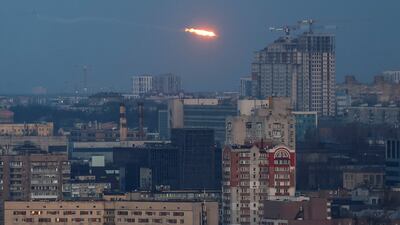
A missile explodes over Kyiv during a Russian attack involving missiles and drones. Reuters -
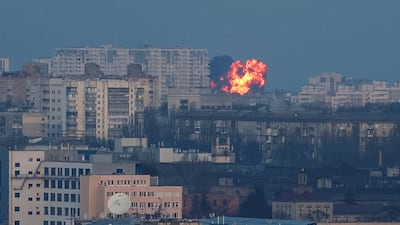
At least 10 people were killed and dozens injured in strikes across Ukraine. Reuters -
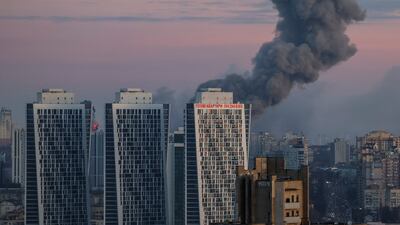
Smoke rises over Kyiv, one of several cities hit in the attack. Reuters -

A medical worker helps a survivor of the strike in Kyiv. Reuters -
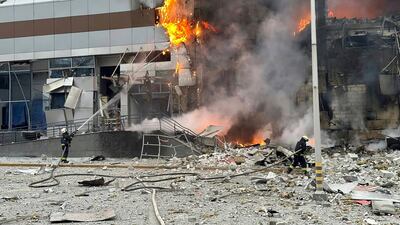
Firefighters tackle a blaze in Kyiv. AP -

Buildings, including a maternity hospital and a shopping centre, were damaged in the strikes. Reuters -

A warehouse in the Ukrainian capital was heavily damaged in the Russian attack. Reuters -

Russia launched about 110 missiles, as well as drones, Ukrainian President Volodymyr Zelenskyy said. AP -

People take shelter inside a Kyiv metro station during the Russian missile and drone attack. Reuters -

Major cities including major cities including Kyiv, Odesa and Kharkiv were targets in the attack. Reuters -

People gather in the city of Dnipro following the attack. EPA -
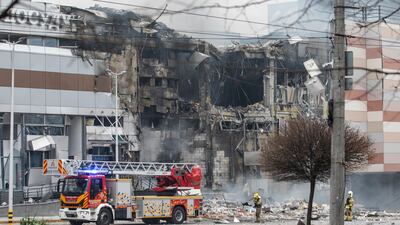
The strikes damaged a shopping mall in Dnipro. EPA


Trouble for tourism
Where an outbreak of hostilities can be a boon for the arms industry, the opposite tends to be the case for holiday companies and airlines.
Up until October 7 last year, Israel's tourist industry was having a good year, with more than three million visitors arriving in the country. But in November, tourist arrivals had dropped to 39,000, according to the Central Bureau of Statistics. In November 2022, visitor numbers were in excess of 370,000.
Tourism across the Middle East and North Africa took a hit in the wake of the Hamas attacks. Visitor numbers to Lebanon and Jordan plunged, a particular problem for Lebanon, where tourism before the coronavirus pandemic contributed 19 per cent to the country's GDP.
In Jordan, high-spending American and European visitors used to flock to the world-famous archaeology site of Petra. But since October, they have stayed away.
Even farther afield, French tour operators said bookings to Morocco and Tunisia were down by 15 per cent to 20 per cent.
Egypt has fared slightly better, but was still subject to a spike in cancellations shortly after the beginning of the Israel-Gaza war.
-

A protester in Sana'a, Yemen, covering his face with a keffiyeh. EPA -

Izzat Hirbawi showing a keffiyeh at the textile factory in Hebron. Reuters -

A newly-recruited member of the Houthis' popular army covering his face with a keffiyeh during a parade in Sana'a, Yemen. EPA -

Two people wear Palestinian keffiyehs, during a Pro-Palestinian demonstration march in Madrid, Spain. AP -

A Palestinian child wearing a keffiyeh and carrying a Palestinian flag during a protest in Beirut, Lebanon. EPA -

A worker sewing at the Hirbawi keffiyeh in Hebron. AFP -
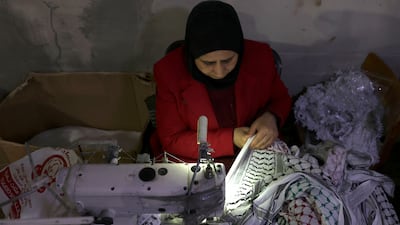
A worker sewing at the Hirbawi keffiyeh factory in Hebron. AFP -

A worker stands over a loom at a textile factory producing the Palestinian Keffiyeh scarf in the occupied West Bank city of Hebron. AFP -

Workers producing the traditional keffiyeh in Hebron. AFP -

A worker stands over a loom at the Hirbawi textile factory producing the Palestinian Keffiyeh scarf in the occupied West Bank city of Hebron. AFP -

A worker stands over a loom at a textile factory producing the Palestinian Keffiyeh scarf in the occupied West Bank city of Hebron. AFP -

A protester flashing the V for victory sign as people march during a demonstration near the US embassy in the capital Amman in solidarity with the people of Gaza. AFP -

Two pro-Palestinian protestors pose outside the Hilton Hotel in Philadelphia, Pennsylvania, where US President Joe Biden was attended a fundraiser on December 11, 2023. AFP -

Pro-Palestinian protestors gathering outside of the New York Times building to protest the newspaper’s coverage of the Israel-Hamas war in New York City. Getty -

A family in Mansfield, Massachusetts taking part in a protest calling for a cease fire in the war in Gaza. AP -

A demonstrator covering her face with a keffiyeh during a rally in support of the Palestinian people, in Sarajevo, Bosnia and Herzegovina. EPA


Egyptian Minister of Tourism Ahmed Issa announced recently that the country opened its doors to 14.9 million visitors in 2023, beating the record of 14.7 million set in 2010.
Nonetheless, the ratings agency Fitch has said that “the Israel-Hamas war poses significant downside risks to tourism”.
Countries like Jordan have done their best to quell the concerns of potential visitors.
“In light of the recent developments in Gaza, we want to emphasise that Jordan continues to be a safe and welcoming destination for tourists from around the world,” the Jordan Tourism Board said.
Most airlines suspended flights to Israel following the outbreak of the Israel-Gaza war.
Earlier this month, the budget airline easyJet said it would maintain its pause on flights to Israel and Jordan and had reported a slowdown in demand to Egypt as a result of the war, prompting it to write down £40 million ($51 million).
But the Hungarian budget airline Wizz Air said it will resume flights to Israel from the beginning of March, “with routes from Budapest, Sofia, Bucharest, Krakow, London [and] Rome to Tel Aviv”.
Wizz Air's operating losses widened by 16 per cent to €180.4 million (£154 million) during the last three months of 2023.
Arms manufacturers have reported year-on-year increases since 2022 as demand for their products has leapt. Shares in the UK's largest weapons systems and military hardware maker, BAE Systems, have risen 144 per cent in five years, boosted firstly by Russia's invasion of Ukraine, then by the Israel-Gaza war, followed by the tension in the Red Sea.
Last year, BAE Systems shares gained 30 per cent on the London Stock Exchange and brought investors a 4.3 per cent dividend yield. Meanwhile, the aerospace and defence company General Dynamics posted full-year revenue for 2023 of $42.3 billion, a 7.3 per cent increase on the previous year.
Global military expenditure increased by 3.7 per cent in real terms last year, reaching a record high of $2.24 trillion, according to the Stockholm International Peace Research Institute.
Bunker bonanza
Shipping costs skyrocketed when Yemen's Houthi rebels began attacking commercial vessels travelling from Asia to Europe through the Red Sea and the Suez Canal.
Those ship owners who chose to send their vessels through the Gulf of Aden and Bab Al Mandeb are being charged higher insurance rates and pay their crews double rates.
But most of the big shipping companies, like Maersk and Hapag-Lloyd, now divert their vessels around the Cape of Good Hope, incurring higher fuel costs.
One benefit from this shake-up in world shipping could be an increase in business for more ports a little off the beaten track as ship masters recalculate their refuelling schedules.
Analysts said demand for marine fuel has risen at Singapore and Rotterdam, the two busiest bunkering ports, where fuel is competitively priced.
“Ships are diverting away from the Red Sea and rerouting around the coast of South and West Africa – this increased traffic has created huge congestion in bunkering ports around Africa and placed significant pressure on port infrastructure,” said John Bassadone, founder and chief executive of independent bunker supplier Peninsula.
As more ships plough the Cape of Good Hope route, fuel sales are increasing, from Port Louis in Mauritius to Cape Town and Durban in South Africa, to the Canary Islands and Gibraltar.
Figures from bunker supplier Integr8 Fuels showed a 15 per cent jump in the prices of low-sulphur bunker fuel in Cape Town.
“We are anticipating increased demand in Las Palmas and Western Mediterranean ports as it's likely the African ports will exceed capacity,” Mr Bassadone said.
Taking to the skies
Another sector where there is an increase in business as a result of the lengthened sea voyages is air freight.
While not all goods are suitable for air freight and despite it being a more expensive option, logistics companies are making increasing use of combining modes of transport.
That is translating into an increase in business for ports like Dubai.
Companies like Hong Kong-based Kerry Logistics can ship cargo by sea to Dubai and then onwards to Europe by air. The journey from a Chinese seaport to a European airport takes between 16 to 21 days – it is 40 per cent cheaper than conventional air freight and is 40 per cent faster than sending a cargo by sea.
Shipping by sea from China to Europe by the Suez Canal takes between 30 and 45 days, according to Maersk. Going by the Cape of Good Hope adds 10 to 14 days.
In the second week of January, the volume of goods being flown by plane from Vietnam to Europe, a busy route for the global clothing industry, jumped by 62 per cent, according to the Norwegian sea and air freight analytics firm Xeneta. At the same time, freight prices rose 10 per cent.
“This is the first signal in Xeneta data that the Red Sea crisis is impacting air freight. This is typically a quieter time of year for air freight, so to see increases of this magnitude, with higher volumes than at any point in 2023, is significant,” said Niall van de Wouw, chief air freight officer at Xeneta.

