


Live updates: Follow the latest news on Cop28
It is “fast becoming inevitable” that global warming will exceed the key target of 1.5°C above pre-industrial levels and leave the world trying to claw it back down, the Cop28 summit has been told.
Scientists say the world will have to reckon with 1.5°C-plus for “at least some decades”, in what is known as an overshoot.
It would then have to turn the heat back down, using trees and carbon capture to replace “net zero” with “net negative” – or else turn to some sci-fi geoengineering.
This has long been regarded as “Plan B” but is becoming Plan A because emissions have not been cut fast enough to stay on track, said Dr Oliver Geden, an author of the findings unveiled in the UAE.
Even if temperatures eventually fall back to 1.5°C above pre-industrial levels, some effects will be irreversible such as extinct species that “won’t come back”, he said.
“We know we’re likely going to cross it, and we should prepare for it. But we also should prepare the decision of what to do about it, and not just say that fight is lost,” Dr Geden told The National.
The Paris Agreement calls for global warming to be held to 1.5°C above pre-industrial levels but does not set a specific deadline, although scientists advising the UN have made calculations up to 2100.
Johan Rockstrom, director of the Potsdam Institute for Climate Impact Research, said there was a one in two chance of returning to 1.5°C above pre-industrial levels by the end of the century, according to the research presented to the UN's climate body.
Many countries are aiming for net zero emissions by 2050 but temperatures could keep rising anyway because carbon dioxide lingers in the atmosphere for hundreds of years.
That means the world needs to get more comfortable talking about carbon removal, said Dr Geden, a subject which campaigners have often viewed with suspicion because they fear it is used to kick emission cuts into the long grass.
“If you want to return warming to an earlier level like 1.5°C, then you would have to get net negative CO2 [carbon dioxide] emissions, or more removals than emissions,” he said.

“Even [if] it would stabilise at 1.5°C, sea level rise would still be there for centuries, so even 1.5°C is not that kind of safe level where everything is fine. Species extinction – if they are gone, they won’t come back. You could see forested areas getting out of balance.
“Since it was always seen as a Plan B and ‘let’s not talk about it too much’, this is really an area where more research needs to be done.”
The 10 New Insights in Climate Science report says there are “multiple lines of evidence” suggesting it is no longer possible to stop the temperature juggernaut at 1.5°C without an overshoot.
It warns of a vicious cycle in which, for example, a long period above 1.5°C damages the Earth’s natural carbon sinks and means global warming only causes more global warming.
“Overshooting 1.5°C is fast becoming inevitable. Minimising the magnitude and duration of overshoot is essential,” the report says.
Green Zone at Cop28 opens to public - in pictures
-
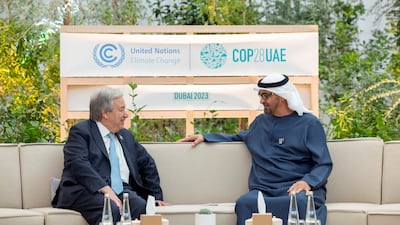
President Sheikh Mohamed and UN Secretary General Antonio Guterres hold a meeting at the Cop28 summit in Dubai. Photo: UAE Presidential Court -
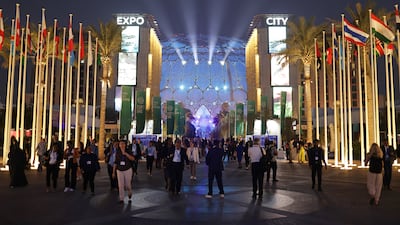
Participants walk among flagpoles on day four of the Cop28 summit in Dubai. Getty Images -
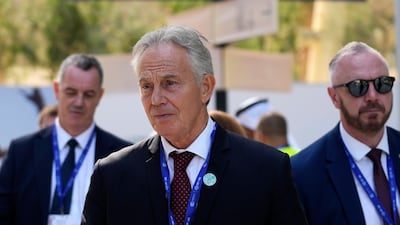
Britain's former prime minister Tony Blair at the summit. AP -
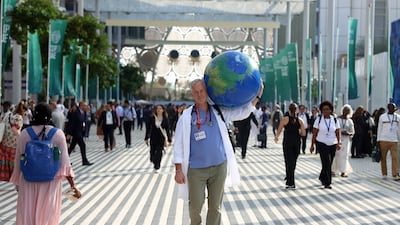
DUBAI, UNITED ARAB EMIRATES - DECEMBER 3: In this handout image suppled by COP28, Joseph Vipond from the Canadian Association of Physicians for the Environment at the Blue Zone during the UN Climate Change Conference COP28 at Expo City Dubai on December 3, 2023 in Dubai, United Arab Emirates. The COP28, which is running from November 30 through December 12, is bringing together stakeholders, including international heads of state and other leaders, scientists, environmentalists, indigenous peoples representatives, activists and others to discuss and agree on the implementation of global measures towards mitigating the effects of climate change. (Photo by Walaa Alshaer / COP28 via Getty Images) -
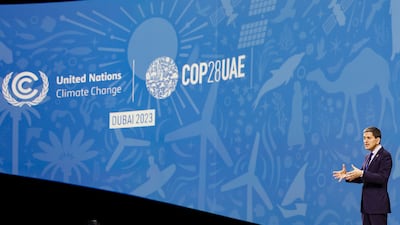
David Miliband, president and chief executive of the International Rescue Committee, addresses a session at Cop28. Getty Images -
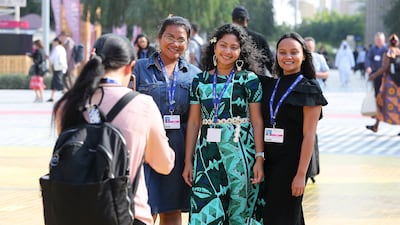
Delegates are photographed in the Blue Zone on the fourth day of Cop28. Pawan Singh / The National -
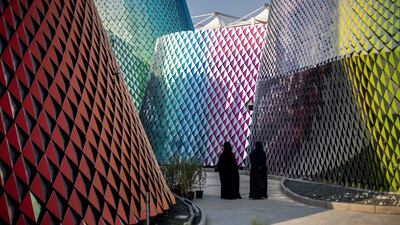
Participants walk at Expo City Dubai. EPA -

Sheikh Abdullah bin Zayed, Minister of Foreign Affairs, Microsoft co-founder Bill Gates, Tanzanian President Samia Hassan and Reem Al Hashimy, Minister of State for International Co-operation, attend the Reaching the Last Mile Forum held alongside Cop28. Reuters -
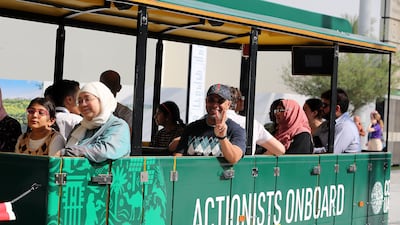
Cop28 visitors ride a train in the Green Zone at Expo City Dubai. Pawan Singh / The National -
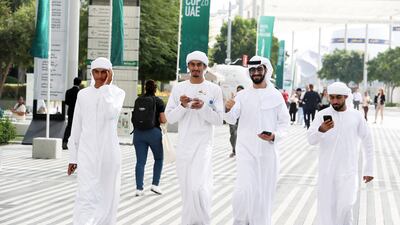
Visitors in the Green Zone at Expo City Dubai. Pawan Singh / The National -

Visitors ride an electric cart in the Green Zone. Pawan Singh / The National -
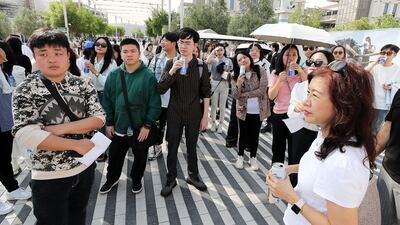
Located in the Sustainability District, the Green Zone will host a wide variety of events and workshops until the final day of Cop28 on December 12. Pawan Singh / The National -
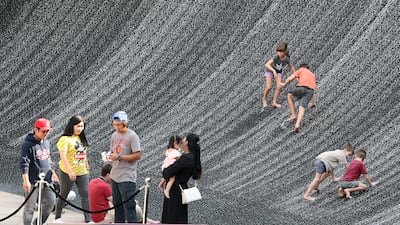
Visitors at the water feature in the Green Zone. Pawan Singh / The National -
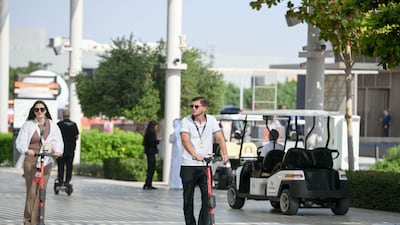
Members of the public ride electric scooters in the Green Zone. Khushnum Bhandari / The National -
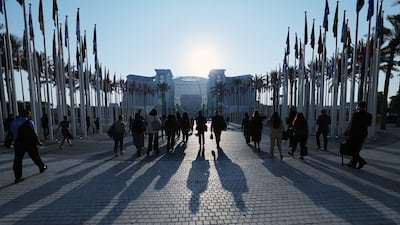
People arrive for the fourth day of the Cop28 summit at Expo City Dubai. EPA -

A welcome sign at the Cop28 venue. AP -
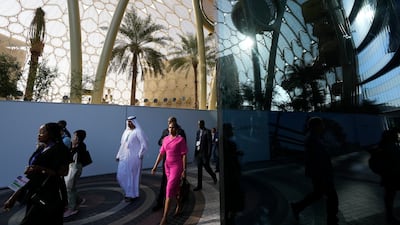
People walk through the site near Al Wasl Dome. AP -
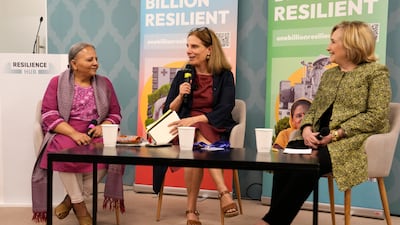
Eleni Myrivili, global chief heat officer at UN Habitat, with former US secretary of state Hillary Clinton and Indian social worker Reema Nanavaty at the Resilience Hub. AP -
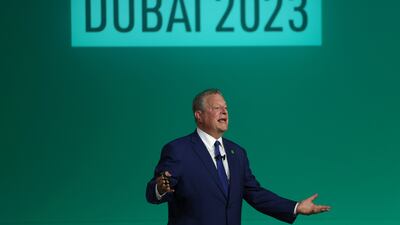
Al Gore, environmentalist and former US vice president, presents the Climate Trace global greenhouse gases emissions database on day four of Cop28. Getty Images -
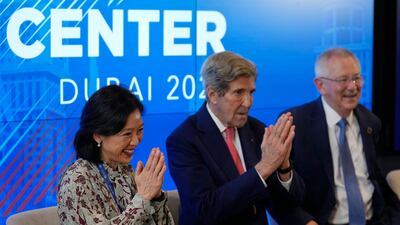
Elizabeth Yee and John Kerry, US Special Presidential Envoy for Climate, at a session at the US Centre. AP -
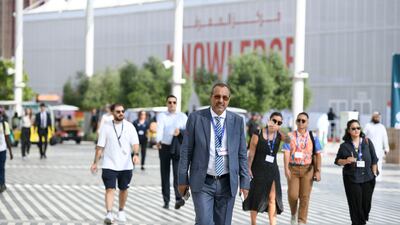
About 200 countries are taking part in the Cop28 talks. Khushnum Bhandari / The National -
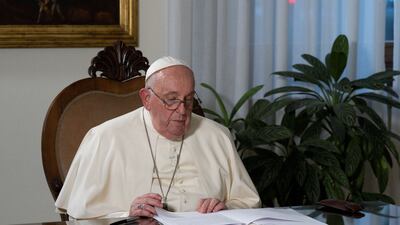
Pope Francis records a video message to be broadcast during the inauguration of the Faith Pavilion, at Casa Santa Marta, in the Vatican. Reuters -

Dr Tedros Ghebreyesus, Director General of the World Health Organisation, speaks at the Health Day opening session. Getty Images -
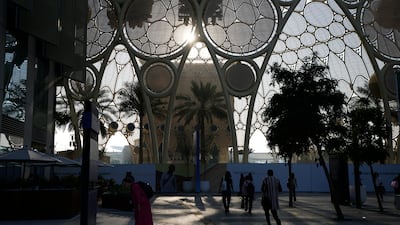
Attendees arrive at the Cop28 summit. AP -
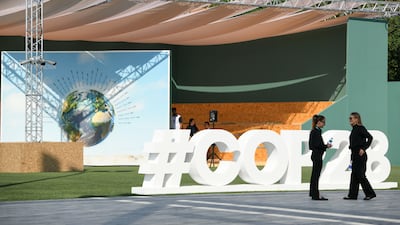
The Voice Action hub for peaceful protesters at Cop28, Expo City, Dubai. Khushnum Bhandari / The National -
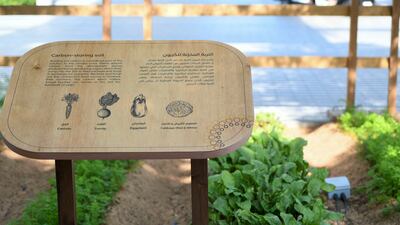
The Expo City farm, which will remain in operation after Cop28 ends. Khushnum Bhandari / The National


“No pathway remains that avoids exceeding 1.5°C global warming for at least some decades, except for truly radical transformations.”
Most carbon removal today involves trees, although more technical options are being developed in which carbon dioxide is sucked out of the atmosphere and buried underground or in the sea.
Such technology will take “a long time to become mature”, said Dr Geden, and is described in a UN report underpinning Cop28’s global stocktake as having a range of practical issues.
Then there is what he called the “real scary stuff”, such as radical proposals to divert sunlight into space, known as solar radiation modification.
For carbon removal to be given a chance instead, policies “must be put in place in the near term”, the findings say – with the stocktake regarded as a key chance to take action before the next one is due in 2028.

