


As the EU's western-most gateway to a prime slice of the Atlantic ocean and the airspace above it, Ireland's official neutrality is something of a kink in the bloc's efforts to build up its defences in alignment with Nato.
The issue emerged from the shadows after the Ukraine war erupted and the question of how well Ireland can defend itself is now hotly debated.
The contentious nature of the topic was highlighted when protesters interrupted Deputy Prime Minister Micheal Martin, who is also Foreign Minister, as he gave a speech at a recent security forum.
A group held up a flag that read “Nato wars, millions dead” and chanted “shame on you”.
For generations, military neutrality has been entrenched in the fabric of the nation and a mainstay in its foreign policy. But an uptick in Russian naval activity in the waters around the Emerald Isle and Russia's attack on its neighbour have opened up a new type of conversation in Ireland - on defence.
Prime Minister Leo Varadkar has said Ireland will neither be applying for Nato membership nor changing its policy of military neutrality.
A poll by Ipsos published in June showed 61 per cent of participants support Ireland’s neutral policy, while 26 per cent said they would like to see a change. Just over half of those seeking a shift in direction said they would like to see the country become part of Nato.
Nato debate 'taking root in Ireland'
While Ireland's neutral stance - refraining from joining military alliances or defence pacts - has for decades been perceived as a strength, it is being put under unprecedented scrutiny.
A debate on whether Ireland would be safer outside or inside Nato if the Ukraine war spills over is gaining traction.
Patrick Bury, a former British Army captain in the Royal Irish Regiment who served in Afghanistan, told The National three factors were fuelling the widening conversation on military matters.
Firstly, the former Nato analyst said, the Irish Defence Forces have been “chronically underfunded” by successive governments dating back to 2008.
Secondly, Russia’s invasion of Ukraine has up-ended the long-held belief among Ireland and its European neighbours that the days of the continent being scarred by war were in the past.
“The invasion of Ukraine has overturned assumptions on European security,” he said.
“As a result of these two factors, the third part of the question is on Irish neutrality and what it is to be neutral in the 21st century.
“There are other European countries grappling with the same question. Sweden had to change its position and it is looking to join Nato. And there are interesting conversations developing in Switzerland regarding the exporting of weapons systems to help Ukraine.”
Dr Bury touched on the dramatic intervention Irish President Michael D Higgins made when he waded into the discussion. Mr Higgins said politicians were playing with fire by opening up a debate on the country's longstanding military neutrality, and said it marked a dangerous drift from a cornerstone of Irish foreign policy.
“It was not the most measured intervention,” Dr Bury said, adding that the president had made it in a “not very statesmanlike way”.
Nevertheless, he said debates on all things military related, including potential Nato membership, are "starting to take root” in Ireland and the tide cannot be stopped.
Some people are concerned that by keeping its neutral stance in the midst of a war in eastern Europe, Ireland risked being looked upon as an apathetic nation, he said.
“We stayed out of the Second World War and by doing so were not on the right side of what was a battle against the Nazis. You could argue the same thing is going on this time with Ukraine," he said.
Nato through the years - in pictures
-

British Foreign Secretary Ernest Bevin signs the North Atlantic Treaty in Washington on April 4, 1949. All photos: Getty -
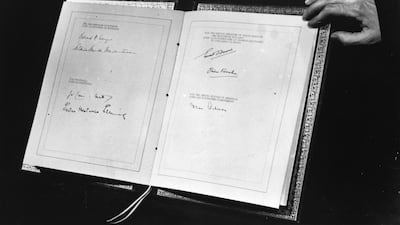
The North Atlantic Treaty showing the signatures of the foreign secretaries and ambassadors of the original signing nations - Belgium, Britain, Canada, Denmark, France, Iceland, Italy, Luxembourg, the Netherlands, Norway, Portugal and the US -
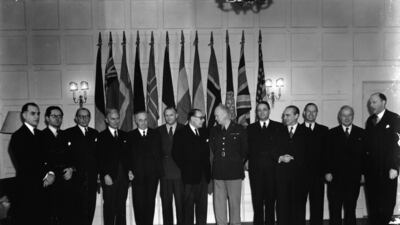
A meeting of the North Atlantic Council deputies in 1951 in London, attended by Gen Dwight D Eisenhower, centre -
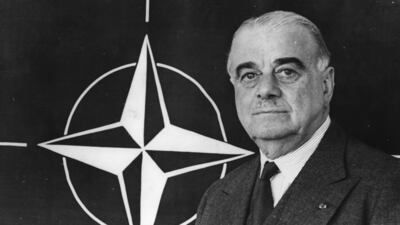
Lord Hastings Lionel Ismay, Secretary General of Nato, with the newly adopted Nato emblem in 1952 -
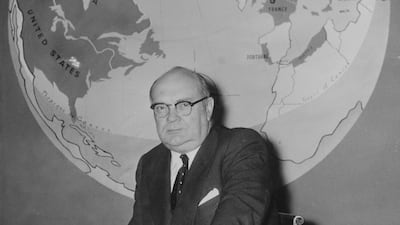
Belgian Foreign Minister Paul-Henri Spaak holds a press conference in Paris after taking over from Hastings Ismay as Nato chief in 1956 -
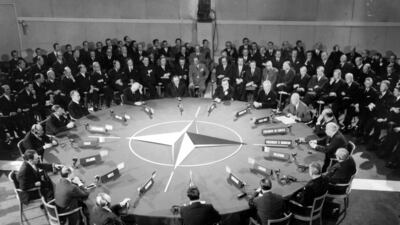
The opening speech at the Nato summit in Paris in 1957 -
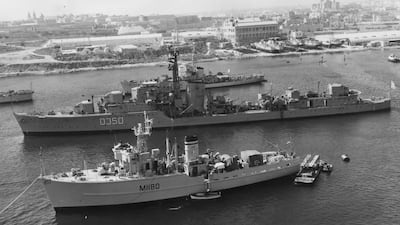
Some of the Nato vessels gathered for Exercise Medflex Invicta in Malta in 1961 -

A McDonnell Douglas F-4 Phantom II fighter-bomber of the Royal Navy is launched from HMS Ark Royal during a Nato exercise in 1972 -

German Nato troops on manoeuvres in 1980 -
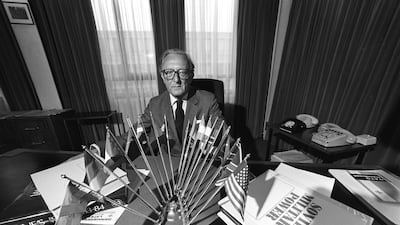
Lord Carrington, the new Secretary General of Nato, sits behind his desk in Brussels, Belgium, in 1984 -
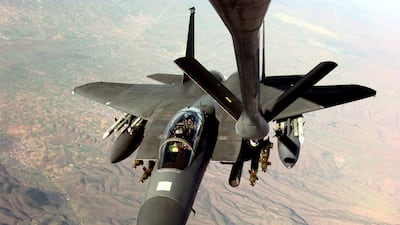
A US Air Force F-15E Strike Eagle refuels in the skies over Macedonia in 1999, as it flies missions in support of Nato Operation Allied Force -

Frigates, part of the Nato permanent fleet based in the Mediterranean Sea, enter the port of Piraeus, Greece, in 2003 -
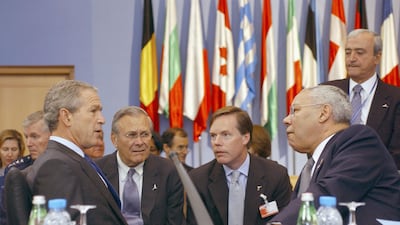
US President George W Bush, US Secretary of Defence Donald Rumsfeld, ambassador R Nicholas Burns and US Secretary of State Colin Powell attend the Nato summit in 2004 in Istanbul, Turkey -
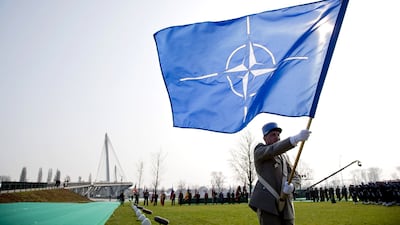
Members of the military attend a commemoration for Nato soldiers during the 2009 summit in Kehl, Germany -
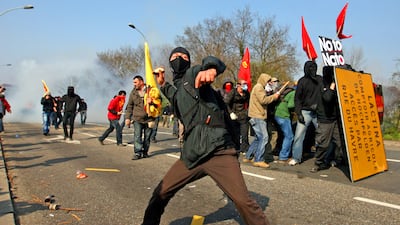
A protester throws a stone during clashes at the Nato summit in 2009 in Strasbourg, France -
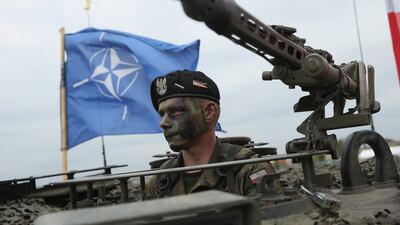
A Polish soldier sits in a tank as a Nato flag flies behind during military exercises in Zagan, Poland, in 2015 -
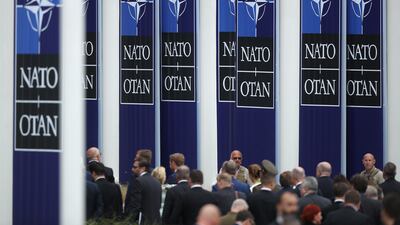
Guests depart after attending the opening ceremony at the 2018 Nato summit in Brussels -
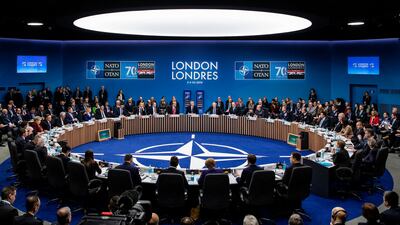
Nato leaders listen to British Prime Minister Boris Johnson while attending the summit in 2019 in Watford, England -
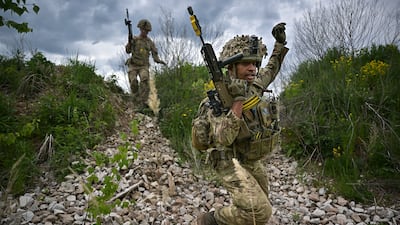
Soldiers from the Royal Welsh Battlegroup take part in manoeuvres during a Nato exercise on the Estonian-Latvian border in 2022 in Voru, Estonia -
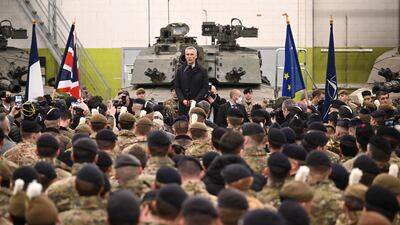
Secretary General of Nato Jens Stoltenberg meets troops at the Tapa Army Base in 2022 in Tallinn, Estonia -
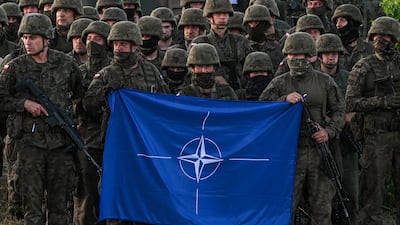
Polish soldiers hold a Nato flag in 2022 at a training ground in Orzysz, Poland -
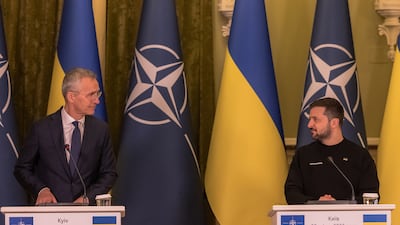
Ukrainian President Volodymyr Zelenskyy and Mr Stoltenberg attend a joint press conference in Kyiv, Ukraine, in April 2023


'Vociferous opposition to Ireland joining Nato'
Finland ditched a decades-old policy of military neutrality when it became Nato's 31st member in April.
Sweden ended its long history of neutrality last year when it announced its intention to join Nato. More than a year on, it continues to push for accession, which is being blocked by Turkey. If it does manage to join, it would leave Ireland one of just four EU nations not in Nato - Austria, Cyprus and Malta being the others.
Switzerland and Austria confirmed on Friday they would join 16 Nato countries in an initiative called Sky Shield aimed at upgrading Europe's air defences.
Nato used as a hammer
But Ben Tonra, a professor of international relations at University College Dublin, said Nato is far from being at the centre of Ireland's discussion on military neutrality. Instead, he said "pacifists" are using it as a tool to try to silence those calling for a change in the approach to defence.
“There’s no debate on Nato membership,” he told The National.
“There isn’t a single politician who has proposed that Ireland joins Nato. What is happening is a debate on Ireland’s security policy.
“The moment you start talking about defence and security those who want to defend the status quo say ‘you want to join Nato’.
“Nato is being used as a hammer to shut down the argument.”
Amid protests at public meetings and arguments on social media, Prof Tonra said the most crucial element of the conversation risks being buried.
"There is a general crisis in the defence forces," he explained. "We are incapable of even knowing what’s happening in our skies or in our seas,” he explained.
“But people are talking about defence in a way they have not before."
There has for many years been a widespread reluctance to engage in defence conversations because “it brings up a lot of historical ghosts”, he said.
The ongoing discussion explores whether Ireland should engage more with the EU on defence and security, and strengthen the formal relationship it has with Nato. In 1999 the nation joined as a member of the Nato Partnership for Peace programme and signed up to the alliance’s Euro-Atlantic Partnership Council.

Ireland relying on UK for to plug defence gaps
Cracks in Ireland’s defence structures have been exposed in recent years by reports suggesting the government had a secret pact with the UK to allow Royal Air Force fighter jets to operate in Irish sovereign airspace.
The bilateral agreement is understood to have been inked in the wake of the 9/11 attacks in the US. It permits RAF Typhoon supersonic fighters to intercept and shoot down rogue aircraft violating Irish airspace.
The reason behind such a deal is simple: decades of persistent underinvestment in the Irish military means the nation is not equipped with a primary radar system capable of detecting enemy aircraft once they have turned off their transponders. The Irish Air Corps does not have any planes that can fly high or fast enough to intercept such threats.
The emergence of details of the deal represented an embarrassment for the government in Dublin but military analysts had long suspected such an pact was in place.
“That was no surprise,” Dr Bury said, adding: "It's been well known for many years."
He called for a shake-up of defence policies in Ireland, and suggested the triple lock system for deploying troops overseas could be altered to raise the deployment threshold to 100 personnel.
Under the mechanism, any deployment of more than 12 Irish soldiers for peacekeeping or EU missions must be approved by the government in Dublin, the Dail (the lower house of the Irish legislature) and a UN resolution.
Mr Martin, the Tanaiste, has questioned whether the policy remains fit for purpose.
Ireland's military should be dealt with more seriously by politicians when allocating funding, Dr Bury said.
“We don’t have to be like the UK but we have to be able to monitor our airspace and waters and have a credible land force,” he added. “The navy needs to improve their radar, boats and hire more crew.”
James Ker-Lindsay, a professor of international relations at London School of Economics, said he was surprised by the reaction to a documentary he made about whether Ireland could be the next nation to reach for Nato.
“I was taken aback by just how vociferous Irish people are opposed to Nato," he said. They shout loudly. It’s difficult to get an idea of just how representative they are.
“But you are going to have a chunk of the population who are opposed to Nato. They believe Ireland must remain neutral at all costs."

