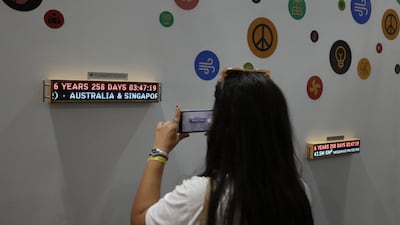
Britain's King Charles and London Mayor Sadiq Khan activated the 'Climate Clock'. Pool

King Charles unveils climate countdown clock at London summit


Neil Murphy
  • English
  • Arabic

King Charles III attended a key climate summit in London, where he helped unveil a countdown clock showing the time remaining before the catastrophic effects of global warming become unavoidable.

The king visited the Climate Innovation Forum on Wednesday, where the five-metre tall clock was launched at Guildhall in the City of London.

The unveiling was accompanied by the launch of 150 similar clocks across London and other major cities in the UK, the largest being located at Piccadilly Circus.

The clocks aim to spur the world into action to limit global warming to 1.5°C, a crucial goal that must be met if total climate breakdown is to be avoided.

Humanity has just six years left to meet this goal, according to data from the Intergovernmental Panel on Climate Change.

The first climate countdown clocks were launched in New York in September 2020. Since then, clocks have also been unveiled in Berlin, Seoul, Rome and Glasgow.

Upon his arrival at the forum, King Charles was met by Minister for Energy Security and Net Zero Graham Stuart and Mayor of London Sadiq Khan, who was also on stage officially switch on the clock.

In a meeting with business leaders, the king heard discussions on how to rapidly finance, replicate and scale innovation, as well as technological solutions, towards a more sustainable future.

King Charles has long promoted environmental causes and is fully expected to continue this tradition following his coronation earlier this year.

In February the king hosted a reception in support of global biodiversity on behalf of the UK government, attended by international ministers, civil society, private sector and indigenous representatives.

Last November he hosted a reception at Buckingham Palace ahead of the Cop27 Summit.

The reception brought together over 200 international business leaders, decision-makers and NGOs to mark the end of the UK’s presidency of Cop26 and look ahead to the Cop27 Summit in Egypt.

The Cop28 Summit will take place this year in Dubai from November 30. The President of the upcoming summit, Sultan Al Jaber, was also in attendance at the Climate Innovation Forum.

Earlier in the day, King Charles hosted astronauts, business leaders, environmentalists and scientists at Buckingham Palace to unveil a seal to mark the launch of the ‘Astra Carta’ framework, which is aimed at inspiring sustainability across the space industry.

Before unveiling the seal, the king said the event was held to try to ensure “the protection of outer space”.

Guests who attended the event included Canadian astronaut Chris Hadfield, British astronaut Tim Peake, the UK’s newest astronaut Rosemary Coogan, the world’s first disabled astronaut John McFall, Queen guitarist and astrophysicist Sir Brian May and representatives from the UK Space Agency, the European Space Agency, Nasa and other international space agencies.

  • The Climate Clock in the Manhattan borough of New York in April 2021. Reuters
    The Climate Clock in the Manhattan borough of New York in April 2021. Reuters
  • A climate clock showing the time remaining before a global temperature rise of 1.5°C is no longer avoidable in Sharm El Sheikh, Egypt. Getty
    A climate clock showing the time remaining before a global temperature rise of 1.5°C is no longer avoidable in Sharm El Sheikh, Egypt. Getty
  • Activists display a climate clock in Shibuya Ward, Tokyo. Reuters
    Activists display a climate clock in Shibuya Ward, Tokyo. Reuters
  • Climate protesters demonstrate in front of a climate clock in Rome. Getty
    Climate protesters demonstrate in front of a climate clock in Rome. Getty
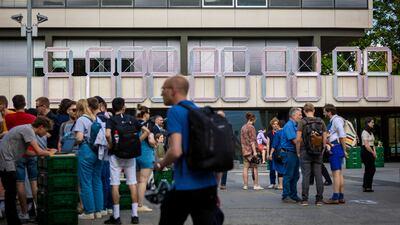
  • The Climate Crisis Clock hangs at the Technical University of Braunschweig in Germany. Getty
    The Climate Crisis Clock hangs at the Technical University of Braunschweig in Germany. Getty
  • The world’s largest climate clock in Prague. Reuters
    The world’s largest climate clock in Prague. Reuters
Sheer grandeur

The Owo building is 14 storeys high, seven of which are below ground, with the 30,000 square feet of amenities located subterranean, including a 16-seat private cinema, seven lounges, a gym, games room, treatment suites and bicycle storage.

A clear distinction between the residences and the Raffles hotel with the amenities operated separately.

What is a Ponzi scheme?

A fraudulent investment operation where the scammer provides fake reports and generates returns for old investors through money paid by new investors, rather than through ligitimate business activities.

Groom and Two Brides

Director: Elie Semaan

Starring: Abdullah Boushehri, Laila Abdallah, Lulwa Almulla

Rating: 3/5

Ten tax points to be aware of in 2026

1. Domestic VAT refund amendments: request your refund within five years

If a business does not apply for the refund on time, they lose their credit.

2. E-invoicing in the UAE

Businesses should continue preparing for the implementation of e-invoicing in the UAE, with 2026 a preparation and transition period ahead of phased mandatory adoption. 

3. More tax audits

Tax authorities are increasingly using data already available across multiple filings to identify audit risks. 

4. More beneficial VAT and excise tax penalty regime

Tax disputes are expected to become more frequent and more structured, with clearer administrative objection and appeal processes. The UAE has adopted a new penalty regime for VAT and excise disputes, which now mirrors the penalty regime for corporate tax.

5. Greater emphasis on statutory audit

There is a greater need for the accuracy of financial statements. The International Financial Reporting Standards standards need to be strictly adhered to and, as a result, the quality of the audits will need to increase.

6. Further transfer pricing enforcement

Transfer pricing enforcement, which refers to the practice of establishing prices for internal transactions between related entities, is expected to broaden in scope. The UAE will shortly open the possibility to negotiate advance pricing agreements, or essentially rulings for transfer pricing purposes. 

7. Limited time periods for audits

Recent amendments also introduce a default five-year limitation period for tax audits and assessments, subject to specific statutory exceptions. While the standard audit and assessment period is five years, this may be extended to up to 15 years in cases involving fraud or tax evasion. 

8. Pillar 2 implementation 

Many multinational groups will begin to feel the practical effect of the Domestic Minimum Top-Up Tax (DMTT), the UAE's implementation of the OECD’s global minimum tax under Pillar 2. While the rules apply for financial years starting on or after January 1, 2025, it is 2026 that marks the transition to an operational phase.

9. Reduced compliance obligations for imported goods and services

Businesses that apply the reverse-charge mechanism for VAT purposes in the UAE may benefit from reduced compliance obligations. 

10. Substance and CbC reporting focus

Tax authorities are expected to continue strengthening the enforcement of economic substance and Country-by-Country (CbC) reporting frameworks. In the UAE, these regimes are increasingly being used as risk-assessment tools, providing tax authorities with a comprehensive view of multinational groups’ global footprints and enabling them to assess whether profits are aligned with real economic activity. 

Contributed by Thomas Vanhee and Hend Rashwan, Aurifer

Updated: June 28, 2023, 4:29 PM