A Russian soldier stands guard in front of an RS-24 Yars, a Russian MIRV-equipped thermonuclear armed intercontinental ballistic missile, during a parade in Moscow. Getty

Russia to send short-range, easily detected nuclear weapons to Belarus


Laura O'Callaghan
  • English
  • Arabic

Russia is likely to openly send nuclear weapons to Belarus next month, an act experts have called “reckless”, as it represents a further erosion of European arms control.

Russian President Vladimir Putin announced on Friday that he would send nuclear weapons to the neighbouring country after special storage facilities are made ready between July 7-8.

The first instance of Moscow moving such warheads outside of Russia since the fall of the Soviet Union is likely to concern Nato as well as China.

Mr Putin sees his Belarusian counterpart Alexander Lukashenko as one of his few allies and is keen to bring the leader – called “Europe’s last dictator” – closer into his circle.

Dan Plesch, professor of diplomacy and strategy at London’s School of Oriental and African Studies, said Russia knows it is in a weak position against conventional western weapons and is keen to demonstrate strength in other arenas.

“It is reckless,” he told The National.

“Presumably they will move some short-range nuclear weapons.

“They apparently will be short-range, ground-to-ground missiles and will be relatively easily [detectable] by Nato. You can’t hide them very effectively.”

Russian President Vladimir Putin hosted Belarusian President Alexander Lukashenko at his home in Sochi on Friday. AP

The 1987 Intermediate-Range Nuclear Forces Treaty signed by the US and the Soviet Union required both parties to agree to give up all of their nuclear and conventional ground-launched ballistic and cruise missiles with ranges of 500km to 5,500km.

“That treaty very effectively has limited Putin’s options in Ukraine and he doesn’t have missiles of [longer] ranges,” Mr Plesch explained.

“That’s why these are relatively short-range missiles because long-range missiles were, broadly speaking, banned under the treaty.”

Mr Putin announced in March that he had agreed to send nuclear weapons to Belarus, pointing to US deployment of tactical nuclear weapons in a host of European countries over many decades.

“Everything is going according to plan,” Mr Putin told Mr Lukashenko, according to a Kremlin transcript of the meeting. The two leaders were discussing the planned nuclear deployment over a meal at the Russian leader's summer retreat in the Black Sea resort of Sochi.

“Preparation of the relevant facilities ends on July 7-8, and we will immediately begin activities related to the deployment of appropriate types of weapons on your territory.”

The Kremlin’s statement, released on Friday, is likely to ruffle feathers in Beijing, as it could be interpreted as “a pretext for the Americans sending nuclear weapons to Japan, [South] Korea” and other neighbouring countries.

“It will set alarm bells off, and quite rightly,” Mr Plesch added. “But it’s part of a broader ongoing arms race. The world is spending $2 trillion on the military every year.”

The development came a day after the UK unveiled a ban on imports of gold and other materials from Belarus, in a bid to prevent Russia from circumventing sanctions.

Moscow is keen to “tie in Lukashenko so he can’t get away [and] cut off all other options for him” to forge ties with the West, said Rasmus Nilsson, a lecturer specialising in Russian and Belarusian foreign policies at SOAS.

Speaking to The National, he outlined three main aims President Putin is likely to have in his plan.

“From Russia’s point of view right now, any sort of ally, any sort of friend is what they need. They can’t be picky,” he said.

First, Mr Putin will be keen to send a message that, while his troops fight in Ukraine, it is “business as usual” at home.

Secondly, Mr Nilsson echoed Mr Plesch’s comments about Moscow’s desire to keep Belarus from turning to the West.

“Lukashenko sometimes tries to do things on his own,” Mr Nilsson said. “He goes and talks to the Chinese, not necessarily thinking whether the Russians want him to do that or whether it will benefit them.

“Russia wants to keep him dependent on them.

“So the Russians are using this as another way of saying, ‘We’re going to put these weapons on your territory which means we will have an excuse to put even more soldiers in, if need be’.”

Thirdly, he suggested Mr Putin is desperate to change the narrative as Kyiv’s much-anticipated counter-offensive gets under way.

“The Russians are tying to make it look as if they’re actually having some success in something,” he said, referring to the bold movement of nukes to Belarus.

“It shows a disregard for European arms control, which is concerning.”

But he cautioned against adopting an alarmist view, pointing out that the Russians are already believed to have nuclear weapons stationed in Kaliningrad, the enclave sandwiched between EU and Nato members Lithuania and Poland.

“They can blow up large cities and things like that,” he said. “When you’re dealing with nuclear weapons nowadays, even at a tactical level, the explosion load can be so big that it is devastating.

“But I don’t think people should focus on some possible nuclear disaster. I don’t think that’s where we’re heading.

“The danger right now is not some nuclear attack – it is this gradual nuclear and general arms control in Europe and in the medium to long term that is a problem.”

Last September, Mr Putin warned the West he was not bluffing when he said Russia would use “all available means to protect Russia and our people”.

Ukraine and Russia conflict – in pictures

  • A Ukrainian soldier moves along a trench at a position near the front-line town of Bakhmut. Reuters
    A Ukrainian soldier moves along a trench at a position near the front-line town of Bakhmut. Reuters
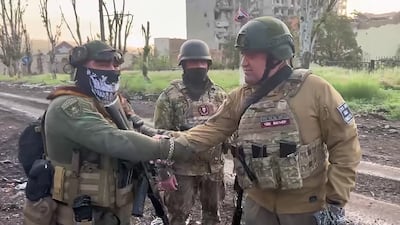
  • The leader of Russia's Wagner Group Yevgeny Prigozhin, right, talks to his fighters in Bakhmut. AFP
    The leader of Russia's Wagner Group Yevgeny Prigozhin, right, talks to his fighters in Bakhmut. AFP
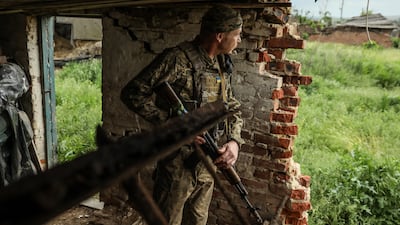
  • A Ukrainian serviceman from the 24th Separate Mechanised Brigade keeps watch on the front line. EPA
    A Ukrainian serviceman from the 24th Separate Mechanised Brigade keeps watch on the front line. EPA
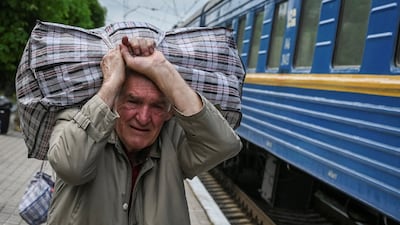
  • An evacuee from eastern Ukraine boards a train in Pokrovsk bound for Lviv. Reuters
    An evacuee from eastern Ukraine boards a train in Pokrovsk bound for Lviv. Reuters
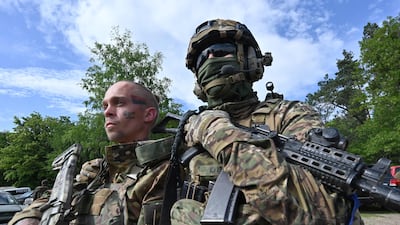
  • Fighters of the Russian Volunteer Corps, which fights on the side of Ukraine, in the north of the country, not far from the Russian border. AFP
    Fighters of the Russian Volunteer Corps, which fights on the side of Ukraine, in the north of the country, not far from the Russian border. AFP
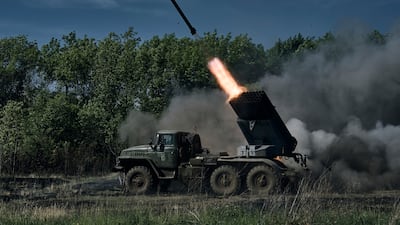
  • A Ukrainian army multiple rocket launcher fires at Russian positions on the front line near Bakhmut. AP
    A Ukrainian army multiple rocket launcher fires at Russian positions on the front line near Bakhmut. AP
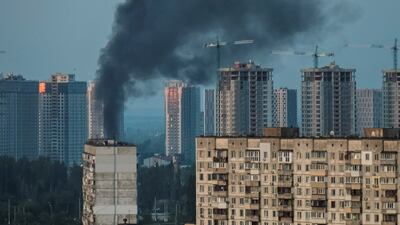
  • Smoke rises after a Russian missile strike in Kyiv. Reuters
    Smoke rises after a Russian missile strike in Kyiv. Reuters
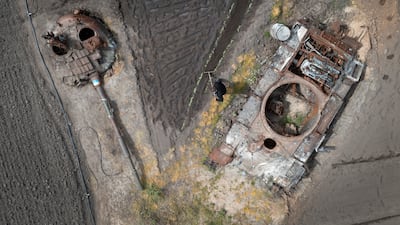
  • A Ukrainian man plants sunflowers between a damaged Russian tank and its turret in his garden in the village of Velyka Dymerka, Kyiv region. AP
    A Ukrainian man plants sunflowers between a damaged Russian tank and its turret in his garden in the village of Velyka Dymerka, Kyiv region. AP
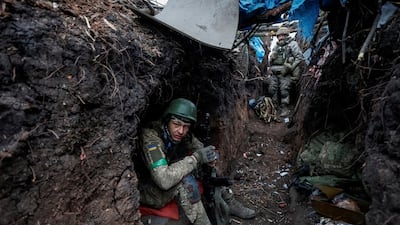
  • Ukrainian servicemen rest at their positions after a battle near the front-line city of Bakhmut. Reuters
    Ukrainian servicemen rest at their positions after a battle near the front-line city of Bakhmut. Reuters
  • A teenager aims a Kalashnikov AK47 rifle during defence training at a centre for school pupils in Lviv. AFP
    A teenager aims a Kalashnikov AK47 rifle during defence training at a centre for school pupils in Lviv. AFP
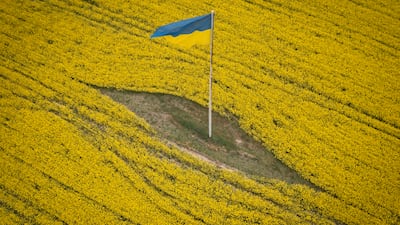
  • A Ukrainian national flag in the middle of a blossoming field near Brovary, east of Kyiv. AP
    A Ukrainian national flag in the middle of a blossoming field near Brovary, east of Kyiv. AP
  • Ukrainian servicemen check Russian positions near the front-line city of Bakhmut. Reuters
    Ukrainian servicemen check Russian positions near the front-line city of Bakhmut. Reuters
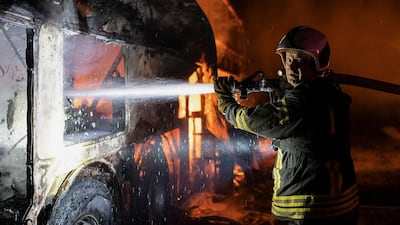
  • Rescuers put out a fire during a Russian air strike on Kyiv. EPA
    Rescuers put out a fire during a Russian air strike on Kyiv. EPA
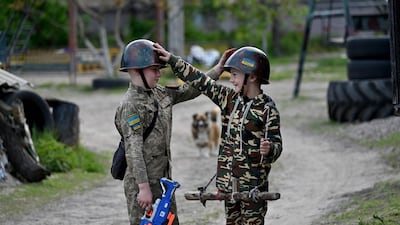
  • Ukrainian boys play at being soldiers in the village of Stoyanka. AFP
    Ukrainian boys play at being soldiers in the village of Stoyanka. AFP
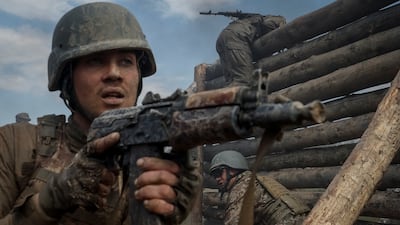
  • Ukrainian servicemen during an exercise in the Chernihiv region. Reuters
    Ukrainian servicemen during an exercise in the Chernihiv region. Reuters
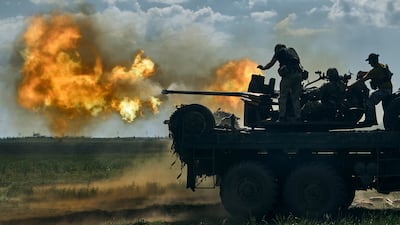
  • Ukrainian soldiers fire a cannon on the front line near Bakhmut. AP
    Ukrainian soldiers fire a cannon on the front line near Bakhmut. AP

SPECS

Nissan 370z Nismo

Engine: 3.7-litre V6

Transmission: seven-speed automatic

Power: 363hp

Torque: 560Nm

Price: Dh184,500

HIV on the rise in the region

A 2019 United Nations special analysis on Aids reveals 37 per cent of new HIV infections in the Mena region are from people injecting drugs.

New HIV infections have also risen by 29 per cent in western Europe and Asia, and by 7 per cent in Latin America, but declined elsewhere.

Egypt has shown the highest increase in recorded cases of HIV since 2010, up by 196 per cent.

Access to HIV testing, treatment and care in the region is well below the global average.  

Few statistics have been published on the number of cases in the UAE, although a UNAIDS report said 1.5 per cent of the prison population has the virus.

Mercer, the investment consulting arm of US services company Marsh & McLennan, expects its wealth division to at least double its assets under management (AUM) in the Middle East as wealth in the region continues to grow despite economic headwinds, a company official said.

Mercer Wealth, which globally has $160 billion in AUM, plans to boost its AUM in the region to $2-$3bn in the next 2-3 years from the present $1bn, said Yasir AbuShaban, a Dubai-based principal with Mercer Wealth.

Within the next two to three years, we are looking at reaching $2 to $3 billion as a conservative estimate and we do see an opportunity to do so,” said Mr AbuShaban.

Mercer does not directly make investments, but allocates clients’ money they have discretion to, to professional asset managers. They also provide advice to clients.

“We have buying power. We can negotiate on their (client’s) behalf with asset managers to provide them lower fees than they otherwise would have to get on their own,” he added.

Mercer Wealth’s clients include sovereign wealth funds, family offices, and insurance companies among others.

From its office in Dubai, Mercer also looks after Africa, India and Turkey, where they also see opportunity for growth.

Wealth creation in Middle East and Africa (MEA) grew 8.5 per cent to $8.1 trillion last year from $7.5tn in 2015, higher than last year’s global average of 6 per cent and the second-highest growth in a region after Asia-Pacific which grew 9.9 per cent, according to consultancy Boston Consulting Group (BCG). In the region, where wealth grew just 1.9 per cent in 2015 compared with 2014, a pickup in oil prices has helped in wealth generation.

BCG is forecasting MEA wealth will rise to $12tn by 2021, growing at an annual average of 8 per cent.

Drivers of wealth generation in the region will be split evenly between new wealth creation and growth of performance of existing assets, according to BCG.

Another general trend in the region is clients’ looking for a comprehensive approach to investing, according to Mr AbuShaban.

“Institutional investors or some of the families are seeing a slowdown in the available capital they have to invest and in that sense they are looking at optimizing the way they manage their portfolios and making sure they are not investing haphazardly and different parts of their investment are working together,” said Mr AbuShaban.

Some clients also have a higher appetite for risk, given the low interest-rate environment that does not provide enough yield for some institutional investors. These clients are keen to invest in illiquid assets, such as private equity and infrastructure.

“What we have seen is a desire for higher returns in what has been a low-return environment specifically in various fixed income or bonds,” he said.

“In this environment, we have seen a de facto increase in the risk that clients are taking in things like illiquid investments, private equity investments, infrastructure and private debt, those kind of investments were higher illiquidity results in incrementally higher returns.”

The Abu Dhabi Investment Authority, one of the largest sovereign wealth funds, said in its 2016 report that has gradually increased its exposure in direct private equity and private credit transactions, mainly in Asian markets and especially in China and India. The authority’s private equity department focused on structured equities owing to “their defensive characteristics.”

Director: Laxman Utekar

Cast: Vicky Kaushal, Akshaye Khanna, Diana Penty, Vineet Kumar Singh, Rashmika Mandanna

Rating: 1/5

Updated: June 09, 2023, 4:28 PM