


A recent plea deal with the jewel thieves responsible for a spectacular museum heist in Germany will give gangsters the impression that “we can do what we want”, a leading expert on the country’s so-called “Arab clans” has said.
Five members of the Remmo family were handed prison terms last Tuesday over the 2019 break-in at Dresden’s Green Vault in which priceless 18th-century treasures were stolen.
Several had their sentences reduced after a deal with prosecutors led to the recovery of 31 stolen items which, a judge said, might otherwise have been lost for ever. Some were allowed to walk free pending appeals and a sixth defendant was cleared.
The Remmo family, which has roots in Lebanon, is among the most prominent in the Berlin underworld and its activities have sparked a sometimes racially charged debate over tackling “clan crime” in Germany.
Mahmoud Jaraba, a researcher at the Erlangen Centre for Islam and Law in Europe who has interviewed clan members at home, in mosques and in social settings, said those caught in Dresden represented only a “sub-sub-clan”.
He told The National that Germany’s attempts to repress the wider field of gang crime had, since 2015 when he began studying the subject, failed to curb the gangs' power.
“Unfortunately, this kind of deal like what happened with the Remmos in Dresden will have a positive impact on the criminal group,” he said.
“This is really a signal for other criminal groups that ‘we can do what we want to do here, and without consequences’.”
Dr Jaraba said German police had failed to educate themselves about the history and structure of the clans in question, which he said had small, well-organised criminal elements that do not represent the whole family.
“There is no effective strategy to really confront these clans or to try to fight them. We are speaking about well-organised families where loyalty is very high, they don’t co-operate with the police in most of the cases,” he said.
“They have very, very good lawyers. They know their laws – sometimes much more than the public prosecutors.”
___________________________________
Dresden Green Vault robbery - in pictures
-
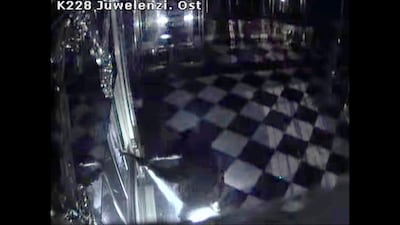
This photo taken from a CCTV video shows a person in black clothes, centre, destroying display cases inside the Green Vault in Dresden, Germany, on November 25, 2019. AP -

Thieves, armed with torches and tools, broke into cabinets and made off with three diamond jewellery sets. Reuters -

According to Staatliche Kunstsammlungen Dresden, this showcase in the Green Vault was broken into during the burglary. EPA -

This undated photo depicts the Jewellery Room of the Green Vault with the display cases, left, showing the part of the collection that was affected by the robbery. AP -
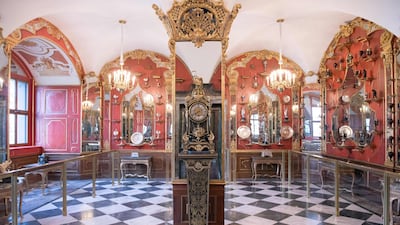
The White Silver Room, one of the rooms in the historic Green Vault, at the Royal Palace in Dresden. AFP -
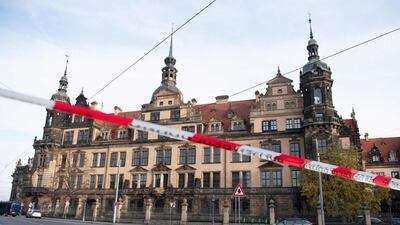
A police cordon hangs in front of the Royal Palace that houses the historic Green Vault in Dresden, on November 25, 2019, after it was broken into. AFP -

This photo shows parts of the collection at Silver Gilt Room, inside the Green Vault in Dresden. AP -

The yard inside the Royal Palace where the Green Vault is located. EPA -

The Jewel Room inside the historic historic Green Vault, which is home to around 4,000 precious objects made of ivory, gold, silver and jewels. AFP -

A policeman checks for evidence outside the Royal Palace. Reuters -

A policeman stands outside Dresden's Royal Palace following the heist. Reuters


___________________________________
Priceless jewels
After the Green Vault break-in in Dresden, police followed the trail 200km to the Berlin underworld.
Prosecutors said the thieves cut power to the museum and broke in through a window before fleeing in a car that they set on fire in an underground car park.
Gang member Rabieh Remmo admitted the thieves had smashed the Green Vault's glass display cases with an axe.
He said they filled a sack with jewellery from the museum and used a fire extinguisher in an attempt to cover their DNA trail.
The treasures once belonged to 18th-century Saxon royalty who commissioned ever more brilliant jewellery in a contest of wealth and prestige with King Louis XIV of France.
The insurance value of the stolen items was at least €114 million ($122.4 million), while museum experts described them as culturally and historically priceless.
Many items are still missing, and a Dutchman was arrested last year for allegedly duping authorities into giving him €40,000 to recover some of the loot before running away with the money.
An investigation into four museum guards was closed after no contacts between them and the suspects could be established.

Three Remmo family members, including two of the accused in Dresden, were previously convicted in 2020 over the theft of a gold coin worth €3.8 million ($4.1 million) from a Berlin museum.
The clan was also linked to a 2014 bank robbery in Berlin that ended in the branch being blown up and the theft of coins, banknotes and gold bars worth millions of euros.
Police have hit back with criminal prosecutions and armed raids against the Remmos and other groups, such as the Al Zein clan whose kingpin, nicknamed the Godfather of Berlin, was deported in 2021.
Chancellor Olaf Scholz’s government has promised to prioritise the fight against organised crime by seizing gangland properties, tackling money laundering and educating police.
But despite policies of “zero tolerance” and “a thousand pinpricks” being drawn up against the gangsters, Dr Jaraba said the sub-clans involved in crime were as strong as ever.
He says some Lebanese families had an uneasy relationship with the German state due in part to being marginalised and given only temporary immigration status in the 1980s and 1990s.
Some family members with no links to gang crime are discriminated against in jobs, schools and even kindergartens because of their surnames, said Dr Jaraba, who called for greater efforts to stop them slipping into criminality.
“We need to open the door for the non-criminal groups and members within these really large family groups,” he said.
“We know that repression alone cannot really solve this kind of complicated social problem. Therefore, preventive work is really very important in order to prevent more people joining such kinds of criminal structures.
“But until today, very, very little work has been done in this regard.”

