


Calls are being made to close a British charity run by the UK representative of Iran's supreme leader Ayatollah Ali Khamenei, after the aid watchdog removed its trustees.
The Charity Commission announced on Wednesday it had removed the trustees from the board of the Islamic Centre of England over its links to Iran.
It has previously received warnings from the watchdog after an unofficial speaker at the centre, Massoud Shadjareh, praised Qassem Suleimani, the deceased commander of the Islamic Revolutionary Guard Corps' Quds Force.
He had called Suleimani, who the UK had designated as a terrorist, a “dedicated soldier of Islam”. Suleimani was killed by a US drone strike in January 2020.
In another incident last year, trustee Seyed Hashem Moosavi made controversial remarks about protesters in Iran, calling them “soldiers of Satan”.
On Thursday, the Tony Blair Institute, a think tank, led calls for the centre to be closed down.
“The Islamic Centre of England, which operates as the official office of Ayatollah Khamenei in the UK and is headed by Khamenei's official representative to the UK, has consistently propagated Islamist extremist views and hosted IRGC-affiliated activities in its premises,” Kasra Aarabi, Iran programme lead at the Tony Blair Institute, told The National.
“In doing so, it has clearly violated Charity Commission guidelines on safeguarding against extremism. The Charity Commission’s recent ruling on the Islamic Centre of England is a welcome step and efforts should now be focused on permanently closing the centre, which is a direct threat to both Britain’s national security and British values.”
An interim manager was appointed last week.
The move comes after the charity became the subject of a statutory inquiry by the regulator in November 2022 over serious concerns about its governance.
The chairwoman of the Foreign Affairs Select Committee Alicia Kearns described the move as a “significant sanction”.
“This is the first step for all of us who have long campaigned for the closure of this cut out of the IRGC,” she said.
“It makes clear that all is not well, and I hope the inquiry will conclude that the IRGC has no place operating on British soil.
“This is a significant sanction and one of the most powerful interventions they have.”
Last year The National revealed the charity had received about £240,000 ($300,465) — £129,556 in 2021 and £109,476 in 2020 — from the government’s Covid-19 furlough programme.
It was given the funding despite having received an official warning from the Charity Commission.
In the latest inquiry, the commission ruled that the trustees had failed to comply with their legal duties and responsibilities, while neglecting to protect the charity’s assets.
Iran's plots against foreign officials and dissidents — in pictures
-
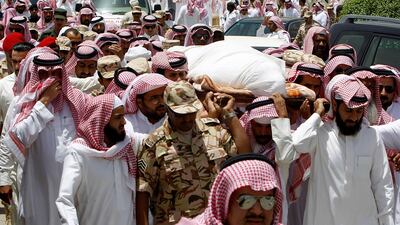
Relatives carry the body of Hassan Al Qahtani outside the Grand Mosque in Riyadh in May 2011. The Saudi diplomat was shot dead in Karachi by a man believed to have been linked to Iran's Islamic Revolutionary Guard Corps' Quds Force. Reuters -
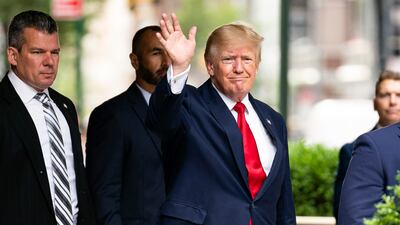
Iran has been attempting to kill or capture former US president Donald Trump after he ordered the air strike that killed the IRGC's Quds Force commander, Qassem Suleimani, in January 2020. AP -
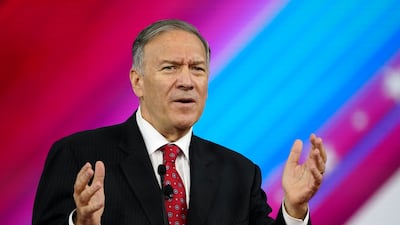
Former secretary of state Mike Pompeo is believed to have been Iran's second target, after former national security adviser John Bolton, marked for assassination. AP -

Gen Kenneth McKenzie, former commander of the US Central Command, has been high on Iran's list of people to be killed in retribution following Suleimani's death. AFP -

Abdul Rahman Ghassemlou, secretary general of the Democratic Party of Iranian Kurdistan, was shot dead in July 1989 by suspected Iranian agents in Vienna. Getty -
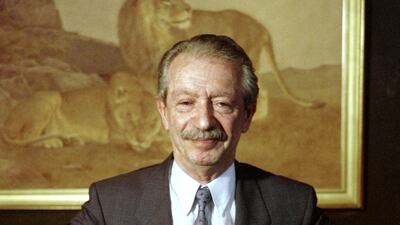
Shapour Bakhtiar, the last Iranian prime minister under the Shah, was killed at his home in August 1991 by assassins believed to have been sent by Tehran. AFP -
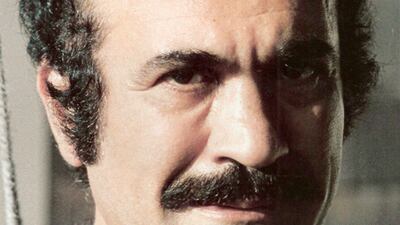
Iranian poet and entertainer Fereydoun Farrokhzad's death has never been solved but German police believe he was killed by Iranian operatives.


UK Security Minister Tom Tugendhat has welcomed the decision to remove the trustees.
“In recent months, I've warned often about the threat that Iran poses to us here in the United Kingdom,” he said.
“The actions of the Iranian [Islamic] Revolutionary Guard Corps and its agents have put lives in danger in our own country.
“Its leadership [was] appointed by the head of the Islamic republic of Iran and it is reported to have celebrated the lives of people like Gen Suleimani, the head of the IRGC [Quds Force], who [did] so much to spread hatred, death and destruction, not just in the Middle East, but around the world.”
British-Iranian hunger striker Vahid Beheshti, who is campaigning to have Iran's IRGC listed as a terrorist group, has also backed the move.
“The inquiry will indeed conclude that the IRGC has no place operating on British soil,” he said.
“Our campaign to proscribe the IRGC is backed with irrefutable evidence, and we will not give up until this is done. #IRGCterrorists have no place in the UK, in Iran, or anywhere in the world.”
Britain has imposed sanctions on IRGC leaders but, as is the case with European allies, has so far stopped short of listing the organisation as a terrorist group.

