


The Egyptian Pharaoh Ramses II has captured the French imagination for centuries, drawing comparisons to France’s own Sun King, Louis XIV.
And now, for the first time in almost 50 years, museum-goers in Paris can gaze at the ruler's sarcophagus, estimated to be more than 3,000 years old. The ancient coffin has made a rare journey out of Egypt to the Grande Halle de la Villette, and where it will remain on display until September.
“When a Frenchman or woman is asked to name a pharaoh, they mention Ramses without fail,” said Egyptologist Dominique Farout, the exhibition’s curator. “His stature and prestige, in our eyes make him a match for Louis XIV”.
The cedar wood coffin pictures the recumbent King with his arms crossed against his chest, holding two royal sceptres. His wide, contoured eyes are open but his lips are sealed. On the crown of his head is a uraeus, a sacred serpent often seen on Egyptian monarchs.
The bare wooden carving with its faded yellow paint does not look fit for a king, let alone the leader of a mighty civilisation. But archaeologists believe that it was once elaborately decorated with gilding and inlay of precious stone and glass. According to the American Society of Archaeologists in Egypt, these may have been stripped from the sarcophagus by the High Priests of Amun, who claimed to be protecting the tombs, during a period of economic and political uncertainty in Egypt.
The rare loan of Ramses II’s sarcophagus was only allowed through a special exception made for France. This is because, In 1976, the coffin and the mummy were taken to the French Musee de l’Homme for restoration and treatment for fungus.
“When the mummy of Ramses II touched down on French soil in 1976, it was welcomed with honours fit for a sitting head of state,” said Farout. The coffin was then exhibited at the Grand Palais.
France has 54 antiquities teams working in Egypt, an official told AFP ― the most of the 25 countries who currently have research teams there.
-

The sarcophagus of Ramses II is displayed on the opening day of the exhibition 'Ramses and the Gold of the Pharaohs' at the Grande Halle de la Villette in Paris. AFP -
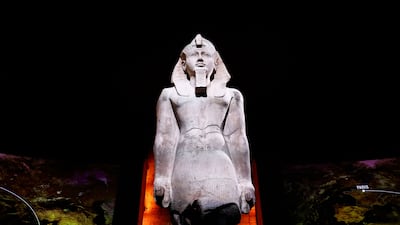
A Colossus of Ramses II in limestone on display. The exhibition, which is on tour in 10 cities and explores the life of Ramses the Great, runs until September 6. AFP -

A journalist takes a photograph of the wooden coffin of Pharaoh Ramses II. AP -
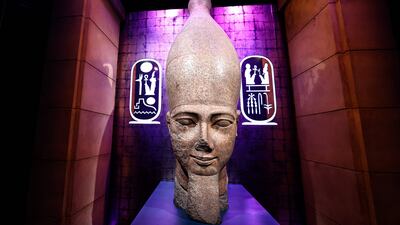
The head of a colossal statue of Ramses II. AFP -

The upper part of a granodiorite statue of Pharaoh Merneptah. AFP -
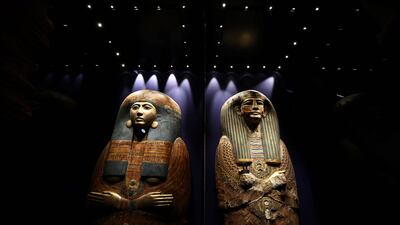
The painted and gilded cedar outer coffin lid of Pinudjem II's wife, Princess Nesikhonsu, left, and the inner coffin lid or mummy board of Pinudjem I. AFP -

A gilded wooden mask from the coffin of Amenemope. Reuters -
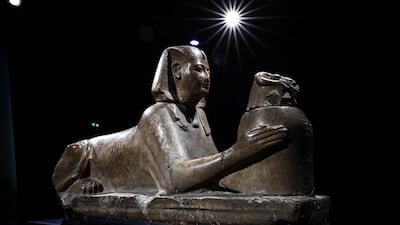
A statue featuring Pharaoh Ramses II as a Sphinx offering a ram-headed vessel. AFP -
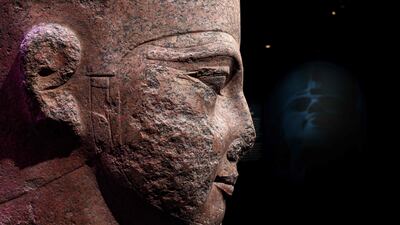
The head of a colossal statue of Ramses II. AFP -

The Coffin of Ramses II. Photo: World Heritage Exhibitions -

Gold bracelets of Sheshonq I with a Wedjat Eye. Photo: World Heritage Exhibitions -

Funerary mask of King Amenemopet. Photo: World Heritage Exhibitions -
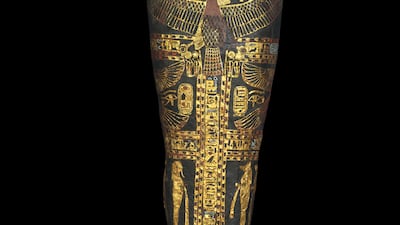
Coffin of Sheshonq II. Photo: World Heritage Exhibitions -
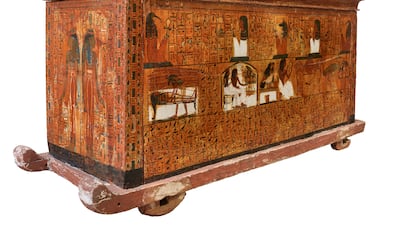
Sennedjem's outer coffin. Photo: World Heritage Exhibitions


This time, though, the mummy itself will remain in Egypt, following a ban on transporting royal mummies abroad.
Ramses II, also known as Ramses the Great, ruled for more than 60 years during the 13th century BC. In that time, he oversaw major military conquests and monumental construction projects. He is believed to have fathered 100 children.
“Ramses II was a mighty warrior,” said Mostafa Waziri, secretary-general of Egypt’s Supreme Council of Antiquities, “[His reign was] a golden period, a time of growth stimulated by a flourishing economy and an abundant labour supplied by prisoners of war.”
Mr Farout added that the enduring myths around Ramses II’s reign helped the French archaeologist Jean-Francois Champollion to decipher Egyptian hieroglyphs in the 19th century.
“In the age of Enlightenment it was believed that Ramses II had invaded China and taught the Chinese how to write,” he said, “This mythical act enabled Champollion to decipher the secret of hieroglyphics when he read the Ramses and Thutmose royal cartouches.”
Yet archaeologists believe that the coffin was not the original one for the dead Pharaoh. Rather, inscriptions inside the sarcophagus highlight how the body was moved from Luxor’s Valley of the Kings, and eventually to a hiding place in the cliff at Deir el-Bahari.
The sarcophagus and the mummy were rediscovered in 1881. “It was once thought that the mummy of Ramses II had been lost forever, having fallen victim to floods and grave robbers,” said Waziri.
The exhibition in Paris also features more than 180 objects from Ramses the Great’s rule, including Princess Neferuptah’s necklace of falcon heads and the upper part of a statue of Ramses II from Luxor.
“Each tells the story of the splendour of ancient Egypt: the history of an empire whose contribution to art, economics, politics, language and culture are without compare,” said Waziri, of the objects in the exhibition, “It is the story of Egypt’s greatest pharaoh and those pharaohs who came before and after him”
These objects are part of a travelling exhibition that has already been presented in Houston and San Francisco, before moving to Sydney. But only France will receive the sarcophagus.
Presentations of ancient Egypt are crowd-pullers in France. Four years ago, La Villette’s exhibition of Tutankhamun attracted at record breaking 1.4 million visitors.
Organisers told AFP that this new exhibition could be even more popular, with 145,000 tickets sold before the opening, significantly higher than the pre-opening numbers for Tutankhamun.

