


Days before the Russian army invaded Ukraine last February, German Chancellor Olaf Scholz set out standards for military commanders they have since failed to match as the war exposed weakness throughout Europe's security forces.
Sensing a turning point loomed, Mr Scholz pointed out in February 2022 the need for militaries to ensure their aeroplanes could fly, fully armed ships could set out to sea and soldiers were properly equipped for the battlefield. The European militaries responding to Ukraine war have struggled with rising materiel and equipment demands, highlighting the need for increased defence budgets and stronger armed forces.
Questions hang over the readiness of nations to defend themselves since Russia’s invasion with a peace deal between Moscow and Kyiv nowhere in sight and squabbles among Nato partners over whether to accept new members.
‘No preparation for war against competitors’
Dr Bence Nemeth, a defence expert at Kings College London whose research has been used by the Pentagon, told The National that continent's defence landscape is bleak. He said this was due to decades-old policies under which countries equipped their armies for counter-insurgency and counter-terrorism rather than state-on-state conflict.
“The armed forces do not have enough stockpiles so it is in this sense that Europe’s armed forces are not prepared for a war,” Dr Nemeth said. “The problem is European militaries over the last 20-30 years were not preparing for war against a competitor. But in another sense they have much better weapons systems than the Russians have.”
Officials meeting in Brussels acknowledged on Monday that weapons caches are running low due to donations to Ukraine and called on manufacturers to expand capacity to produce hardware as rapidly as needed. "It is the most urgent issue. If we fail on that, the result of the war is in danger," said Josep Borrell, the EU's high representative for foreign and defence policy said before a meeting with ministers from the EU countries in Brussels. "The Russian artillery shoots about 50,000 shots a day, and Ukraine needs to be at the same level of capacity. They have cannons but they lack ammunition."
Germany’s Bundeswehr in particular is “in very bad shape”, said Dr Nemeth, after decades of post-Second World War guilt led to a lack of investment in military matters.

“They became very pacifist,” he said of consecutive German governments. “Over the last 15 years they have started to take defence more seriously but the change didn’t really happen until last year when Olaf Scholz increased the military budget.”
Dr Nemeth, who has been researching defence for 15 years, estimated that those funds pledged by the Chancellor will be just enough to “fill the gaps” in the Bundeswehr, but will likely fall short of reforming it into a robust force.
Boris Pistorius, the German Defence Minister, says Berlin needs new Leopard tanks to replace those being sent to Ukraine. Alluding to a sense of urgency in the Ministry of Defence, he said was unconcerned how this was funded.
“For me, the crucial fact is that we have to order new tanks, not in a year but swiftly so that production can begin.
“Where the money will come from? Let me casually put it like this: frankly, I don't care. It is essential that we can provide them quickly.”
Mr Pistorius was responding to the question of whether he was pushing for an increase in the €100 billion (£89 billion) special fund set up for the modernisation of the military after Russia's invasion of Ukraine.
Stepan Stepanenko, a defence expert at the Henry Jackson Society in London, said the current rate of Leopard 2 tanks being manufactured in Germany was too slow to meet demand both domestically and internationally and could have lethal consequences.
“Defence manufacturing in large quantities is not needed in normal circumstances but when it is, it’s life or death,” he told The National. “Peace time, production of Leopard 2 is about two tanks per month. While this is expected to scale up with increased demand, the rate of production remains unknown as it is not only up to Krauss-Maffei Wegmann, the manufacturer, but their suppliers who provide elements of comms, tracking and other systems.”
The French military is in a slightly better position than the German army, Dr Nemeth suggested, because it has the “cultural background, the mentality and the procurement system to spend money more efficiently” than allies.
France says its next seven-year military budget will increase to €413 billion (£360 billion) from 2024-30, up from €295 billion.
Despite sharing a border with Ukraine, Hungary is “not so concerned” about the war, Dr Nemeth said, citing its relationship with Moscow, which is possibly the closest among any Nato member.
“Politically, it has the closest relationship with Russia of any Nato member,” he said.
Romania, which also borders Ukraine, “needs to do something” to build up its army, he said.
Finland, which has a 1,340-kilometre border with Russia, is in a much stronger position militarily and is equipped with a “very capable” army compared to its European counterparts, the expert said. The Finnish conscript-centred armed forces has the ability to mobilise 230,000 personnel at short notice.
“It’s not a big military but they can mobilise very, very quickly,” Dr Nemeth explained. “Since the Winter War (1939-1940) there has been an expectation that Russia could attack Finland and they didn’t change their doctrine during peacetime. While most of the European countries started to focus on military operations far from home during the 1990s and 2010s, Finland started to think in terms of territorial defence when Russia occupied Crimea in 2014.”
Finland and its neighbour Sweden have been pouring more money into defence as they seek Nato membership.
A senior source in the Swedish Army said scaling up plans from the government would pose a challenge in years ahead.
Sweden is keen to upgrade outdated equipment and train more soldiers amid heightened regional tensions with Russia, a senior military official has said.
Speaking at the International Armoured Vehicles Conference on the condition of anonymity, he said: “I have 250 per cent more budget than I had two years ago and the task is basically to double the army in eight years’ time, so that’s a challenge in itself.”
He said that Sweden's armed combat vehicles dating back to the 1990s were in urgent need of replacing and although the budget was there it would be difficult for the army to “renew” itself at pace.
'Poland will be Europe's strongest army'
Poland is in a strong position from a defence perspective, but its vulnerability from being sandwiched between Ukraine and the Russian enclave of Kaliningrad cannot be underestimated. Dr Nemeth noted Warsaw’s purchase of 180 K2 Black Panther tanks from South Korea last year as a key sign of a major shift within the country.
The Polish government has said this year's military budget will jump from less than 2.5 per cent of GDP to 4 per cent.
“In two to three years, Poland will have the best army in Europe,” he said. “They are building up the most capable army in Europe.”
The UK military, on the other hand, has endured a fall from grace due to dwindling resources and mismanagement of priorities, Dr Nemeth said.
The army was once looked upon with awe by allies and envy by foes due to its reputation built on fortitude, prowess and cutting-edge equipment.
“Until now the British Army has been seen as the best in Europe but now it’s losing that prestige,” he said. “The conflicts in Afghanistan and Iraq sucked out resources from the British Army.”
But Robert Clark, director of defence and security at Civitas, said despite “extreme and ill-thought out” cuts to the British Army it remains among the most prestigious militaries in the world.
“The deplorability and capability, underpinned by the Royal Navy's aircraft carriers, demonstrates that in fact the UK military has a global reach only rivalled by the US,” Mr Clark, who served in Afghanistan with the UK armed forces, told The National. “The British Army and Royal Air Force have a senior NCO [non-commissioned officer] and Officer leadership class, which cut their teeth during hard-fought land campaigns including Iraq and Afghanistan, crucial operational experience again rivalled only by the US.”
Mr Clark said defence needed to be prioritised to ensure Britain’s military was in good shape “to face head-on the threats and challenges which will present over the coming years — specifically potential conflict with China and continued Russian aggression in eastern Europe.”

The International Institute for Strategic Studies noted that between 2014 — when the war between Ukraine and Russian-backed separatists began — and 2020, defence outlay in Europe was static as a proportion of global defence expenditure.
The amount hovered between 16.5 per cent and 17 per cent, last year's IISS military balance report said.
In 2021 things shifted as the threat of an all-out Russian invasion of Ukraine grew.
The subsequent increases, combined with a decline in defence spending in Latin America, Africa and the Middle East, meant European spending accounted for nearly a fifth (18.7 per cent) of the global total.

‘Sunak has yet to prove defence credentials'
The senior US general's claim that the British Army was a spent forces reportedly set off a wave of calls from MPs for Mr Sunak to step up to the plate.
Mr Wallace admitted the armed forces had been “hollowed out and underfunded”.
Tobias Ellwood, Tory MP and chairman of the defence select committee in the House of Commons, urged the prime minister to reverse the spending cuts because military equipment had become outdated.
“I do hope the defence review will look at these issues and reverse some of the swathing cuts that were made a couple of years ago,” he told Sky News.
“It is up to the Treasury and No 10 to recognise the world is changing. We are now at war in Europe, we need to move to a war footing. We have become complacent. We need to invest to make sure we retain people, the good people that are there, but there are not enough of them and the equipment is now obsolete.”
Richard Foord, the Liberal Democrats’ defence spokesman and a former British Army major, said such a warning reflected the views of an American general and not necessarily that of the US military as a whole.
But the MP for Tiverton and Honiton told The National that the army was in a wretched state and seriously in need of a cash boost and change of approach in recruitment.
“The suggestion that the British Army would struggle at the moment to put a division into the field is probably right,” the Iraq War veteran said. “There has been a tendency in the last three defence reviews to look favourably on the Royal Navy and the Royal Air Force at the expense of the army. So in that sense the issues that were being flagged to the British government by this US general are real.
“We do have challenges around recruitment and retention and this is partly about the underinvestment in the army.
“I was at a meeting of a defence and security circle and I think the view that Sunak has yet to prove his defence credentials is hard to disagree with.”
The army’s policy of outsourcing recruitment is not working, he claimed, with “dreadful” campaigns failing to motivate young people to sign up.
Nato requires all member states to spend at least 2 per cent of their national income on defence. The prime minister is resisting pressure to follow his predecessor, Liz Truss, and push the contribution up to 3 per cent by 2030.
Mr Foord said the army was “seriously in need of some proper investment” amid fears troop numbers — already at their lowest since the early 1800s — could fall to fewer than 76,000. The force is on track to shrink to 73,000 under existing plans that will come to pass unless the defence coffers are replenished.
Given that several members of Mr Sunak’s Cabinet have military experience, Mr Foord said “you would expect them to be very much wedded to investment in the armed forces”.
“There’s a point now where they are prioritising keeping their roles over what’s best for the armed forces,” he said. “If they were genuinely committed to defence, then they might choose not to serve in the Sunak Cabinet rather than persist with the sort of underinvestment that we’re seeing.”
The government should also seek to foster stronger unity among Nato allies, Mr Foord said, stressing the need for the transatlantic alliance to appear as one in the face of threats from Russia. For example, the decision to send tanks to Ukraine should have been a collective one, he said.
“[The prime minister] is in a position where he would like to claim credit for ratcheting up support for Ukraine but the reality is he’s distracted by domestic concerns and I don’t think we’ve yet seen [an] international statesman figure,” he said.
“The really important thing we’ve got to do is to try to keep Nato allies completely solid so that we can’t get a cigarette paper between the approaches of ourselves and our allies. All Nato allies need to get back to the mindset of the sort of investment we had in the 1980s, rather than in the mid-90s [when] we enjoyed that peace dividend of being able to disarm after the Cold War. We need a little bit of a correction.”
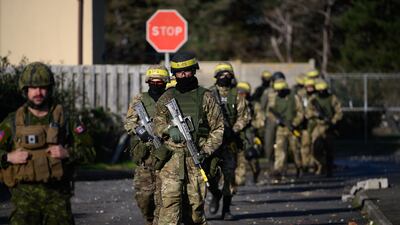
Nato chief Jens Stoltenberg visits Ukrainian troops training in the UK — in pictures
-

Nato Secretary General Jens Stoltenberg arrives to observe Ukrainian troops being trained at a military facility in south-east England. All photos: Getty Images -
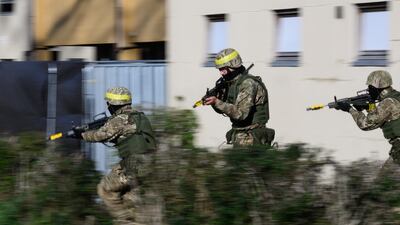
Ukrainian military personnel take part in the training exercise. -
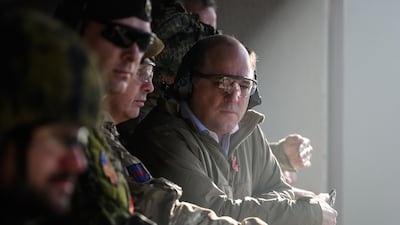
Britain's Defence Secretary Ben Wallace observing the exercises. -
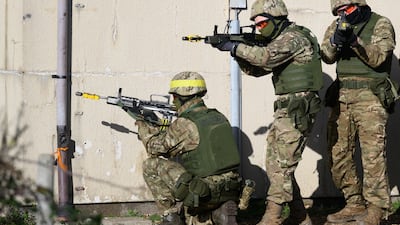
The UK has offered to train 19,000 Ukrainian personnel, with several thousand already completing their training and returning to Ukraine since the programme was announced in June. -
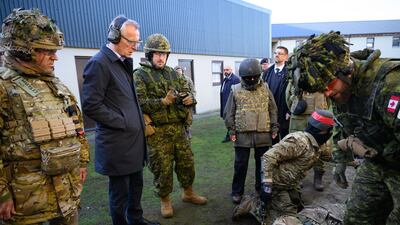
Jens Stoltenberg watches the exercises. -

Jens Stoltenberg speaks with troops. -
More than 1,000 UK service personnel from the British Army, Royal Air Force and Royal Marines have helped to run the programme. -
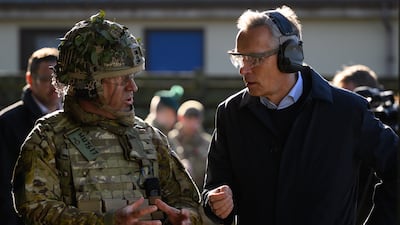
Mr Stoltenberg is shown a series of displays.



