


Britain is on course to narrowly avoid a recession this year, but about seven million households are expected to struggle to pay energy and food bills, an economic think tank says.
Forecasts show the UK will swerve a technical recession — as defined by two or more quarters of falling gross domestic product in a row — not just in the final three months of 2022 but also throughout 2023, says the National Institute of Economic and Social Research.
After the Bank of England predicted a shallower but still protracted recession last week and the International Monetary Fund forecast Britain to be the only major economy to contract this year, the institute's outlook is more optimistic.
But it has warned in its latest report that it will “certainly feel like a recession”, with real personal disposable income having shrunk for four consecutive quarters.
It projects that one in four UK households — about seven million families — will be unable to meet in full their energy and food bills in the 2023-24 financial year, up from about one in five in 2022-23.
Middle-income households will face a hit to their personal disposable income ranging from 7 per cent to 13 per cent, reaching up to £4,000 ($4,817) in the financial year 2022-23, the institute said.
Inflation around the world - in pictures
-

People queue to buy wheat flour at government-controlled prices in Islamabad. Pakistan's economy has been hit hard by a political crisis, as well as devastating floods and the global energy crisis, with the rupee plummeting and inflation at decades-high levels. AFP -
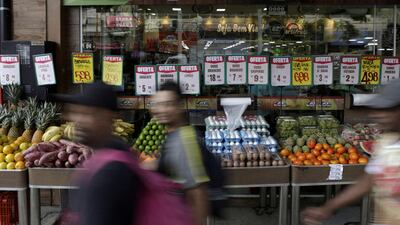
A market in Rio de Janeiro. Brazil's inflation ended 2022 with a sharp slowdown from double-digit peaks seen throughout the year. Reuters -

A market in Istanbul. Turkey's inflation at the end of 2022 stood at 64. 27 per cent, the country's Statistical Institute said, while the independent group of inflation researchers ENAG calculated it at 137. 55 per cent. EPA -
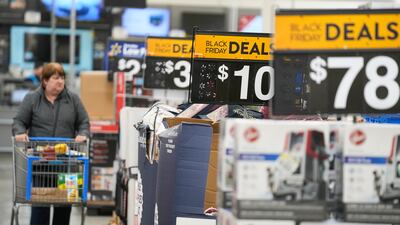
A Walmart in New Jersey. According to a poll, US Republicans and Democrats have distinct views of what’s most important for the government to address amid high inflation. More Republicans name gas and food prices, energy and immigration, while Democrats focus on health care, climate change and poverty. AP -
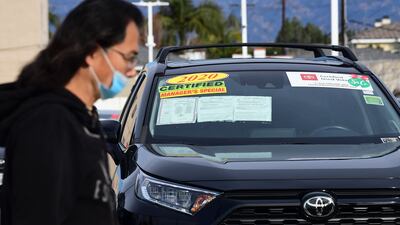
A used car sales lot in California. US Federal Reserve officials have indicated it’s possibly too early to declare victory over inflation. AFP -
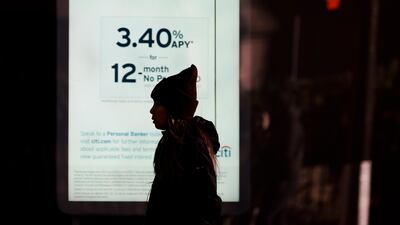
A person walks by a sign showing interest rates at a bank in New York. EPA -
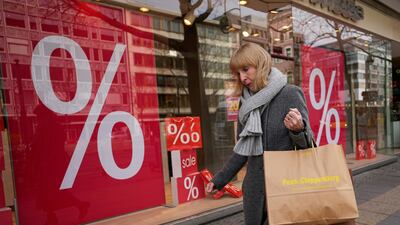
A woman walks with purchases past a store in Berlin. In December, consumer price growth across the Euro zone slowed to 9.2 per cent from 10.1 per cent a month earlier, Eurostat data showed last week. AP -
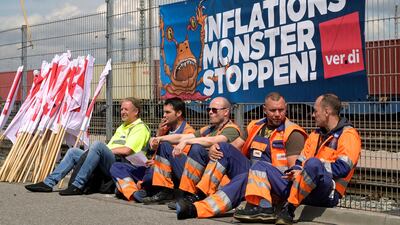
Workers sit in front of a banner reading "Stop the Inflation Monster" at the Burchardkai Container Terminal as they go on strike for higher wages at the harbour in Hamburg, Germany. Reuters -

Price tags at a market in Nice, France. Reuters -

Commuters cross Waterloo Bridge in London. The British Retail Consortium said spending in store chains rose by 6.9 per cent in annual terms in December, but this was a long way off consumer price inflation, which hit 10.7 per cent in November. Reuters -

Jobseekers in Johannesburg. South Africa’s governing party wants the central bank’s mandate broadened to shore up the economy and promote employment in addition to its existing task of tackling inflation. Reuters -

Social grant recipients stand in a queue outside a post office, as joblessness takes its toll in Meadowlands, South Africa. Reuters


It is predicting that GDP will be “anaemic” and remain close to nil throughout the year, eking out growth of just 0.2 per cent in 2023, with the BoE’s interest rate rises adding to cost pressures for consumers and businesses.
The group also predicts that inflation, currently at 10.5 per cent, will only fall to 5.3 per cent by the end of 2023 and stay above 3 per cent throughout 2024.
Inflation will not reach the Bank’s 2 per cent target until the third quarter of 2025.
“The UK economy performed better than forecast in 2022, with annual GDP growth of 4.1 per cent and unemployment at 3.7 per cent," said Prof Leaza McSorley, senior research manager at the institute.
“So, while the economy seems unlikely to fall into a protracted contraction, the risks are skewed on the downside with higher Bank rate and some withdrawal of fiscal support likely to bear down on activity over the course of 2023 and 2024.”
UK's finance minister says he is focused on bringing down inflation as economy shrinks - video
The institute believed that interest rates rises “may almost have finished”, with the Bank delivering its 10th rise on Thursday last week, from 3.5 per cent to 4 per cent.
But the report said that: “If core inflation remains high, interest rates may have to remain at their peak for a longer period than we and the markets currently anticipate.”
The Bank is facing a “difficult” path ahead, the institute said.
“Given the extent to which the Bank has received criticism for not tightening quickly enough when there were signs of the economy overheating in the post-pandemic recovery, it is possible that monetary policymakers will loosen too quickly to avoid the converse criticism.”
It is calling on Chancellor Jeremy Hunt to loosen his fiscal policy in his spring budget, “rather than allowing himself to be governed by self-set fiscal target”.
It also wants Mr Hunt to increase public sector investment and develop a new energy support tariff that discounts bills for the poorest households and raises the price with use to give incentives to the more affluent to use energy more efficiently.
What is a recession? - video
Meanwhile, the new Ecommerce Delivery Benchmark Report by Auctane and the consultancy Retail Economics has found that inflation is set to add £18.2 billion to UK non-food retail sales this year.
Sales values are expected to hit £249 billion in 2023, but the 2.6 per cent increase — or another £18.2 billion of spending on last year — will be driven entirely by rising consumer prices, the report says.
A survey for the study of more than 730 retail businesses across eight international markets found that 80 per cent of retailers are planning to increase the price of products, with 40 per cent suggesting rising costs will be their biggest challenge this year.
Two thirds of UK consumers (66 per cent) say inflation is their biggest concern, Retail Economics found.
About 74 per cent plan to change their buying behaviour, with 34 per cent saying they would only make necessary purchases while 29 per cent intend to delay or reduce spending.
As a result, UK retail sales volumes are set to fall by 4.9 per cent on last year due to shoppers having to spend more to get less for their money, with retail inflation expected to hit 7.5 per cent over the year ahead.
The study also found more than a quarter of retail companies plan to increase the cost of delivery for their customers, while just 18 per cent said they would not increase the price of products, delivery or returns this year.
How to prepare for a recession - video
Almost 30 per cent of UK consumers said they would “happily” switch to parcel lockers or click and collect services for their online orders.
“Retailers will continue to face a toxic mix of pressures this year as rising input and operating costs collide against a backdrop of weaker consumer demand, rising interest rates and shifting consumer behaviours," said Retail Economics chief executive Richard Lim said.
“These conditions favour those retailers who have strong balance sheets, who can invest heavily in price, leverage data to target their most valued customers and win new ones, while efficiently utilising stores to provide a truly omnichannel proposition.
“Those that carry high levels of debt, have weak pricing power and sit in the middle of the market could find life very difficult.”

